Belfrage Björn, Koldestam Anders, Sjöberg Christina, Wallerstedt Susanna M
Närhälsan Dals-Ed Health Center, Dals-Ed, Sweden.
Eur J Clin Pharmacol. 2015 Mar;71(3):363-8. doi: 10.1007/s00228-014-1792-9. Epub 2015 Jan 9.
Indicators based on the number of drugs in the medication list are sometimes used to reflect quality of drug treatment. This study aimed to evaluate the concurrent validity of such polypharmacy indicators, i.e., their ability to differentiate between appropriate and suboptimal drug treatment.
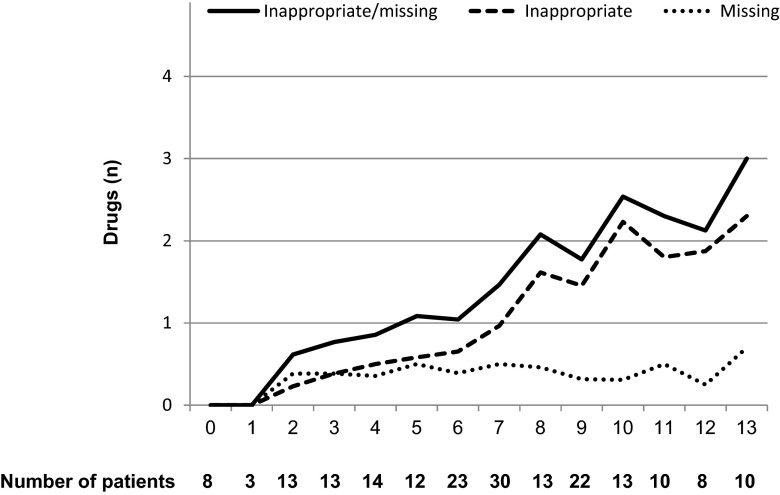
In 200 hip fracture patients (≥65 years of age), consecutively recruited to a randomized controlled study in Sahlgrenska University Hospital in 2009, quality of drug treatment at study entry was assessed according to a gold standard as well as to indicators based on the number of drugs in the medication list. As gold standard, two specialist physicians independently assessed and then agreed on the quality for each patient, after initial screening with Screening Tool of Older Persons' potentially inappropriate Prescriptions (STOPP) and Screening Tool to Alert to Right Treatment (START). Suboptimal drug treatment was defined as ≥1 STOPP/START outcomes assessed as clinically relevant at the individual level.
A total of 141 (71 %) patients had suboptimal drug treatment according to the gold standard. The corresponding figures according to the indicators ≥5 and ≥10 drugs were 149 (75) and 49 (25 %), respectively. The sensitivity for the indicators ≥5 and ≥10 drugs to detect suboptimal drug treatment was 0.86 (95 % confidence interval: 0.80; 0.92) and 0.32 (0.25; 0.40), respectively. The specificity was 0.53 (0.41; 0.65) and 0.93 (0.82; 0.97).
The findings suggest that no polypharmacy indicator could serve as a general indicator of prescribing quality; cut-offs for such indicators need to be chosen according to purpose.
基于用药清单中药物数量的指标有时用于反映药物治疗质量。本研究旨在评估此类多重用药指标的同时效度,即它们区分适当和次优药物治疗的能力。
2009年在萨尔格伦斯卡大学医院连续招募了200名髋部骨折患者(≥65岁),这些患者被纳入一项随机对照研究。在研究开始时,根据金标准以及基于用药清单中药物数量的指标评估药物治疗质量。作为金标准,两名专科医生在使用老年人潜在不适当处方筛查工具(STOPP)和正确治疗警示筛查工具(START)进行初步筛查后,独立评估并就每位患者的质量达成一致。次优药物治疗被定义为在个体水平上经评估有≥1项STOPP/START结果具有临床相关性。
根据金标准,共有141名(71%)患者接受了次优药物治疗。根据药物数量≥5种和≥10种的指标,相应数字分别为149名(75%)和49名(25%)。药物数量≥5种和≥10种的指标检测次优药物治疗的敏感性分别为0.86(95%置信区间:0.80;0.92)和0.32(0.25;0.40)。特异性分别为0.53(0.41;0.65)和0.93(0.82;0.97)。
研究结果表明,没有多重用药指标可作为处方质量的通用指标;此类指标的临界值需要根据目的来选择。