Heltne Marianne, Saltvedt Ingvild, Lydersen Stian, Prestmo Anders, Sletvold Olav, Spigset Olav
Department of Health and Welfare Services, City of Trondheim, Trondheim, Norway.
Department of Neuromedicine and Movement Science, Faculty of Medicine and Health Sciences, Norwegian University of Science and Technology (NTNU), Trondheim, Norway.
Eur J Clin Pharmacol. 2017 Aug;73(8):937-947. doi: 10.1007/s00228-017-2263-x. Epub 2017 May 26.
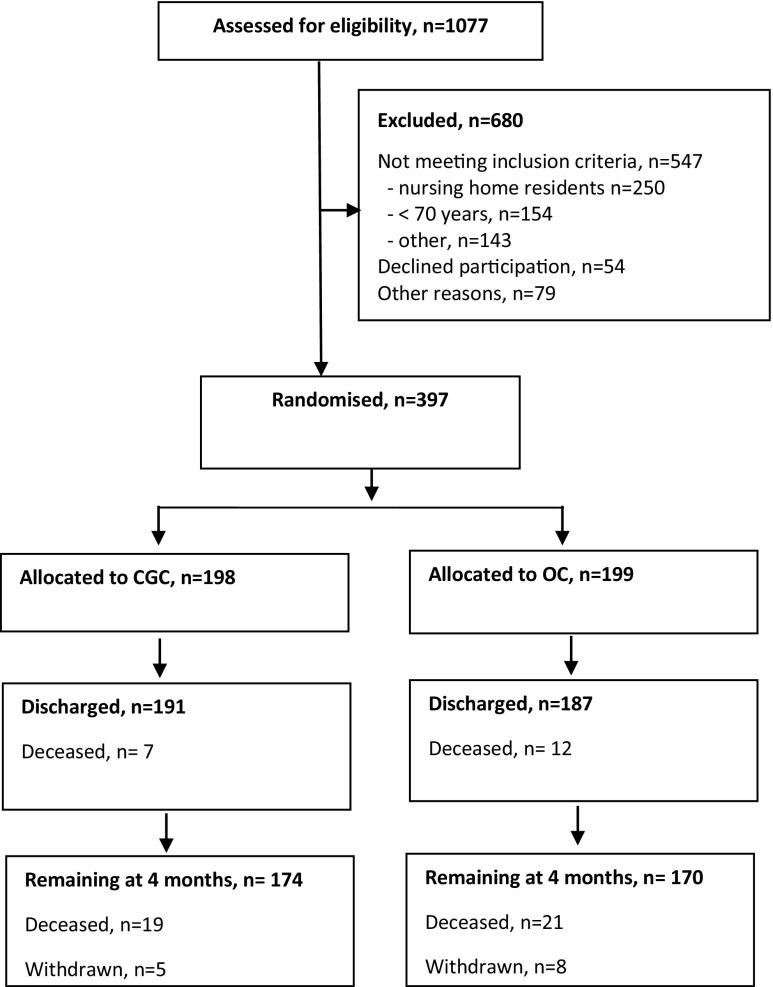
In the Trondheim Hip Fracture Trial, 397 home-dwelling patients with hip fractures were randomised to comprehensive geriatric care (CGC) in a geriatric ward or traditional orthopaedic care (OC). Patients in the CGC group had significantly better mobility and function 4 months after discharge. This study explores group differences in drug prescribing and possible associations with the outcomes in the main study.
Drugs prescribed at admission and discharge were registered from hospital records. Mobility, function, fear of falling and quality of life were assessed using specific rating scales. Linear regression was used to analyse association between drug changes and outcomes at 4 months.
The mean age was 83 years, and 74% were females. The mean number (± SD) of drugs in the CGC and OC groups was 3.8 (2.8) and 3.9 (2.8) at inclusion and 7.1 (2.8) and 6.2 (3.0) at discharge, respectively (p = 0.003). The total number of withdrawals was 209 and 82 in the CGC and OC groups, respectively (p < 0.0001), and the number of starts was 844 and 526, respectively (p < 0.0001). A significant negative association was found between the number of drug changes during the hospital stay and mobility and function 4 months later in both groups. However, this association disappeared when adjusting for baseline function and comorbidities.
These secondary analyses suggest that there are significant differences in the pharmacological treatment between geriatric and orthopaedic wards, but these differences could not explain the beneficial effect of CGC in the Trondheim Hip Fracture Trial.
在特隆赫姆髋部骨折试验中,397名居家髋部骨折患者被随机分为老年病房的综合老年护理(CGC)组或传统骨科护理(OC)组。CGC组患者出院4个月后,其活动能力和功能明显更好。本研究探讨了两组在药物处方方面的差异以及与主要研究结果可能存在的关联。
从医院记录中登记入院和出院时所开的药物。使用特定的评定量表评估活动能力、功能、跌倒恐惧和生活质量。采用线性回归分析住院期间药物变化与4个月时结果之间的关联。
平均年龄为83岁,74%为女性。CGC组和OC组纳入时的平均用药数量(±标准差)分别为3.8(2.8)和3.9(2.8),出院时分别为7.1(2.8)和6.2(3.0)(p = 0.003)。CGC组和OC组的停药总数分别为209和82(p < 0.0001),起始用药数量分别为844和526(p < 0.0001)。两组住院期间药物变化的数量与4个月后的活动能力和功能之间均存在显著的负相关。然而,在对基线功能和合并症进行调整后,这种关联消失了。
这些二次分析表明,老年病房和骨科病房在药物治疗方面存在显著差异,但这些差异无法解释特隆赫姆髋部骨折试验中CGC的有益效果。