Conover David O, Baumann Hannes
School of Marine and Atmospheric Sciences, Stony Brook University Stony Brook, NY, USA.
Evol Appl. 2009 Aug;2(3):276-90. doi: 10.1111/j.1752-4571.2009.00079.x.
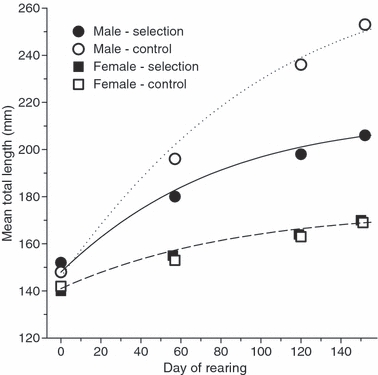
Evidence of fishery-induced evolution has been accumulating rapidly from various avenues of investigation. Here we review the knowledge gained from experimental approaches. The strength of experiments is in their ability to disentangle genetic from environmental differences. Common garden experiments have provided direct evidence of adaptive divergence in the wild and therefore the evolvability of various traits that influence production in numerous species. Most of these cases involve countergradient variation in physiological, life history, and behavioral traits. Selection experiments have provided examples of rapid life history evolution and, more importantly, that fishery-induced selection pressures cause simultaneous divergence of not one but a cluster of genetically and phenotypically correlated traits that include physiology, behavior, reproduction, and other life history characters. The drawbacks of experiments are uncertainties in the scale-up from small, simple environments to larger and more complex systems; the concern that taxons with short life cycles used for experimental research are atypical of those of harvested species; and the difficulty of adequately simulating selection due to fishing. Despite these limitations, experiments have contributed greatly to our understanding of fishery-induced evolution on both empirical and theoretical levels. Future advances will depend on integrating knowledge from experiments with those from modeling, field studies, and molecular genetic approaches.
来自各种调查途径的渔业诱导进化证据正在迅速积累。在此,我们回顾从实验方法中获得的知识。实验的优势在于其能够区分遗传差异和环境差异。共同花园实验提供了野生环境中适应性分化的直接证据,因此也证明了影响众多物种产量的各种性状的进化潜力。这些案例大多涉及生理、生活史和行为性状的反梯度变异。选择实验提供了快速生活史进化的例子,更重要的是,渔业诱导的选择压力会导致不仅一个,而是一组包括生理、行为、繁殖和其他生活史特征的遗传和表型相关性状同时发生分化。实验的缺点包括从小而简单的环境扩大到更大、更复杂系统时的不确定性;用于实验研究的短生命周期分类群不同于被捕捞物种的分类群这一担忧;以及充分模拟捕捞造成的选择的困难。尽管有这些局限性,实验在实证和理论层面都极大地促进了我们对渔业诱导进化的理解。未来的进展将取决于将实验知识与建模、实地研究和分子遗传学方法的知识相结合。