Pierson Jennifer C, Allendorf Fred W, Saab Victoria, Drapeau Pierre, Schwartz Michael K
Wildlife Biology Program, University of Montana Missoula, MT, USA.
Division of Biological Sciences, University of Montana Missoula, MT, USA.
Evol Appl. 2010 May;3(3):263-78. doi: 10.1111/j.1752-4571.2009.00111.x. Epub 2010 Jan 28.
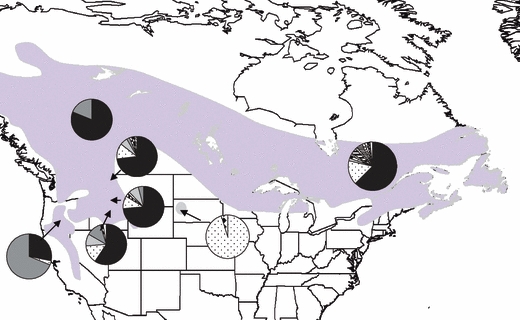
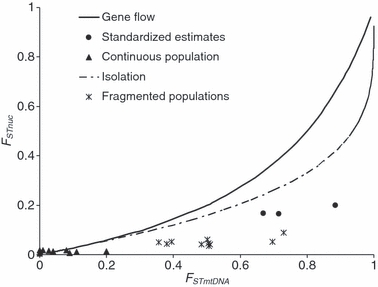
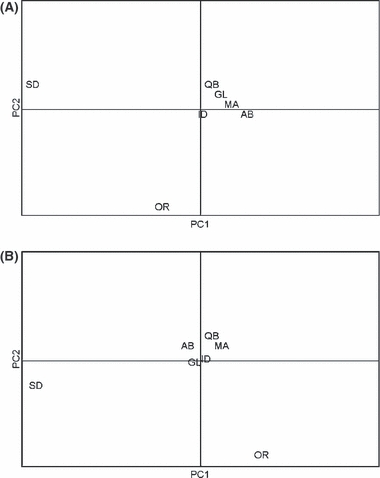
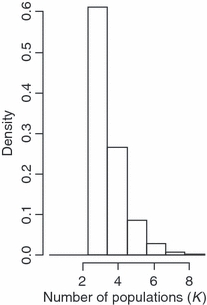
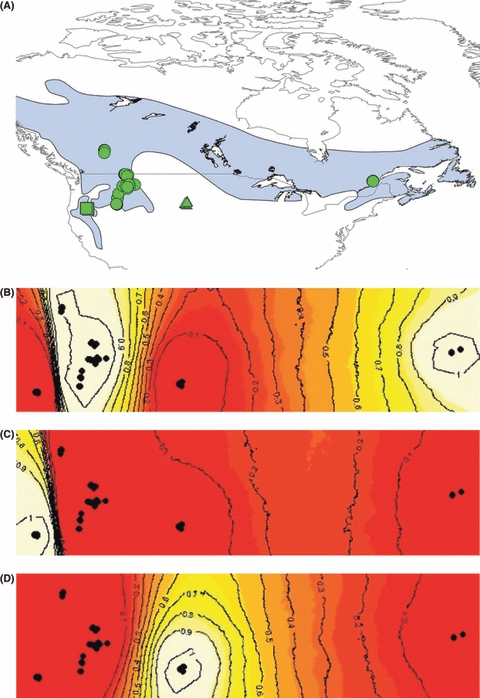
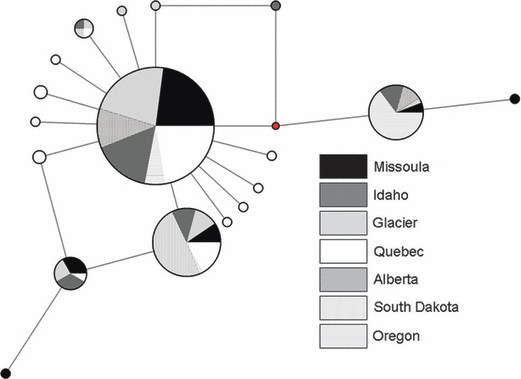
We used population- and individual-based genetic approaches to assess barriers to movement in black-backed woodpeckers (Picoides arcticus), a fire-specialist that mainly occupies the boreal forest in North America. We tested if male and female woodpeckers exhibited the same movement patterns using both spatially implicit and explicit genetic analyses to define population structure and movement patterns of both sexes among populations. Three genetic groups were identified, a large, genetically continuous population that spans from the Rocky Mountains to Quebec, a small isolated population in South Dakota and a separate population in the western portion of their distribution (Oregon). Patterns of genetic diversity suggest extensive gene flow mediated by both males and females within the continuous boreal forest. However, male-mediated gene flow is the main form of connectivity between the continuously distributed group and the smaller populations of South Dakota and Oregon that are separated by large areas of unforested habitat, which apparently serves as a barrier to movement of female woodpeckers.
我们采用基于种群和个体的遗传方法,评估黑背啄木鸟(Picoides arcticus)的扩散障碍。黑背啄木鸟是一种依赖火灾的鸟类,主要栖息于北美北方森林。我们利用空间隐含和显式遗传分析来确定种群结构以及两性在种群间的移动模式,以此测试雄性和雌性啄木鸟是否表现出相同的移动模式。研究确定了三个遗传组,一个从落基山脉延伸至魁北克的大型、基因连续的种群,南达科他州的一个小型孤立种群,以及分布区西部(俄勒冈州)的一个独立种群。遗传多样性模式表明,在连续的北方森林中,雄性和雌性都介导了广泛的基因流动。然而,雄性介导的基因流动是连续分布种群与南达科他州和俄勒冈州较小种群之间连通性的主要形式,这些较小种群被大片非森林栖息地隔开,这片区域显然对雌性啄木鸟的移动构成了障碍。