Arnaud Jean-François, Fénart Stéphane, Cordellier Mathilde, Cuguen Joël
Laboratoire de Génétique et Évolution des Populations Végétales, UMR CNRS 8016, Bâtiment SN2, Université des Sciences et Technologies de Lille - Lille 1 Villeneuve d'Ascq Cedex, France.
Evol Appl. 2010 May;3(3):305-18. doi: 10.1111/j.1752-4571.2010.00121.x. Epub 2010 Feb 18.
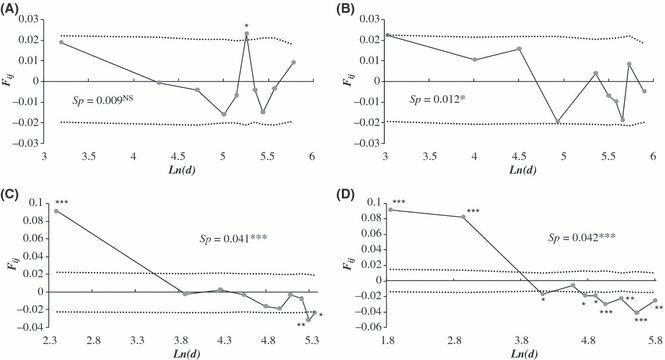
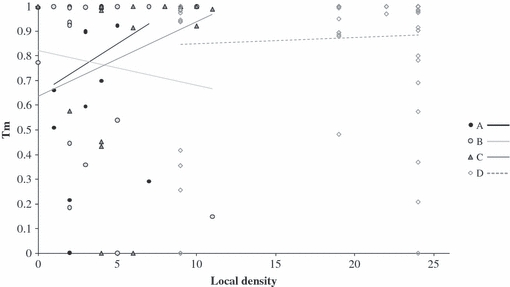
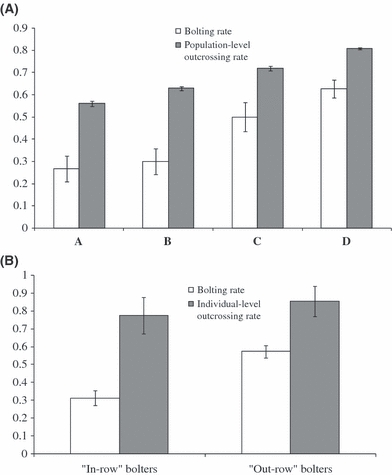
Reproductive traits are key parameters for the evolution of invasiveness in weedy crop-wild hybrids. In Beta vulgaris, cultivated beets hybridize with their wild relatives in the seed production areas, giving rise to crop-wild hybrid weed beets. We investigated the genetic structure, the variation in first-year flowering and the variation in mating system among weed beet populations occurring within sugar beet production fields. No spatial genetic structure was found for first-year populations composed of F1 crop-wild hybrid beets. In contrast, populations composed of backcrossed weed beets emerging from the seed bank showed a strong isolation-by-distance pattern. Whereas gametophytic self-incompatibility prevents selfing in wild beet populations, all studied weed beet populations had a mixed-mating system, plausibly because of the introgression of the crop-derived Sf gene that disrupts self-incompatibility. No significant relationship between outcrossing rate and local weed beet density was found, suggesting no trends for a shift in the mating system because of environmental effects. We further reveal that increased invasiveness of weed beets may stem from positive selection on first-year flowering induction depending on the B gene inherited from the wild. Finally, we discuss the practical and applied consequences of our findings for crop-weed management.
生殖性状是杂草型作物-野生杂种入侵性进化的关键参数。在甜菜中,栽培甜菜在种子生产区与其野生近缘种杂交,产生了作物-野生杂种杂草甜菜。我们调查了甜菜生产田内杂草甜菜种群的遗传结构、第一年开花的变异以及交配系统的变异。由F1作物-野生杂种甜菜组成的第一年种群未发现空间遗传结构。相比之下,从种子库中出现的回交杂草甜菜种群呈现出强烈的距离隔离模式。虽然配子体自交不亲和性阻止了野生甜菜种群的自交,但所有研究的杂草甜菜种群都具有混合交配系统,这可能是由于作物来源的Sf基因渗入破坏了自交不亲和性。未发现异交率与当地杂草甜菜密度之间存在显著关系,这表明交配系统没有因环境影响而发生变化的趋势。我们进一步揭示,杂草甜菜入侵性的增加可能源于对第一年开花诱导的正向选择,这取决于从野生种继承的B基因。最后,我们讨论了我们的研究结果对作物-杂草管理的实际和应用后果。