Laboratoire de Génétique et Évolution des Populations Végétales, UMR CNRS 8198, Bâtiment SN2, Université des Sciences et Technologies de Lille - Lille 1 Villeneuve d'Ascq Cedex, F-59655, France.
UMR CNRS 6553 ECOBIO, Station biologique, Université de Rennes 1 Paimpont, F-35380, France.
Ecol Evol. 2014 May;4(10):1828-52. doi: 10.1002/ece3.1061. Epub 2014 Apr 18.
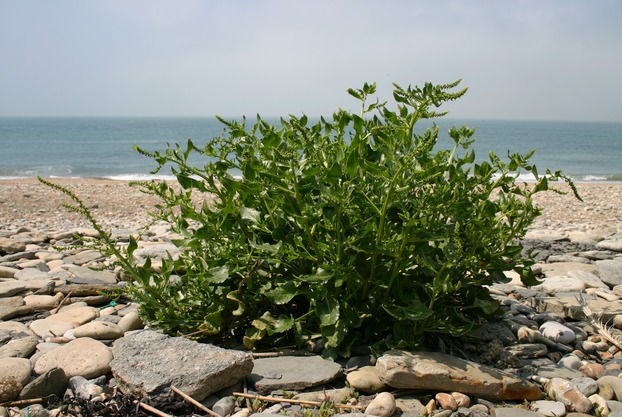
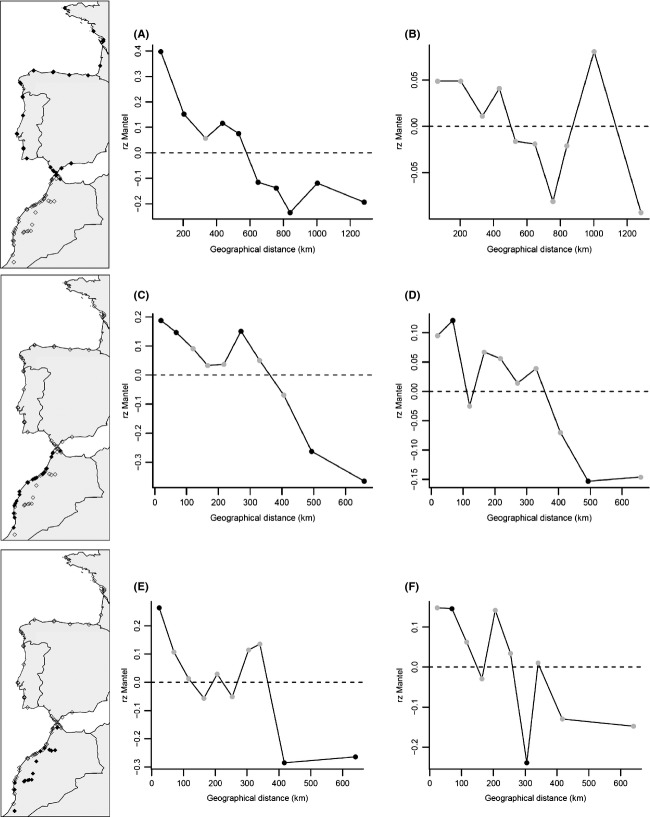
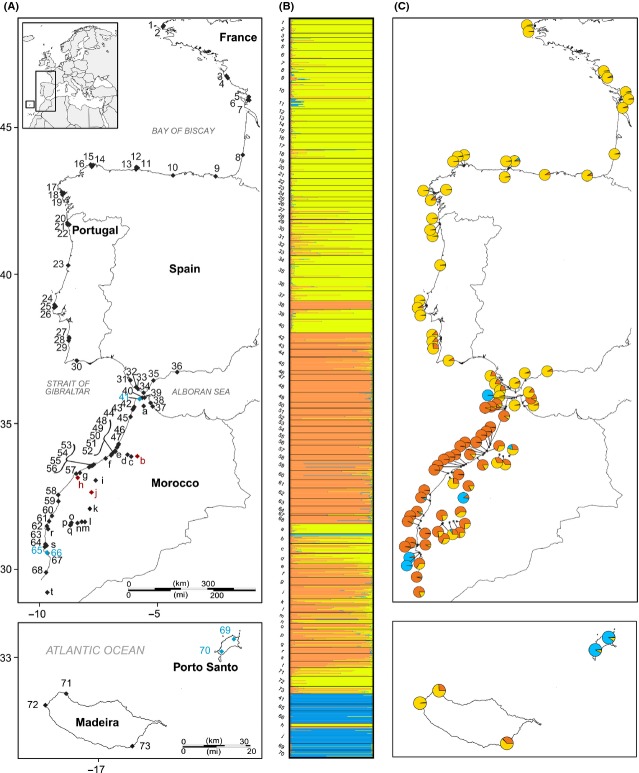
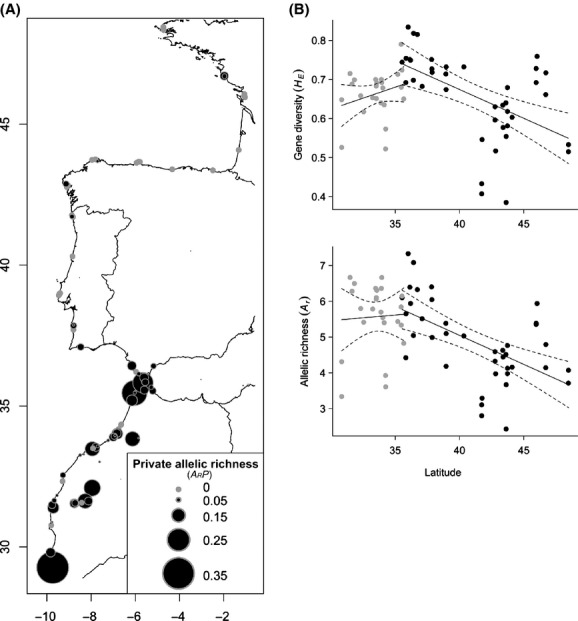
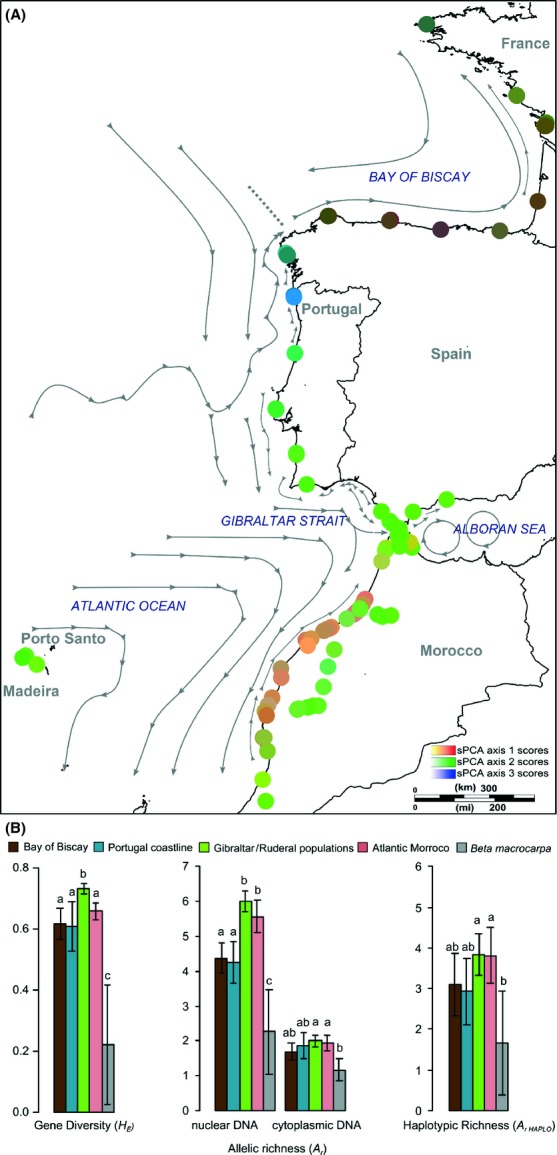
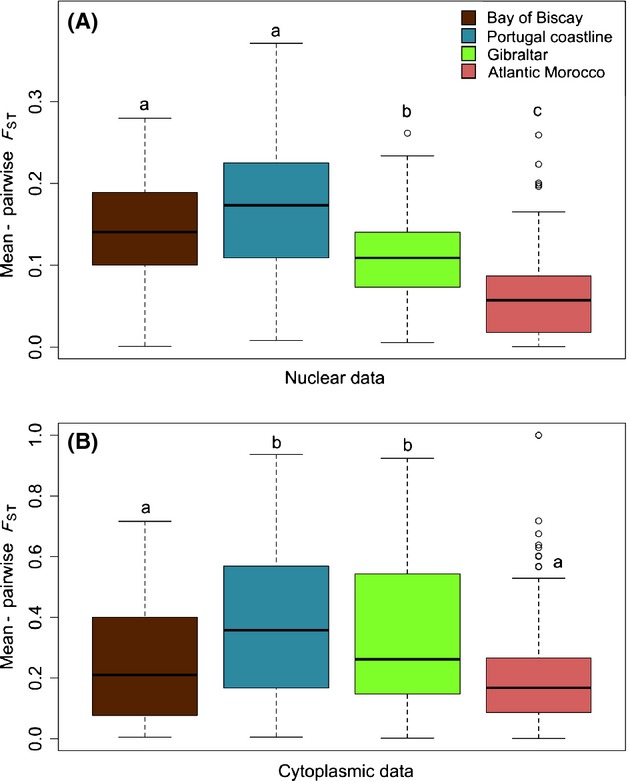
Understanding the factors that contribute to population genetic divergence across a species' range is a long-standing goal in evolutionary biology and ecological genetics. We examined the relative importance of historical and ecological features in shaping the present-day spatial patterns of genetic structure in two related plant species, Beta vulgaris subsp. maritima and Beta macrocarpa. Using nuclear and mitochondrial markers, we surveyed 93 populations from Brittany (France) to Morocco - the southern limit of their species' range distribution. Whereas B. macrocarpa showed a genotypic structure and a high level of genetic differentiation indicative of selfing, the population genetic structure of B. vulgaris subsp. maritima was consistent with an outcrossing mating system. We further showed (1) a strong geographic clustering in coastal B. vulgaris subsp. maritima populations that highlighted the influence of marine currents in shaping different lineages and (2) a peculiar genetic structure of inland B. vulgaris subsp. maritima populations that could indicate the admixture of distinct evolutionary lineages and recent expansions associated with anthropogenic disturbances. Spatial patterns of nuclear diversity and differentiation also supported a stepwise recolonization of Europe from Atlantic-Mediterranean refugia after the last glacial period, with leading-edge expansions. However, cytoplasmic diversity was not impacted by postglacial recolonization: stochastic long-distance seed dispersal mediated by major oceanic currents may mitigate the common patterns of reduced cytoplasmic diversity observed for edge populations. Overall, the patterns we documented here challenge the general view of reduced genetic diversity at the edge of a species' range distribution and provide clues for understanding how life-history and major geographic features interact to shape the distribution of genetic diversity.
理解导致物种分布范围内种群遗传分化的因素是进化生物学和生态遗传学的长期目标。我们研究了历史和生态特征在塑造两种相关植物物种(Beta vulgaris subsp. maritima 和 Beta macrocarpa)的遗传结构的现代空间模式中的相对重要性。使用核和线粒体标记,我们调查了来自布列塔尼(法国)到摩洛哥(其物种分布范围的南端)的 93 个种群。虽然 B. macrocarpa 表现出自交的基因型结构和高水平的遗传分化,但 B. vulgaris subsp. maritima 的种群遗传结构与异交交配系统一致。我们进一步表明:(1)沿海 B. vulgaris subsp. maritima 种群存在强烈的地理聚类,突出了海洋流对塑造不同谱系的影响;(2)内陆 B. vulgaris subsp. maritima 种群的特殊遗传结构可能表明不同进化谱系的混合和与人为干扰相关的近期扩张。核多样性和分化的空间模式也支持了末次冰期后从大西洋-地中海避难所向欧洲的逐步重新殖民,伴随着前缘扩张。然而,细胞质多样性不受冰后期重新殖民的影响:由主要海洋流介导的随机长距离种子扩散可能减轻了边缘种群中观察到的细胞质多样性减少的常见模式。总体而言,我们在这里记录的模式挑战了物种分布范围边缘遗传多样性减少的一般观点,并为理解生活史和主要地理特征如何相互作用以塑造遗传多样性的分布提供了线索。