Foucaud Julien, Orivel Jérôme, Loiseau Anne, Delabie Jacques H C, Jourdan Hervé, Konghouleux Djoël, Vonshak Merav, Tindo Maurice, Mercier Jean-Luc, Fresneau Dominique, Mikissa Jean-Bruno, McGlynn Terry, Mikheyev Alexander S, Oettler Jan, Estoup Arnaud
INRA, UMR CBGP (INRA/IRD/Cirad/Montpellier SupAgro) Montferrier-sur-Lez cedex, France.
Université de Toulouse, UPS, EDB (Laboratoire Evolution et Diversité Biologique) Toulouse, France ; CNRS, EDB (Laboratoire Evolution et Diversité Biologique) Toulouse, France.
Evol Appl. 2010 Jul;3(4):363-74. doi: 10.1111/j.1752-4571.2010.00119.x. Epub 2010 Feb 2.
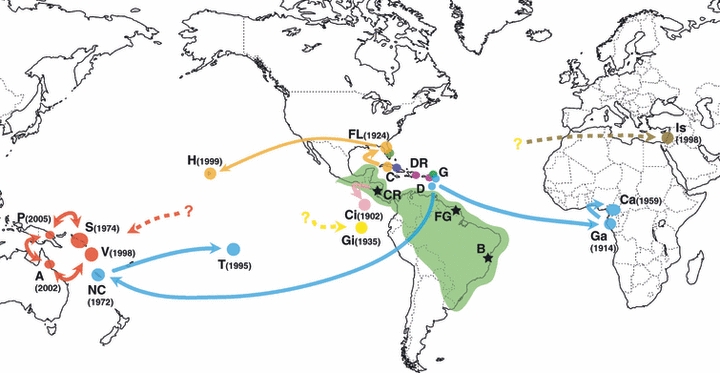
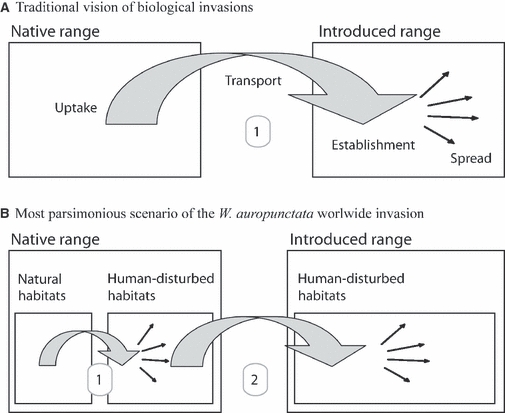
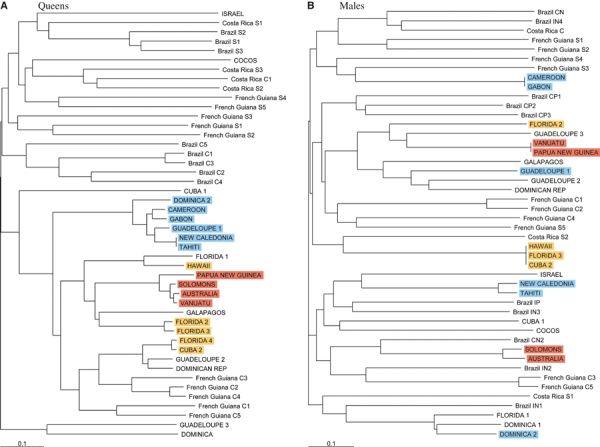
Biological invasions are generally thought to occur after human aided migration to a new range. However, human activities prior to migration may also play a role. We studied here the evolutionary genetics of introduced populations of the invasive ant Wasmannia auropunctata at a worldwide scale. Using microsatellite markers, we reconstructed the main routes of introduction of the species. We found three main routes of introduction, each of them strongly associated to human history and trading routes. We also demonstrate the overwhelming occurrence of male and female clonality in introduced populations of W. auropunctata, and suggest that this particular reproduction system is under selection in human-modified habitats. Together with previous researches focused on native populations, our results suggest that invasive clonal populations may have evolved within human modified habitats in the native range, and spread further from there. The evolutionarily most parsimonious scenario for the emergence of invasive populations of the little fire ant might thus be a two-step process. The W. auropunctata case illustrates the central role of humans in biological change, not only due to changes in migration patterns, but also in selective pressures over species.
生物入侵通常被认为是在人类协助物种迁移到新区域后发生的。然而,迁移之前的人类活动也可能起到一定作用。我们在此对入侵性蚂蚁金刻沃氏蚁(Wasmannia auropunctata)在全球范围内的引入种群进行了进化遗传学研究。利用微卫星标记,我们重建了该物种的主要引入路线。我们发现了三条主要引入路线,每条路线都与人类历史和贸易路线密切相关。我们还证明了金刻沃氏蚁引入种群中存在压倒性的雌雄克隆现象,并表明这种特殊的繁殖系统在人类改造的栖息地中受到选择。结合之前针对本地种群的研究,我们的结果表明,入侵性克隆种群可能在原生范围内的人类改造栖息地中进化,并从那里进一步扩散。因此,小火蚁入侵种群出现的进化上最简约的情景可能是一个两步过程。金刻沃氏蚁的案例说明了人类在生物变化中的核心作用,这不仅是由于迁移模式的改变,还包括对物种的选择压力。