Milicevic Snjezana, Bijelic Radojka, Krivokuca Vladimir, Bojic Mirjana, Popovic-Pejicic Snjezana, Bojanic Nebojsa
Urology Clinic, Clinical Center of Banja Luka, Banja Luka, Bosnia and Herzegovina.
Health Center, Banja Luka, Bosnia and Herzegovina.
Med Arch. 2013 Dec;67(6):423-7. doi: 10.5455/medarh.2013.67.423-427. Epub 2013 Dec 28.
Prevalence of the kidney stones (renal calculi) increase in several countries in parallel with the increase of overweight, diabetes (type 2 diabetes) and hypertension.
The goal of our research was to evaluate the connection between the calcium nephrolithiasis and overweight, as quantified using the Body Mass Index (BMI) of the adult population, with a particular reflection on the age groups within it.
The research was prospective and it was implemented at the Clinical Center of Banja Luka, at the Urology Clinic in the period from 1(st) April 2012 to 1(st) January 2013. The trial encompassed 120 patients with calcium nephrolithiasis of the upper part of the urinary tract and 120 patients without nephrolithiasis. A group of patients with the calcium nephrolithiasis presented a working group, while a group of patients without nephrolithiasis presented a control group. The BMI obtained on the basis of bodily weight and height of the patient, where the age and sex of specific reference values of the BMI were developed by the Center for Disease Control and Prevention (CDC) were not used in the calculation of the BMI.
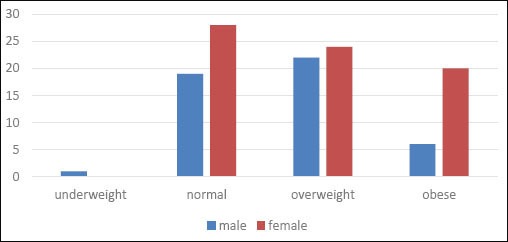
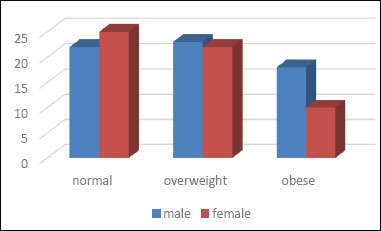
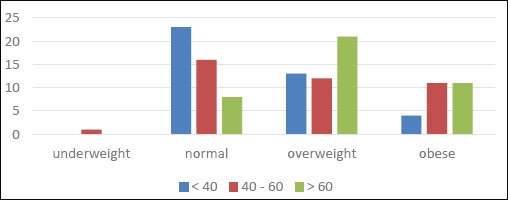
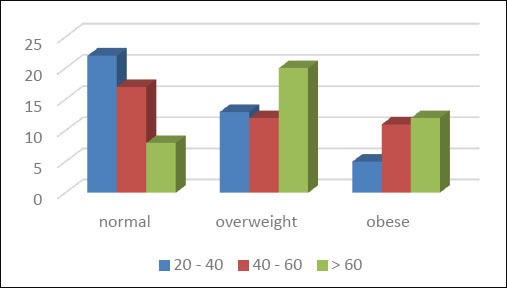
Analyzing the values of the BMI in relation to age groups, where there was a statistically significant difference in the working group, whereas in the control group there was a statistically high significant difference, testing of statistical significance of the average value of the BMI was done by observed age groups of working and control group, as well as to the total sample of work and control group using the Chi-Square test and T-test for independent samples. Having observed the age group of 20-40 years, statistically significant differences have been noted at the level of risk of 10%, which confirms that there is a connection between the categories of the BMI and the group, which the patient comes from (Chi-Square test p-0.05), that is, T-test has shown that the values are different at the level of 10%, i.e. p<0.1 (p=0.073). Having observed the age group 40-60, there was no dependency between the category of the BMI and the group, that is, the differences are not statistically significant, p>0.05 (t-test p=0.314). In addition to this, the average BMI values are not significantly different, p>0.05 (t-test p=0.871). Having observed the age group of the older than 60, there was no dependency between the category of the BMI and the group, that is, the differences are not statistically significant, p>0.05 (Chi-square test p=0.167). Having observed the total sample of the working and control group, there was no dependency of the category of the BMI and the group (or urolithiasis), p>0.05 (Chi-Square test p=1.208), whereas the results of the T-test showed that there was no statistically significant difference of the arithmetic mean values of the BMI working group and control group, p>0.05 (t-test p=0.620).
Overweight in younger age groups of adult population may be connected to the occurrence of calcium nephrolithiasis, thus we suggest that urolithiasis should be considered with them, as part of overweight, by which a change of living habits and the manner of food consumption could prevent this disease.
在几个国家,肾结石(肾石病)的患病率随着超重、糖尿病(2型糖尿病)和高血压的增加而上升。
我们研究的目的是评估成人人群中以体重指数(BMI)量化的钙肾结石与超重之间的联系,并特别关注其中的年龄组。
该研究是前瞻性的,于2012年4月1日至2013年1月1日在巴尼亚卢卡临床中心泌尿外科诊所进行。试验包括120例上尿路钙肾结石患者和120例无肾结石患者。一组钙肾结石患者作为工作组,一组无肾结石患者作为对照组。根据患者的体重和身高获得BMI,计算BMI时未使用疾病控制与预防中心(CDC)制定的BMI特定参考值的年龄和性别。
分析BMI值与年龄组的关系,工作组存在统计学显著差异,而对照组存在统计学高度显著差异。使用卡方检验和独立样本t检验对工作组和对照组的观察年龄组以及工作组和对照组的总样本进行BMI平均值的统计学显著性检验。观察20 - 40岁年龄组,在10%的风险水平上存在统计学显著差异,这证实了BMI类别与患者所属组之间存在联系(卡方检验p = 0.05),即t检验表明在10%的水平上值不同,即p < 0.1(p = 0.073)。观察40 - 60岁年龄组,BMI类别与组之间不存在相关性,即差异无统计学显著性,p > 0.05(t检验p = 0.314)。此外,平均BMI值无显著差异,p > 0.05(t检验p = 0.871)。观察60岁以上年龄组,BMI类别与组之间不存在相关性,即差异无统计学显著性,p > 0.05(卡方检验p = 0.167)。观察工作组和对照组的总样本,BMI类别与组(或尿路结石)不存在相关性,p > 0.05(卡方检验p = 1.208),而t检验结果表明工作组和对照组BMI算术平均值无统计学显著差异,p > 0.05(t检验p = 0.620)。
成年人群中较年轻年龄组的超重可能与钙肾结石的发生有关,因此我们建议将尿路结石与超重一起考虑,通过改变生活习惯和食物消费方式可以预防这种疾病。