Oancea Claudia, Rüster Brigitte, Brill Boris, Roos Jessica, Heinssmann Maria, Bug Gesine, Mian Afsar Ali, Guillen Nathalie Andrea, Kornblau Steven M, Henschler Reinhard, Ruthardt Martin
Department of Hematology, Goethe University, Frankfurt, Germany.
Department of Transfusion Medicine and Immunohematology, Goethe University, Frankfurt, Germany.
Genes Cancer. 2014 Nov;5(11-12):378-92. doi: 10.18632/genesandcancer.39.
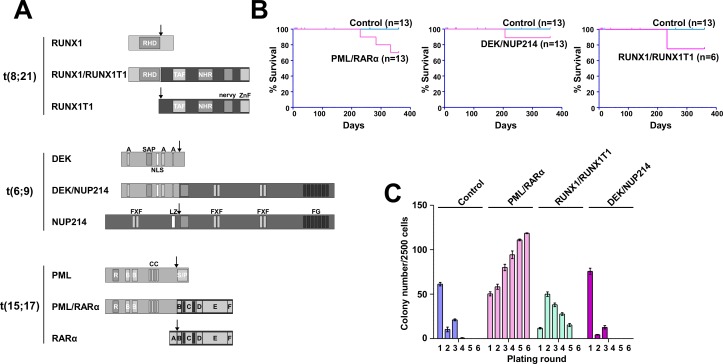
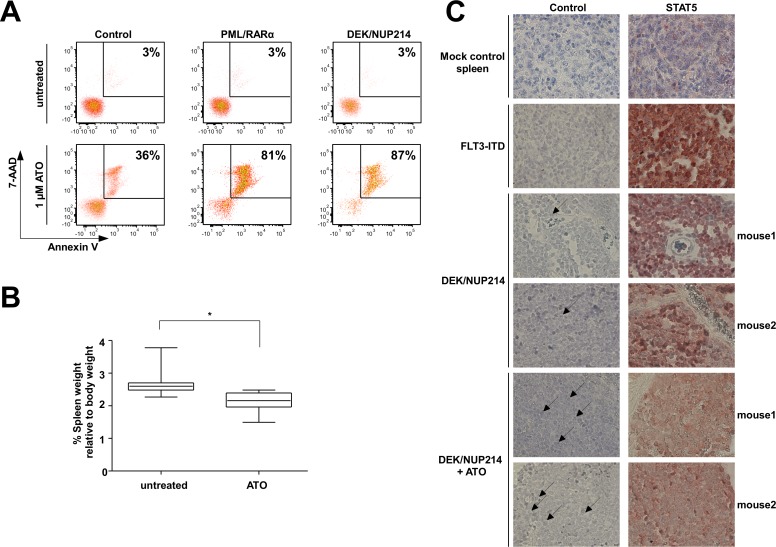
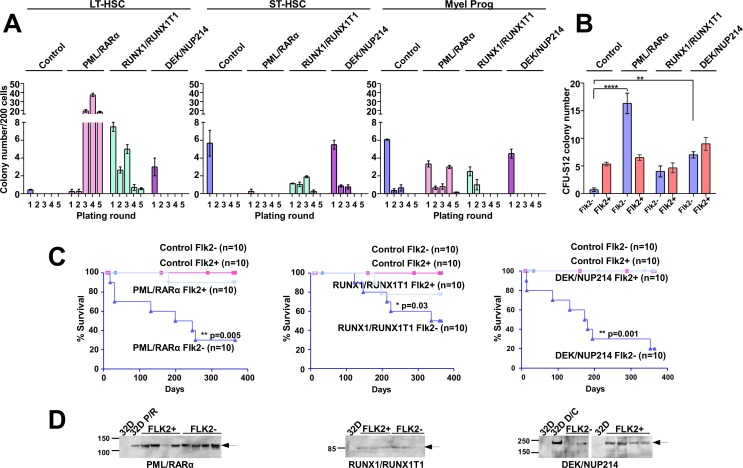
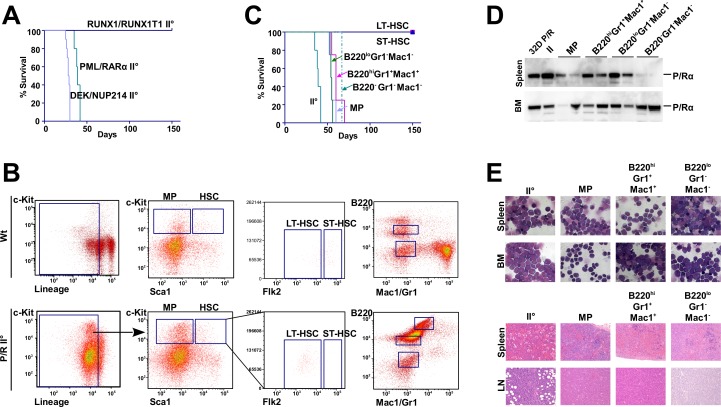
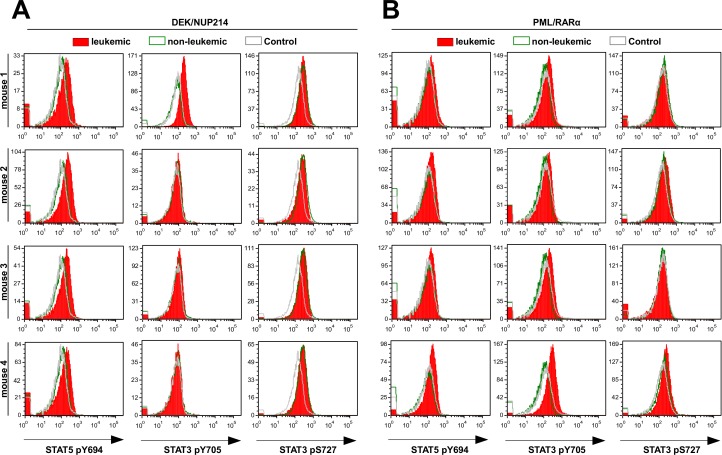
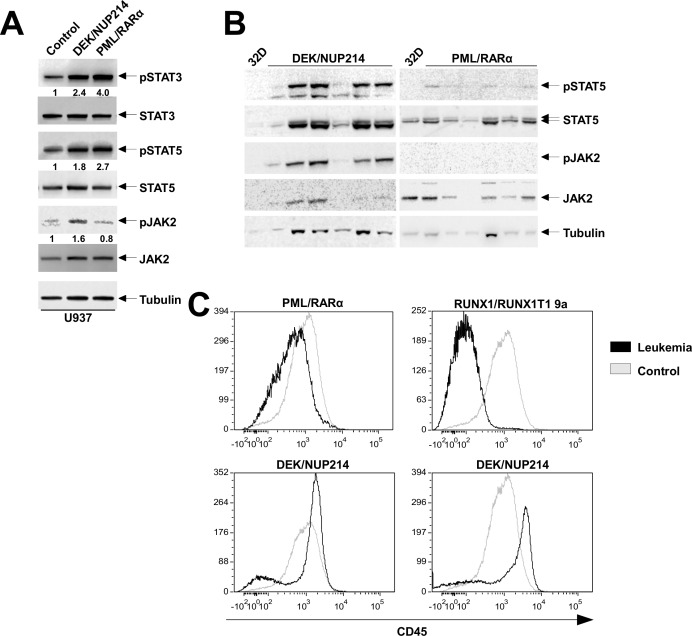
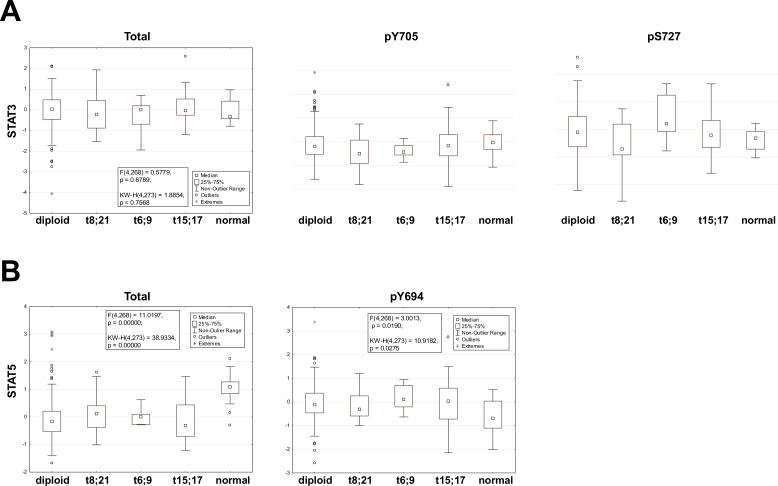
Acute myeloid leukemia (AML) is characterized by an aberrant self-renewal of hematopoietic stem cells (HSC) and a block in differentiation. The major therapeutic challenge is the characterization of the leukemic stem cell as a target for the eradication of the disease. Until now the biology of AML-associated fusion proteins (AAFPs), such as the t(15;17)-PML/RARα, t(8;21)-RUNX1/RUNX1T1 and t(6;9)-DEK/NUP214, all able to induce AML in mice, was investigated in different models and genetic backgrounds, not directly comparable to each other. To avoid the bias of different techniques and models we expressed these three AML-inducing oncogenes in an identical genetic background and compared their influence on the HSC compartment in vitro and in vivo. These AAFPs exerted differential effects on HSCs and PML/RARα, similar to DEK/NUP214, induced a leukemic phenotype from a small subpopulation of HSCs with a surface marker pattern of long-term HSC and characterized by activated STAT3 and 5. In contrast the established AML occurred from mature populations in the bone marrow. The activation of STAT5 by PML/RARα and DEK/NUP214 was confirmed in t(15;17)(PML/RARα) and t(6;9)(DEK/NUP214)-positive patients as compared to normal CD34+ cells. The activation of STAT5 was reduced upon the exposure to Arsenic which was accompanied by apoptosis in both PML/RARα- and DEK/NUP214-positive leukemic cells. These findings indicate that in AML the activation of STATs plays a decisive role in the biology of the leukemic stem cell. Furthermore we establish exposure to arsenic as a novel concept for the treatment of this high risk t(6;9)-positive AML.
急性髓系白血病(AML)的特征是造血干细胞(HSC)异常自我更新和分化受阻。主要的治疗挑战是将白血病干细胞作为根除该疾病的靶点进行表征。到目前为止,在不同的模型和遗传背景下研究了与AML相关的融合蛋白(AAFP)的生物学特性,如t(15;17)-PML/RARα、t(8;21)-RUNX1/RUNX1T1和t(6;9)-DEK/NUP214,它们都能在小鼠中诱导AML,但彼此之间没有直接可比性。为了避免不同技术和模型的偏差,我们在相同的遗传背景下表达这三种诱导AML的致癌基因,并比较它们在体外和体内对HSC区室的影响。这些AAFP对HSC发挥了不同的作用,与DEK/NUP214类似,PML/RARα从一小部分具有长期HSC表面标志物模式且以STAT3和5激活为特征的HSC亚群中诱导出白血病表型。相比之下,已确定的AML发生于骨髓中的成熟细胞群体。与正常CD34+细胞相比,在t(15;17)(PML/RARα)和t(6;9)(DEK/NUP214)阳性患者中证实了PML/RARα和DEK/NUP214对STAT5的激活作用。暴露于砷后,STAT5的激活作用降低,同时PML/RARα和DEK/NUP214阳性白血病细胞均发生凋亡。这些发现表明,在AML中,STAT的激活在白血病干细胞的生物学特性中起决定性作用。此外,我们确立了暴露于砷作为治疗这种高危t(6;9)阳性AML的新观念。