Ahangarpour Akram, Abdollahzade Fard Amin, Gharibnaseri Mohammad Kazem, Jalali Taha, Rashidi Iran
Department of Physiology and Physiology Research Center, School of Medicine, Jundishapur University of Medical Sciences of Ahvaz, Ahvaz, Iran;
Department of Physiology and Physiology Research Center, School of Paramedicine, Jundishapur University of Medical Sciences of Ahvaz, Ahvaz, Iran;
Vet Res Forum. 2014 Spring;5(2):121-7.
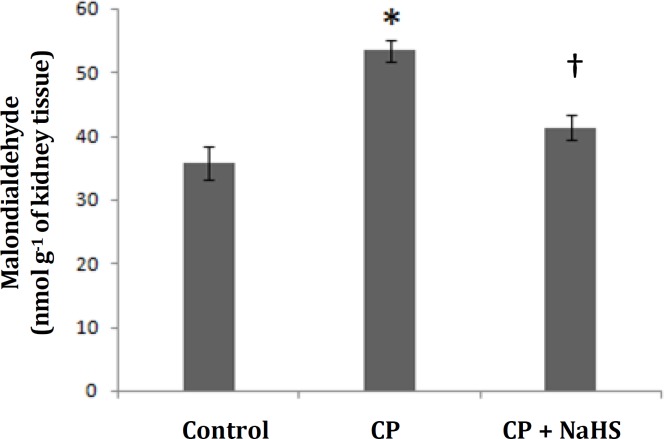
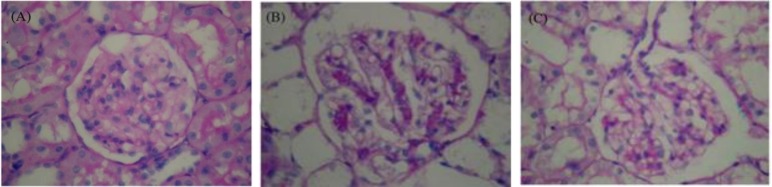
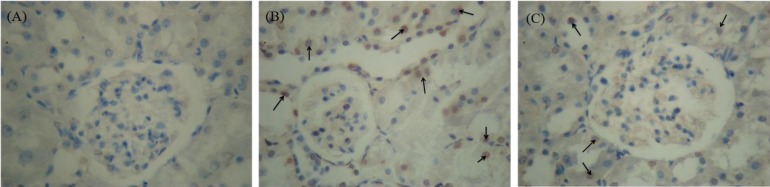
Hydrogen Sulfide (H2S) prevents and treats a variety of disorders via its cytoprotective effects. However, the effects of H2S on rats with cisplatin (CP) nephrotoxicity are unclear. The aim was to study the effects of H2S on rats with CP nephrotoxicity. Thirty male Sprague-Dawley rats were divided into three groups: control group, nephrotoxic group received single dose of CP (6 mg kg(-1)) and nephrotoxic groups that received single dose 100 µmol kg(-1) NaHS. On fifth day after injection, urine of each rat was collected over a 24-hr period. Animals were sacrificed 6 days after CP (or vehicle) treatment, and blood, urine, and kidneys were obtained, prepared for light microscopy evaluation, lipid peroxidation content and laboratory analysis. The results showed that plasma urea (226%), creatinine (271%), renal lipid peroxidation content (151%), Na and K fractional excretion, urine protein, volume and kidney weight in CP nephrotoxic rats were significantly higher and urine osmolarity and creatinine clearance lower than in controls. Increases of the proximal tubular cells apoptosis and mesangial matrix in CP nephrotoxicity group rats were observed. Hydrogen sulfide reversed the CP-induced changes in the experimental rats H2S prevented the progression of CP nephrotoxicity in rats possibly through its cytoprotective effects such as antioxidant properties.
硫化氢(H₂S)通过其细胞保护作用预防和治疗多种疾病。然而,H₂S对顺铂(CP)诱导的肾毒性大鼠的影响尚不清楚。本研究旨在探讨H₂S对CP诱导的肾毒性大鼠的影响。将30只雄性Sprague-Dawley大鼠分为三组:对照组、接受单次剂量CP(6 mg kg⁻¹)的肾毒性组和接受单次剂量100 µmol kg⁻¹ NaHS的肾毒性组。注射后第5天,收集每只大鼠24小时的尿液。CP(或溶剂)处理6天后处死动物,采集血液、尿液和肾脏,用于光学显微镜评估、脂质过氧化含量测定和实验室分析。结果显示,CP肾毒性大鼠的血浆尿素(226%)、肌酐(271%)、肾脂质过氧化含量(151%)、钠和钾分数排泄、尿蛋白、尿量和肾脏重量显著高于对照组,而尿渗透压和肌酐清除率低于对照组。观察到CP肾毒性组大鼠近端肾小管细胞凋亡增加和系膜基质增多。硫化氢逆转了CP诱导的实验大鼠的变化,H₂S可能通过其抗氧化等细胞保护作用阻止了大鼠CP肾毒性的进展。