Jaros Patricia, Cookson Adrian L, Campbell Donald M, Duncan Gail E, Prattley Deborah, Carter Philip, Besser Thomas E, Shringi Smriti, Hathaway Steve, Marshall Jonathan C, French Nigel P
Massey University, Palmerston North, New Zealand.
Emerg Infect Dis. 2014 Dec;20(12):1980-9. doi: 10.3201/eid2012.140281.
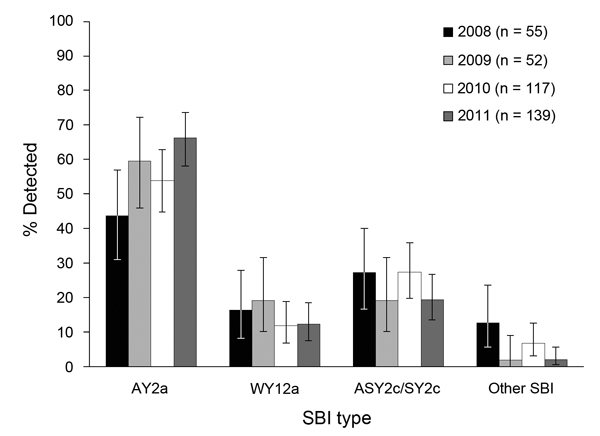
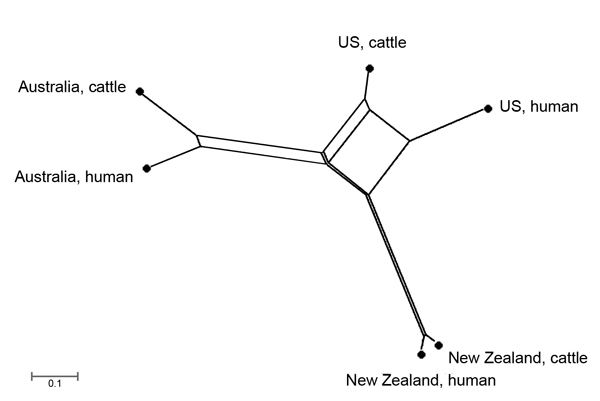
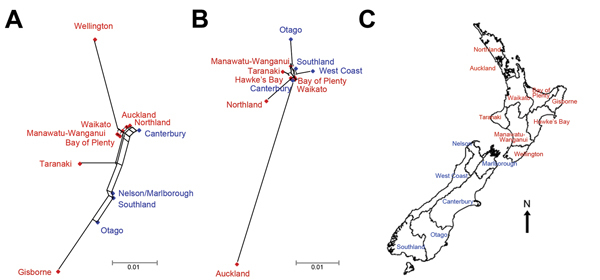
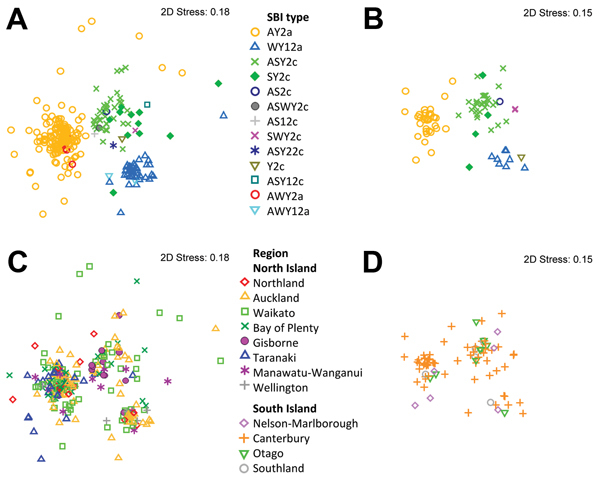
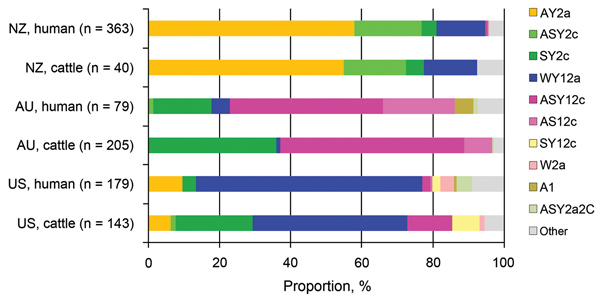
Shiga toxin-producing Escherichia coli (STEC)O157:H7 is a zoonotic pathogen of public health concern worldwide. To compare the local and large-scale geographic distributions of genotypes of STEC O157:H7 isolates obtained from various bovine and human sources during 2008–2011, we used pulsed-field gel electrophoresis and Shiga toxin–encoding bacteriophage insertion (SBI) typing. Using multivariate methods, we compared isolates from the North and South Islands of New Zealand with isolates from Australia and the United States. The STEC O157:H7 population structure differed substantially between the 2 islands and showed evidence of finer scale spatial structuring, which is consistent with highly localized transmission rather than disseminated foodborne outbreaks. The distribution of SBI types differed markedly among isolates from New Zealand, Australia, and the United States. Our findings also provide evidence for the historic introduction into New Zealand of a subset of globally circulating STEC O157:H7 strains that have continued to evolve and be transmitted locally between cattle and humans.
产志贺毒素大肠杆菌(STEC)O157:H7是一种引起全球公共卫生关注的人畜共患病原体。为比较2008 - 2011年期间从各种牛源和人源获得的STEC O157:H7分离株基因型的本地和大规模地理分布,我们采用脉冲场凝胶电泳和志贺毒素编码噬菌体插入(SBI)分型方法。运用多变量方法,我们将来自新西兰北岛和南岛的分离株与来自澳大利亚和美国的分离株进行了比较。STEC O157:H7的群体结构在两个岛屿之间存在显著差异,并显示出更精细尺度的空间结构证据,这与高度局部性传播而非广泛的食源性暴发相一致。SBI型的分布在来自新西兰、澳大利亚和美国的分离株之间明显不同。我们的研究结果还为全球流行的STEC O157:H7菌株的一个子集历史性地引入新西兰提供了证据,这些菌株在牛和人之间持续进化并在本地传播。