Yamaguchi Tsuyoshi, Qi Jia, Wang Hui-Ling, Zhang Shiliang, Morales Marisela
National Institutes of Health, National Institute on Drug Abuse, Intramural Research Program, Neuronal Networks Section, 251 Bayview Boulevard, Baltimore, MD, 21224, USA.
Eur J Neurosci. 2015 Mar;41(6):760-72. doi: 10.1111/ejn.12818. Epub 2015 Jan 9.
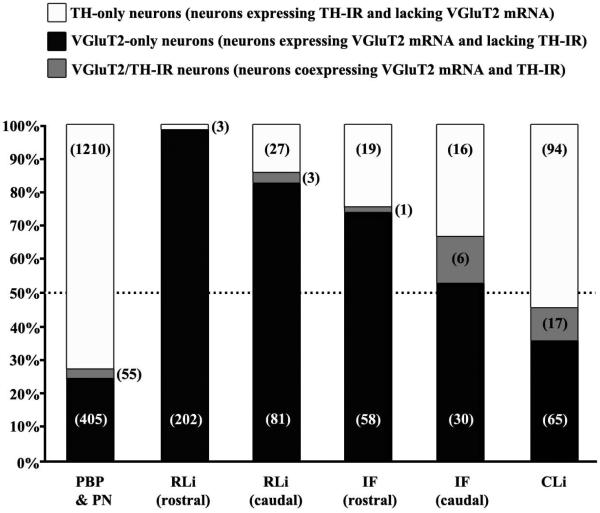
The ventral tegmental area (VTA) comprises dopamine (DA), γ-aminobutyric acid (GABA) and glutamate (Glu) neurons. Some rat VTA Glu neurons, expressing vesicular glutamate transporter 2 (VGluT2), co-express tyrosine hydroxylase (TH). While transgenic mice are now being used in attempts to determine the role of VGluT2/TH neurons in reward and neuronal signaling, such neurons have not been characterized in mouse tissue. By cellular detection of VGluT2 mRNA and TH immunoreactivity (TH-IR), we determined the cellular expression of VGluT2 mRNA within VTA TH-IR neurons in the mouse. We found that some mouse VGluT2 neurons coexpressed TH-IR, but their frequency was lower than in the rat. To determine whether low expression of TH mRNA or TH-IR accounts for this low frequency, we evaluated VTA cellular coexpression of TH transcripts and TH protein. Within the medial aspects of the VTA, some neurons expressed TH mRNA but lacked TH-IR; among them a subset coexpressed VGluT2 mRNA. To determine if lack of VTA TH-IR was due to TH trafficking, we tagged VTA TH neurons by Cre-inducible expression of mCherry in TH::Cre mice. By dual immunofluorescence, we detected axons containing mCherry, but lacking TH-IR, in the lateral habenula, indicating that low frequency of VGluT2 mRNA (+)/TH-IR (+) neurons in the mouse is due to lack of synthesis of TH protein, rather than TH protein trafficking. In conclusion, VGluT2 neurons are present in the rat and mouse VTA, but they differ in the populations of VGluT2/TH and TH neurons. Under normal conditions, the translation of TH protein is suppressed in the mouse mesohabenular TH neurons.
腹侧被盖区(VTA)由多巴胺(DA)、γ-氨基丁酸(GABA)和谷氨酸(Glu)能神经元组成。一些表达囊泡谷氨酸转运体2(VGluT2)的大鼠VTA Glu能神经元共表达酪氨酸羟化酶(TH)。虽然目前正在使用转基因小鼠来确定VGluT2/TH能神经元在奖赏和神经元信号传导中的作用,但此类神经元在小鼠组织中尚未得到表征。通过细胞检测VGluT2 mRNA和TH免疫反应性(TH-IR),我们确定了小鼠VTA中TH-IR能神经元内VGluT2 mRNA的细胞表达情况。我们发现一些小鼠VGluT2能神经元共表达TH-IR,但它们的频率低于大鼠。为了确定TH mRNA或TH-IR的低表达是否导致了这种低频率,我们评估了VTA中TH转录本和TH蛋白的细胞共表达情况。在VTA的内侧区域,一些神经元表达TH mRNA但缺乏TH-IR;其中一部分共表达VGluT2 mRNA。为了确定VTA中TH-IR的缺乏是否是由于TH的运输,我们通过在TH::Cre小鼠中Cre诱导的mCherry表达来标记VTA TH能神经元。通过双重免疫荧光,我们在外侧缰核中检测到含有mCherry但缺乏TH-IR的轴突,这表明小鼠中VGluT2 mRNA(+)/TH-IR(+)神经元的低频率是由于TH蛋白合成的缺乏,而不是TH蛋白的运输。总之,大鼠和小鼠的VTA中都存在VGluT2能神经元,但它们在VGluT2/TH和TH能神经元的数量上有所不同。在正常情况下,小鼠中脑缰核TH能神经元中TH蛋白的翻译受到抑制。