Qiao Jianliang, Han Chunlei, Zhang Junjing, Wang Zhiyong, Meng Xingkai
Department of General Surgery, Xuanwu Hospital, Capital Medical University, Beijing 100053, P.R. China ; Department of General Surgery, The Affiliated Hospital of Inner Mongolia Medical University, Hohhot, Inner Mongolia Autonomous Region 010050, P.R. China.
Turku PET Centre, Turku University Hospital and University of Turku, Turku 20521, Finland.
Exp Ther Med. 2015 Feb;9(2):367-371. doi: 10.3892/etm.2014.2110. Epub 2014 Dec 5.
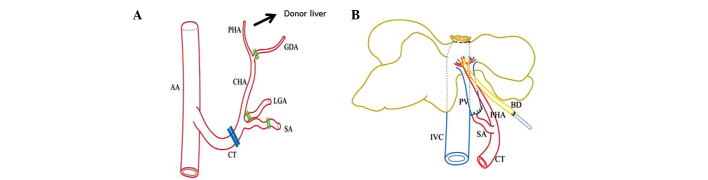
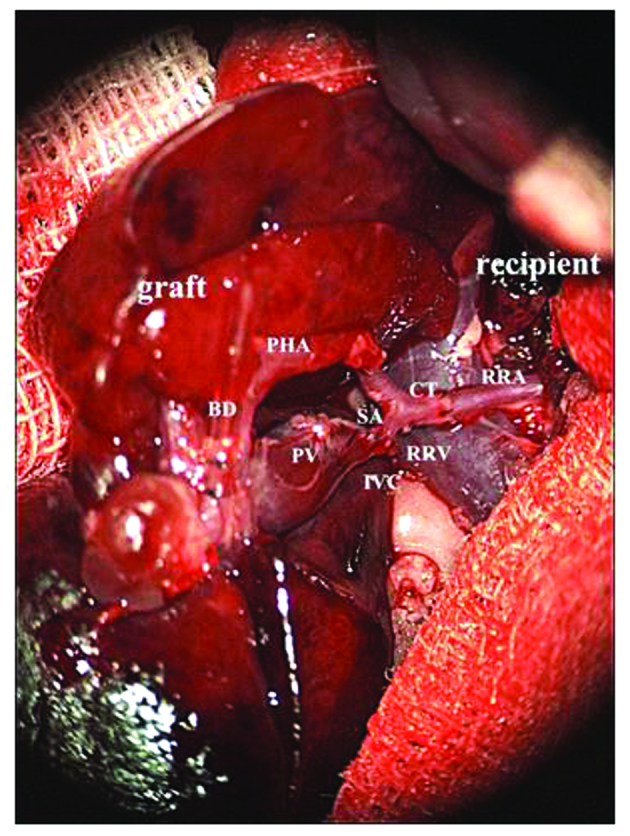
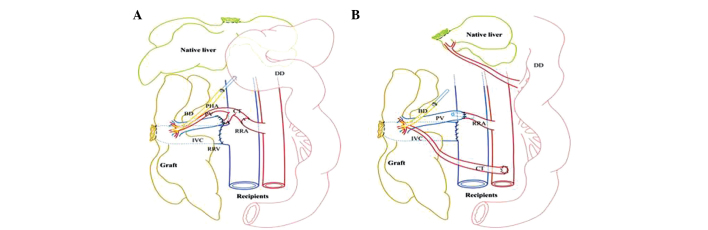
Auxiliary partial heterotopic liver transplantation (APHLT) with portal vein arterialization is a valuable procedure to be considered in the treatment of patients with acute liver failure and metabolic liver diseases. The aim of this study was to develop a new rat model of APHLT with liver dual arterial blood supply (LDABS). A total of 20 rats were used. The donor liver was resected, and the celiac trunk was reserved. Left and medial hepatic lobes accounting for 70% of the liver mass were removed en bloc and the suprahepatic caval vein was ligated simultaneously. Thus, 30% of the donor liver was obtained as the graft. Sleeve anastomosis of the graft portal vein and splenic artery were performed after narrowing the portal vein lumen through suturing. The right kidney of the recipient was removed, and sleeve anastomosis was performed between the celiac trunk of the graft and the right renal artery of the recipient. In addition, end-to-end anastomosis was performed between the infrahepatic caval vein of the graft and the right renal vein of the recipient. Following the reperfusion of the graft, the blood flow of the arterialized portal vein was controlled within the physiological range through suturing and narrowing under monitoring with an ultrasonic flowmeter. The bile duct of the graft was implanted into the duodenum of the recipient through an internal stent catheter. A 70% section of the native liver (left and medial hepatic lobes) was resected using bloodless hepatectomy. The mean operative duration was 154.5±16.4 min, and the warm and cold ischemia times of the graft were 8.1±1.1 min and 64.5±6.6 min, respectively. The blood flow of the arterialized portal vein to the graft was 1.8±0.3 ml/min/g liver weight. The success rate of model establishment (waking with post-surgical survival of >24 h) was 70% (7/10). Following successful model establishment, all rats survived 7 days post-surgery (100%; 7/7). The graft was found to be soft in texture and bright red in color following exploratory laparotomy. In conclusion, a new rat model of APHLT with LDABS without stent for vascular reconstruction was developed. This is a feasible and reliable rat model for liver transplantation study.
门静脉动脉化辅助性部分异位肝移植(APHLT)是治疗急性肝衰竭和代谢性肝病患者时值得考虑的一种有价值的手术方法。本研究的目的是建立一种新的具有肝脏双动脉血供(LDABS)的APHLT大鼠模型。共使用了20只大鼠。切除供体肝脏,保留腹腔干。整块切除占肝脏质量70%的左肝叶和中叶,并同时结扎肝上腔静脉。这样,获得30%的供体肝脏作为移植物。在通过缝合使门静脉管腔变窄后,对移植物门静脉和脾动脉进行套入式吻合。切除受体的右肾,并在移植物的腹腔干与受体的右肾动脉之间进行套入式吻合。此外,在移植物的肝下腔静脉与受体的右肾静脉之间进行端端吻合。在移植物再灌注后,用超声流量计监测,通过缝合和变窄将动脉化门静脉的血流控制在生理范围内。将移植物的胆管通过内置支架导管植入受体的十二指肠。采用无血肝切除术切除70%的自体肝脏(左肝叶和中叶)。平均手术时间为154.5±16.4分钟,移植物的热缺血时间和冷缺血时间分别为8.1±1.1分钟和64.5±6.6分钟。动脉化门静脉向移植物的血流为1.8±0.3毫升/分钟/克肝脏重量。模型建立成功率(术后存活超过24小时苏醒)为70%(7/10)。成功建立模型后,所有大鼠术后存活7天(100%;7/7)。剖腹探查发现移植物质地柔软,颜色鲜红。总之,建立了一种新的无血管重建支架的具有LDABS的APHLT大鼠模型。这是一种用于肝移植研究的可行且可靠的大鼠模型。