Kim Miyoung, Cha Seung-Ick, Choi Keum-Ju, Shin Kyung-Min, Lim Jae-Kwang, Yoo Seung-Soo, Lee Jaehee, Lee Shin-Yup, Kim Chang-Ho, Park Jae-Yong, Yang Dong Heon
Department of Internal Medicine, Kyungpook National University School of Medicine, Daegu, Korea.
Department of Radiology, Kyungpook National University School of Medicine, Daegu, Korea.
Tuberc Respir Dis (Seoul). 2014 Dec;77(6):243-50. doi: 10.4046/trd.2014.77.6.243. Epub 2014 Dec 31.
Information regarding prognostic value of growth differentiation factor 15 (GDF-15) and heart-type fatty acid-binding protein (H-FABP) in patients with chronic obstructive pulmonary disease (COPD) exacerbation is limited. The aim of this study was to investigate whether serum levels of GDF-15 and H-FABP predict an adverse outcome for COPD exacerbation.
Clinical variables, including serum GDF-15 and H-FABP levels were compared in prospectively enrolled patients with COPD exacerbation that did or did not experience an adverse outcome. An adverse outcome included 30-day mortality and need for endotracheal intubation or inotropic support.
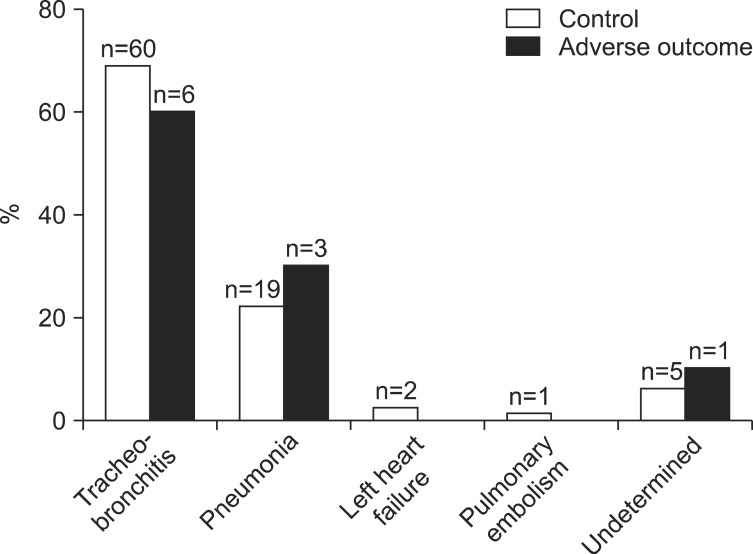
Ninety-seven patients were included and allocated into an adverse outcome (n=10) or a control (n=87) group. Frequencies of mental change and PaCO2>37 mm Hg were significantly higher in the adverse outcome group (mental change: 30% vs. 6%, p=0.034 and PaCO2>37 mm Hg: 80% vs. 22%, p<0.001, respectively). Serum GDF-15 elevation (>1,600 pg/mL) was more common in the adverse outcome group (80% vs. 43%, p=0.041). However, serum H-FABP level and frequency of serum H-FABP elevation (>755 pg/mL) did not differ between the two groups. Multivariate analysis showed that an elevated serum GDF-15 and PaCO2>37 mm Hg were significant predictors of an adverse outcome (odds ratio [OR], 25.8; 95% confidence interval [CI], 2.7-243.8; p=0.005 and OR, 11.8; 95% CI, 1.2-115.3; p=0.034, respectively).
Elevated serum GDF-15 level and PaCO2>37 mm Hg were found to predict an adverse outcome independently in patients with COPD exacerbation, suggesting the possibility that serum GDF-15 could be used as a prognostic biomarker of COPD exacerbation.
关于生长分化因子15(GDF - 15)和心型脂肪酸结合蛋白(H - FABP)在慢性阻塞性肺疾病(COPD)急性加重患者中的预后价值的信息有限。本研究的目的是调查血清GDF - 15和H - FABP水平是否可预测COPD急性加重的不良结局。
比较前瞻性纳入的发生或未发生不良结局的COPD急性加重患者的临床变量,包括血清GDF - 15和H - FABP水平。不良结局包括30天死亡率以及需要气管插管或使用血管活性药物支持。
纳入97例患者,分为不良结局组(n = 10)和对照组(n = 87)。不良结局组精神状态改变和动脉血二氧化碳分压(PaCO2)>37 mmHg的频率显著更高(精神状态改变:30% 对6%,p = 0.034;PaCO2>37 mmHg:80% 对22%,p < 0.001)。血清GDF - 15升高(>1600 pg/mL)在不良结局组更常见(80% 对43%,p = 0.041)。然而,两组之间血清H - FABP水平及血清H - FABP升高(>755 pg/mL)的频率无差异。多因素分析显示,血清GDF - 15升高和PaCO2>37 mmHg是不良结局的显著预测因素(比值比[OR]分别为25.8;95%置信区间[CI]为2.7 - 243.8;p = 0.005和OR为11.8;95%CI为1.2 - 115.3;p = 0.034)。
发现血清GDF - 15水平升高和PaCO2>37 mmHg可独立预测COPD急性加重患者的不良结局,提示血清GDF - 15有可能作为COPD急性加重的预后生物标志物。