Todenhöfer Tilman, Hennenlotter Jörg, Esser Michael, Mohrhardt Sarah, Aufderklamm Stefan, Böttge Johannes, Rausch Steffen, Mischinger Johannes, Bier Simone, Gakis Georgios, Kuehs Ursula, Stenzl Arnulf, Schwentner Christian
Department of Urology, Eberhard-Karls University, Hoppe-Seyler Strasse 3, 72076 Tübingen, Germany ; V6H 3Z6 Vancouver Prostate Centre, University of British Columbia, 2660 Oak Street, Vancouver, BC, Canada V6H 3Z6.
Department of Urology, Eberhard-Karls University, Hoppe-Seyler Strasse 3, 72076 Tübingen, Germany.
Dis Markers. 2014;2014:973406. doi: 10.1155/2014/973406. Epub 2014 Dec 22.
The optimal use of urine markers in the surveillance of non-muscle-invasive bladder cancer (NMIBC) remains unclear. Aim of the present study was to investigate the combined and stepwise use of the four most broadly available urine markers to detect tumor recurrence in patients undergoing surveillance of NMIBC.
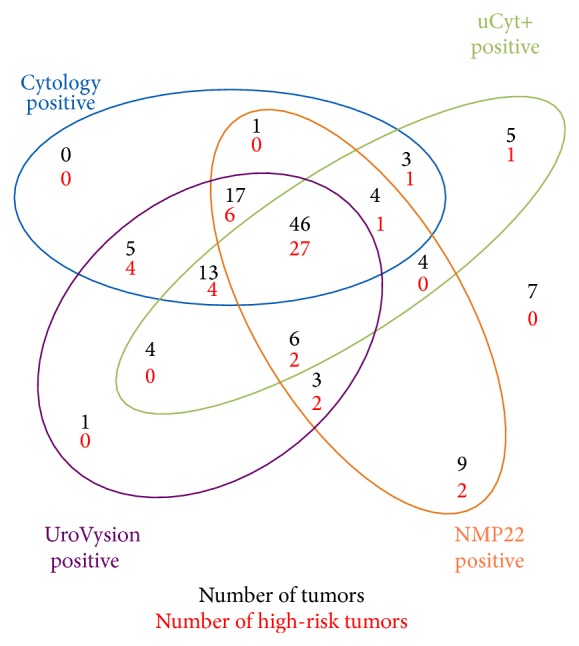
483 patients with history of NMIBC were included. Cytology, UroVysion, fluorescence in situ hybridization (FISH), immunocytology (uCyt+), and NMP22 ELISA were performed before surveillance cystoscopy. Characteristics of single tests and combinations were assessed by contingency analysis.
128 (26.5%) patients had evidence of tumor recurrence. Sensitivities and negative predictive values (NPVs) of the single tests ranged between 66.4-74.3 and 82.3-88.2%. Two-marker combinations showed sensitivities and NPVs of 80.5-89.8 and 89.5-91.2%. A stepwise application of the two-test combinations with highest accuracy (cytology and FISH; cytology and uCyt+; uCyt+ and FISH) showed NPVs for high-risk recurrences (G3/Cis/pT1) of 98.8, 98.8, and 99.1%, respectively.
Combinations of cytology, FISH, immunocytology, and NMP22 show remarkable detection rates for recurrent NMIBC. Stepwise two-test combinations of cytology, FISH, and immunocytology have a low probability of missing a high-risk tumor. The high sensitivities may justify the use of these combinations in prospective studies assessing the use of urine markers to individualize intervals between cystoscopies during follow-up.
尿标志物在非肌层浸润性膀胱癌(NMIBC)监测中的最佳应用仍不明确。本研究的目的是调查四种最常用的尿标志物联合及逐步应用于NMIBC监测患者中检测肿瘤复发的情况。
纳入483例有NMIBC病史的患者。在监测性膀胱镜检查前进行细胞学检查、UroVysion检测、荧光原位杂交(FISH)、免疫细胞学检查(uCyt+)和NMP22酶联免疫吸附测定(ELISA)。通过列联分析评估单项检测及联合检测的特征。
128例(26.5%)患者有肿瘤复发证据。单项检测的敏感性和阴性预测值(NPV)在66.4% - 74.3%和82.3% - 88.2%之间。双标志物联合检测的敏感性和NPV分别为80.5% - 89.8%和89.5% - 91.2%。逐步应用准确性最高的双检测组合(细胞学与FISH;细胞学与uCyt+;uCyt+与FISH),高危复发(G3/Cis/pT1)的NPV分别为98.8%、98.8%和99.1%。
细胞学、FISH、免疫细胞学和NMP22联合检测对复发性NMIBC显示出显著的检出率。细胞学、FISH和免疫细胞学的逐步双检测组合漏诊高危肿瘤的可能性较低。高敏感性可能证明在评估尿标志物用于确定随访期间膀胱镜检查个体化间隔的前瞻性研究中使用这些组合是合理的。