Han Ji-Chang, Li Xian-Dong, Du Jin, Xu Feng, Wei Yu-Ju, Li Hong-Bing, Zhang Yi-Jie
Department of Respiration, Huaihe Hospital of Henan University, Ximen Street No, 115, Kaifeng 475000, P,R China.
World J Surg Oncol. 2015 Jan 14;13:5. doi: 10.1186/1477-7819-13-5.
Matrix metalloproteinase 7 (MMP-7) promotes tumor invasion and metastasis in several cancers. However, its role in lung cancer progression is understudied. In this study, we investigated the correlation between MMP-7 expression and lung cancer pathology.
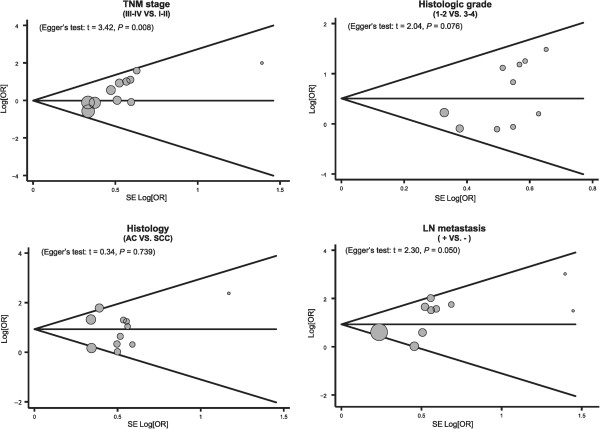
We searched the databases PubMed, Embase, Web of Science, Cochrane Library, CISCOM, CINAHL, China BioMedicine (CBM) and China National Knowledge Infrastructure (CNKI) for scientific literature relevant to MMP-7 and lung cancer. Carefully selected studies were pooled and ORs with 95% CI were calculated. Subgroup analyses and publication bias were analyzed to understand the retrieved data in greater detail. Version 12.0 STATA software was used for statistical analysis.
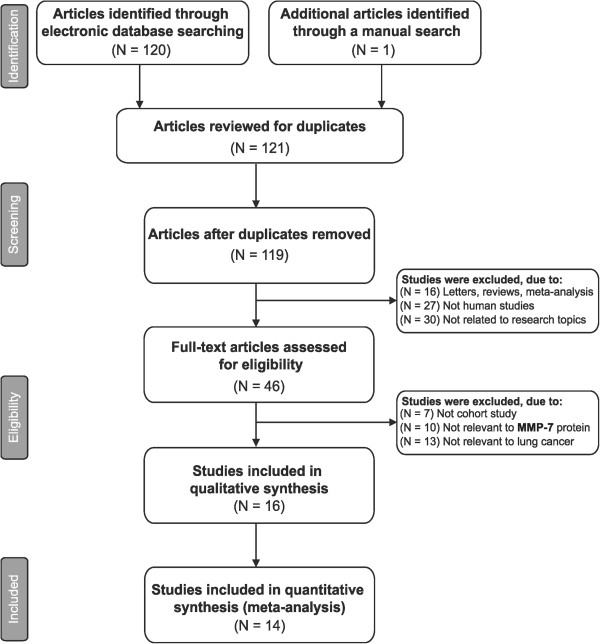
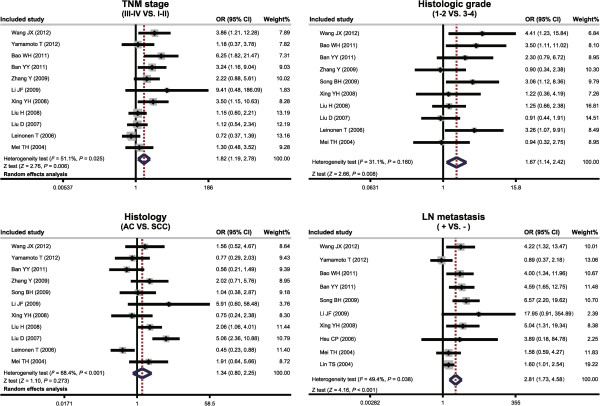
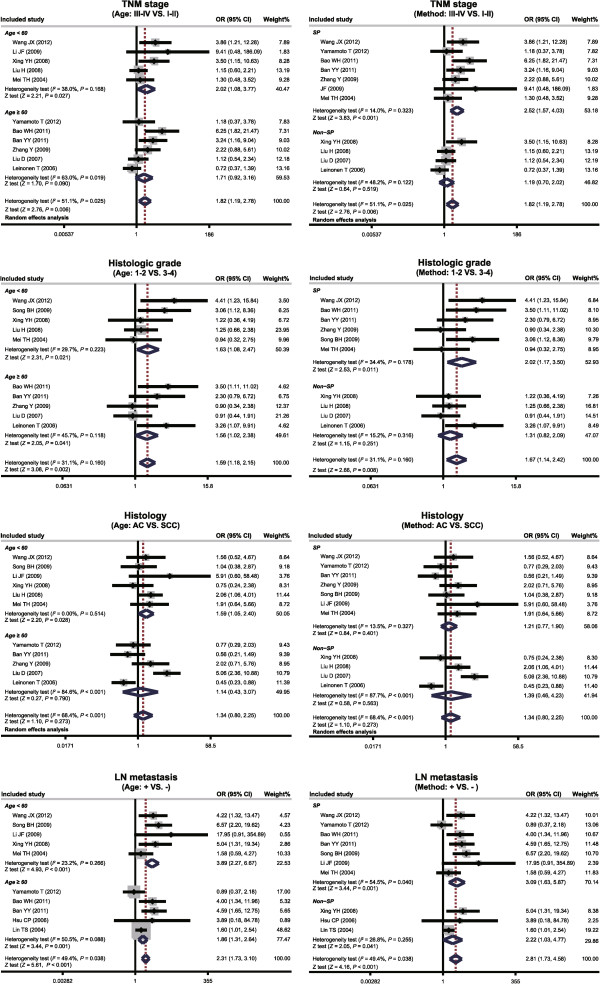
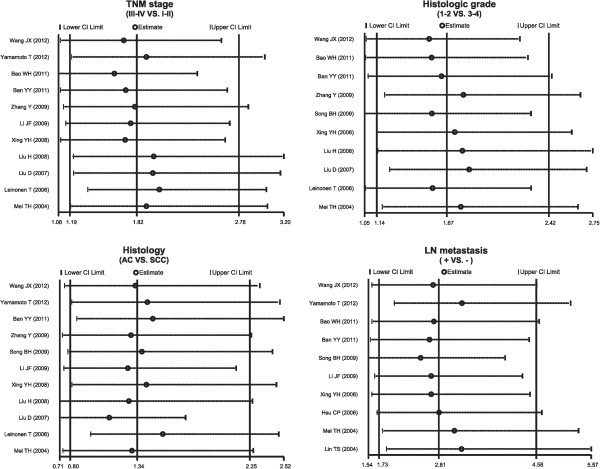
We retrieved a total of 121 studies through database searches. Finally, 14 cohort studies satisfied our inclusion/exclusion criteria, and these 14 studies, published between 2004 and 2012, were selected for meta-analysis to understand the influence of MMP-7 expression in lung cancer progression. Our results showed consistent differences in MMP-7 expression when comparisons were made between TNM I-II versus III-IV (OR = 1.82, 95% CI: 1.19 to 2.78, P = 0.006); histologic grade 1 to 2 versus 3 to 4 (OR = 1.67, 95% CI: 1.14 to 2.42, P = 0.008); and lymph node-negative versus lymph node-positive samples (OR = 2.81, 95% CI: 1.73 to 4.58, P <0.001), with significantly higher MMP-7 expression levels found in the more advanced stages. Subgroup analysis showed that age was not the factor influencing the associations between histologic grade, LN metastasis and MMP-7 expression in lung cancer patients, as both under 60 and over 60 age groups showed strong correlations (all P <0.05). However, when TNM staging was analyzed for its association with MMP-7 expression, only patients under age 60 showed a statistically significant correlation.
Our meta-analysis results revealed that MMP-7 overexpression is associated with advanced TNM and histological grades, and is linked to aggressive LN metastasis in lung cancer patients; thus MMP-7 is a useful biomarker to assess the disease status in lung cancers.
基质金属蛋白酶7(MMP - 7)在多种癌症中促进肿瘤侵袭和转移。然而,其在肺癌进展中的作用研究较少。在本研究中,我们调查了MMP - 7表达与肺癌病理之间的相关性。
我们在PubMed、Embase、Web of Science、Cochrane图书馆、CISCOM、CINAHL、中国生物医学数据库(CBM)和中国知网(CNKI)中搜索与MMP - 7和肺癌相关的科学文献。仔细筛选研究并进行汇总,计算95%置信区间的比值比(OR)。进行亚组分析和发表偏倚分析以更详细地了解检索到的数据。使用STATA 12.0软件进行统计分析。
通过数据库搜索,我们共检索到121项研究。最后,14项队列研究符合我们的纳入/排除标准,这些发表于2004年至2012年的14项研究被选用于荟萃分析,以了解MMP - 7表达在肺癌进展中的影响。我们的结果显示,在TNM I-II期与III-IV期之间进行比较时,MMP - 7表达存在一致差异(OR = 1.82,95% CI:1.19至2.78,P = 0.006);组织学1至2级与3至4级之间(OR = 1.67,95% CI:1.14至2.42,P = 0.008);以及淋巴结阴性与淋巴结阳性样本之间(OR = 2.81,95% CI:1.73至4.58,P <0.001),在更晚期阶段发现MMP - 7表达水平显著更高。亚组分析表明,年龄不是影响肺癌患者组织学分级、淋巴结转移与MMP - 7表达之间关联的因素,因为60岁以下和60岁以上年龄组均显示出强相关性(所有P <0.05)。然而,在分析TNM分期与MMP - 7表达的关联时,仅60岁以下患者显示出统计学显著相关性。
我们的荟萃分析结果表明,MMP - 7过表达与晚期TNM和组织学分级相关,并与肺癌患者侵袭性淋巴结转移有关;因此,MMP - 7是评估肺癌疾病状态的有用生物标志物。