
胞质c环的组成、形成及调控,III型分泌注射体的一个动态组成部分
Composition, formation, and regulation of the cytosolic c-ring, a dynamic component of the type III secretion injectisome.
作者信息
Diepold Andreas, Kudryashev Mikhail, Delalez Nicolas J, Berry Richard M, Armitage Judith P
机构信息
Department of Biochemistry, University of Oxford, Oxford, United Kingdom.
Biozentrum, University of Basel, Basel, Switzerland.
出版信息
PLoS Biol. 2015 Jan 15;13(1):e1002039. doi: 10.1371/journal.pbio.1002039. eCollection 2015 Jan.
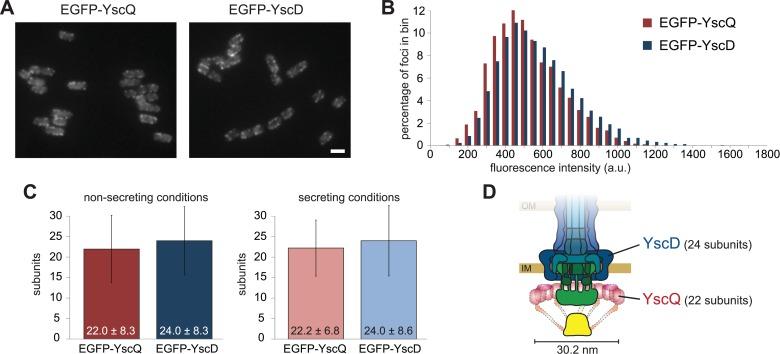
Many gram-negative pathogens employ a type III secretion injectisome to translocate effector proteins into eukaryotic host cells. While the structure of the distal "needle complex" is well documented, the composition and role of the functionally important cytosolic complex remain less well understood. Using functional fluorescent fusions, we found that the C-ring, an essential and conserved cytosolic component of the system, is composed of ~22 copies of SctQ (YscQ in Yersinia enterocolitica), which require the presence of YscQC, the product of an internal translation initiation site in yscQ, for their cooperative assembly. Photoactivated localization microscopy (PALM) reveals that in vivo, YscQ is present in both a free-moving cytosolic and a stable injectisome-bound state. Notably, fluorescence recovery after photobleaching (FRAP) shows that YscQ exchanges between the injectisome and the cytosol, with a t½ of 68 ± 8 seconds when injectisomes are secreting. In contrast, the secretin SctC (YscC) and the major export apparatus component SctV (YscV) display minimal exchange. Under non-secreting conditions, the exchange rate of YscQ is reduced to t½ = 134 ± 16 seconds, revealing a correlation between C-ring exchange and injectisome activity, which indicates a possible role for C-ring stability in regulation of type III secretion. The stabilization of the C-ring depends on the presence of the functional ATPase SctN (YscN). These data provide new insights into the formation and composition of the injectisome and present a novel aspect of type III secretion, the exchange of C-ring subunits, which is regulated with respect to secretion.
许多革兰氏阴性病原体利用III型分泌注射体将效应蛋白转运到真核宿主细胞中。虽然远端“针状复合体”的结构已有充分记录,但功能上重要的胞质复合体的组成和作用仍了解较少。通过使用功能性荧光融合蛋白,我们发现C环是该系统中一个必需且保守的胞质成分,由约22个SctQ拷贝(小肠结肠炎耶尔森菌中的YscQ)组成,它们的协同组装需要YscQC的存在,YscQC是yscQ内部翻译起始位点的产物。光激活定位显微镜(PALM)显示,在体内,YscQ以自由移动的胞质状态和稳定的与注射体结合的状态存在。值得注意的是,光漂白后荧光恢复(FRAP)表明,YscQ在注射体和胞质之间交换,当注射体分泌时,半衰期为68±8秒。相比之下,分泌素SctC(YscC)和主要输出装置成分SctV(YscV)的交换极少。在非分泌条件下,YscQ的交换速率降至半衰期=134±16秒,揭示了C环交换与注射体活性之间的相关性,这表明C环稳定性在III型分泌调节中可能发挥作用。C环的稳定取决于功能性ATP酶SctN(YscN)的存在。这些数据为注射体的形成和组成提供了新的见解,并揭示了III型分泌的一个新方面,即C环亚基的交换,其受分泌调节。



 Zotero 插件