Hawassa University, College of Agriculture, Hawassa, Ethiopia.
Hawassa University, College of Medicine and Health Sciences, Hawassa, Ethiopia.
BMC Public Health. 2015 Jan 17;15:8. doi: 10.1186/s12889-014-1337-2.
The cause of under-nutrition in schoolchildren is complex and varying from region to region. However, identifying the cause is the basic step for nutritional intervention programs.
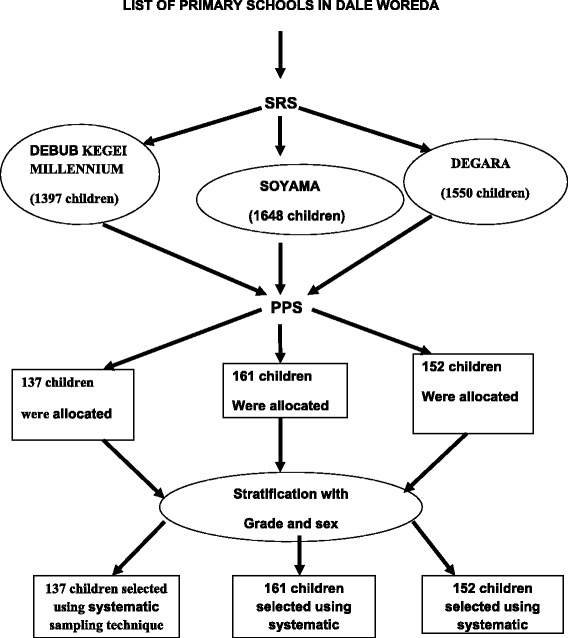
School based cross-sectional survey was conducted among 450 schoolchildren aged 7-14 years, using multi-stage sampling techniques in Dale Woreda, southern Ethiopia. A structured questionnaire and 24-hour recall methods were administered to determine the sociodemographic and dietary intake of participants. Stool microscopic examination was done. Weight and height were measured using a standard calibrated scale. Odds ratio generated from logistic regression was used to determine the strength of variables association.
Older age group (10-14 vs. 7-9) (AOR = 3.4; 95% CI, 1.7-6.6) and having Trichuris Trichura infection (AOR = 3.9; 95% CI, 1.4 -11.6) increased the risk of being stunted. Children whose mothers have completed primary education are less likely to be stunted than children whose mothers do not have formal education (AOR = 0.3; 95% CI, 0.2-0.8). Having large family size (AOR = 3.3; 95% CI, 1.4-7.9) and inadequate intake of carbohydrate (AOR = 3.1; 95% CI, 1.4-6.8) were independent predictors of wasting. Children whose mothers completed primary education are less likely to be underweight (AOR = 0.3; 95% CI, 0.1-0.9). Children live in food insecure households are more likely to be stunted, under-weight and wasted than children live in food secure households (AOR = 2.5; 95%, 1-5.6; AOR = 3.9; 95% CI, 1.2-12.0; AOR = 4.8; 95% CI, 1.7-13.6;).
Household food insecurity, low maternal education and infection with Trichuris trichura were some of the major factors contributing to under-nutrition in the study area.
儿童营养不良的原因因地而异,且较为复杂。然而,确定病因是营养干预计划的基本步骤。
采用多阶段抽样技术,在埃塞俄比亚南部 Dale Woreda 对 450 名 7-14 岁的在校儿童进行了基于学校的横断面调查。采用结构化问卷和 24 小时回顾法确定参与者的社会人口学和饮食摄入情况。进行粪便显微镜检查。使用标准校准秤测量体重和身高。使用逻辑回归生成的比值比来确定变量关联的强度。
与 7-9 岁年龄组相比,年龄较大的年龄组(10-14 岁)(AOR = 3.4;95%CI,1.7-6.6)和感染旋毛虫(AOR = 3.9;95%CI,1.4-11.6)增加了发育迟缓的风险。母亲完成小学教育的儿童比没有接受正规教育的儿童(AOR = 0.3;95%CI,0.2-0.8)更不容易发育迟缓。大家庭规模(AOR = 3.3;95%CI,1.4-7.9)和碳水化合物摄入不足(AOR = 3.1;95%CI,1.4-6.8)是消瘦的独立预测因素。母亲完成小学教育的儿童不太可能体重不足(AOR = 0.3;95%CI,0.1-0.9)。与生活在有保障家庭的儿童相比,生活在没有保障家庭的儿童更有可能发育迟缓、体重不足和消瘦(AOR = 2.5;95%CI,1-5.6;AOR = 3.9;95%CI,1.2-12.0;AOR = 4.8;95%CI,1.7-13.6;)。
家庭粮食不安全、母亲教育程度低和感染旋毛虫是该研究地区营养不良的一些主要因素。