Forsberg Mathias, Hemmingsson Carl, Amano Hiroshi, Pozina Galia
Department of Physics, Chemistry and Biology (IFM), Linköping University, S-581 83 Linköping, Sweden.
Department of Electrical Engineering and Computer Science, Nagoya University, Chikusa-ku, Nagoya, 464-8603, Japan.
Sci Rep. 2015 Jan 20;5:7889. doi: 10.1038/srep07889.
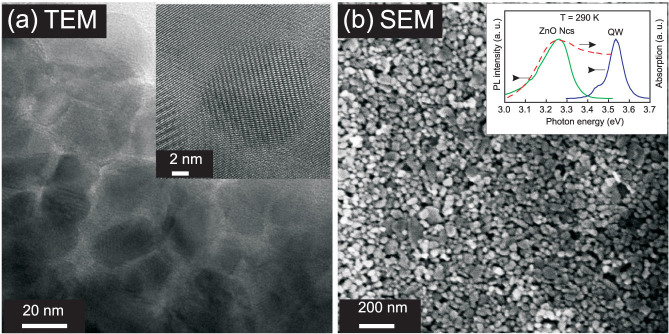
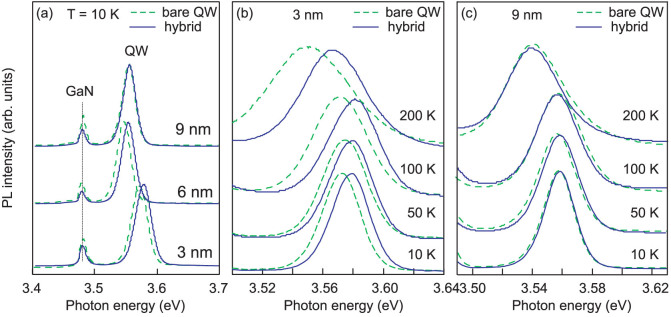
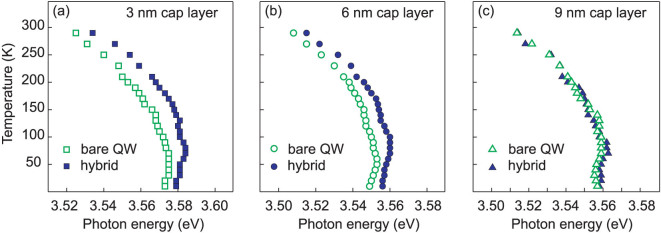
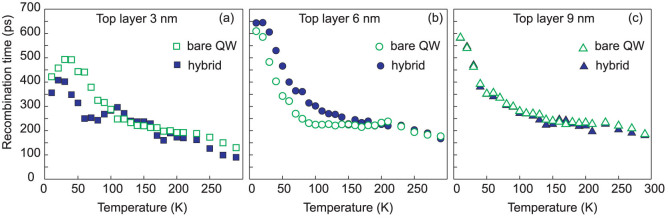
Hybrid samples based on ZnO colloidal nanocrystals (NCs) deposited on AlGaN/GaN quantum well (QW) structures with different top barrier thickness d = 3, 6 and 9 nm are studied by time-resolved photoluminescence. Thermal behavior of the QW exciton lifetime in the hybrids and in the bare QW structures has been compared and it has been found that the QW exciton recombination rate increases in the hybrid having d = 3 nm and decreases in the hybrid with d = 6 nm, while no change has been observed for the structure with d = 9 nm. It is suggested that non-radiative resonance energy transfer from the QW excitons to the ZnO NCs and a variation of the surface potential can both influence the QW exciton lifetime in the hybrids.
通过时间分辨光致发光研究了基于沉积在具有不同顶部势垒厚度d = 3、6和9 nm的AlGaN/GaN量子阱(QW)结构上的ZnO胶体纳米晶体(NCs)的混合样品。比较了混合样品和裸QW结构中QW激子寿命的热行为,发现d = 3 nm的混合样品中QW激子复合率增加,d = 6 nm的混合样品中QW激子复合率降低,而d = 9 nm的结构未观察到变化。研究表明,从QW激子到ZnO NCs的非辐射共振能量转移和表面势的变化都可以影响混合样品中QW激子的寿命。