Khan Khurum, Peckitt Clare, Sclafani Francesco, Watkins David, Rao Sheela, Starling Naureen, Jain Vikram, Trivedi Sachin, Stanway Susannah, Cunningham David, Chau Ian
Department of Medicine, GI and Lymphoma Unit, The Royal Marsden NHS Foundation Trust, London and Surrey, UK.
BMC Cancer. 2015 Jan 21;15:15. doi: 10.1186/s12885-015-1014-6.
SBA is a rare tumour which carries a poor prognosis. Very few data on prognostic factors and treatment outcomes are available. We conducted a retrospective analysis of patients treated for SBA at our institution.
Clinico-pathological characteristics, treatments and outcomes of all the SBA patients treated consecutively from 1996 to 2011 were retrospectively collected. The prognostic value of baseline factors was assessed using the Cox regression model. The Kaplan-Meier method was used to estimate the survival outcomes.
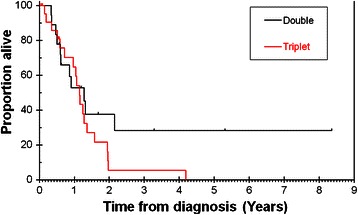
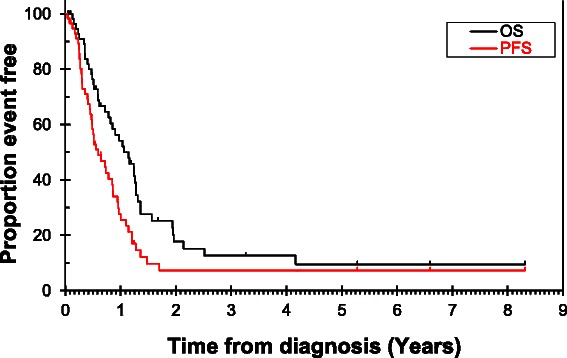
Eighty-four patients with SBA were treated during the study period. Of these, 48 presented with early stage SBA, while 36 had unresectable disease. All early stage SBA patients (58.3% males; median age, 59 years) underwent resection (R0 in 44/48) and 27 (56%) received adjuvant chemotherapy. Median relapse-free survival and overall survival (OS) were 31.1 months (95% CI: 8.0-54.3) and 42.9 (95% CI: 0-94.9), respectively. In univariate analyses, poor histological differentiation (p = 0.025) and lymphovascular invasion (p = 0.003) were prognostic for OS. In the group of patients with relapsed, unresectable or metastatic disease (n = 59), systemic chemotherapy was administered in 46 cases (78%). The response rate to first line chemotherapy was 50%. Median progression-free survival and OS were 8.8 (95% CI: 5.5-12.3) and 12.8 months (95% CI: 8.4-17.2), respectively. In univariate analyses, low albumin (p = 0.041) and high platelet count (p = 0.007) were prognostic for OS.
Prospective clinical trials are needed to inform the management of SBA patients. Prognostic factors evaluated in our series may be useful for patient stratification and treatment selection in future studies.
小肠腺癌(SBA)是一种罕见肿瘤,预后较差。关于预后因素和治疗结果的数据非常有限。我们对在我院接受SBA治疗的患者进行了一项回顾性分析。
回顾性收集1996年至2011年连续治疗的所有SBA患者的临床病理特征、治疗方法及结果。采用Cox回归模型评估基线因素的预后价值。采用Kaplan-Meier法估计生存结果。
研究期间共治疗84例SBA患者。其中,48例为早期SBA,36例为不可切除疾病。所有早期SBA患者(58.3%为男性;中位年龄59岁)均接受了手术切除(44/48例切缘阴性),27例(56%)接受了辅助化疗。中位无复发生存期和总生存期(OS)分别为31.1个月(95%CI:8.0-54.3)和42.9个月(95%CI:0-94.9)。单因素分析显示,组织学分化差(p = 0.025)和淋巴管侵犯(p = 0.003)是OS的预后因素。在复发、不可切除或转移性疾病患者组(n = 59)中,46例(78%)接受了全身化疗。一线化疗的缓解率为50%。中位无进展生存期和OS分别为8.8个月(95%CI:5.5-12.3)和12.8个月(95%CI:8.4-17.2)。单因素分析显示,低白蛋白(p = 0.041)和高血小板计数(p = 0.007)是OS的预后因素。
需要进行前瞻性临床试验以指导SBA患者的管理。我们系列研究中评估的预后因素可能有助于未来研究中的患者分层和治疗选择。