Khan Khurum, Ang Joo Ern, Starling Naureen, Sclafani Francesco, Shah Krunal, Judson Ian, Molife L Rhoda, Banerji Udai, de Bono Johann S, Cunningham David, Kaye Stan B
Drug Development Unit, The Royal Marsden NHS Foundation Trust, Sutton SM2 5PT, UK.
Gastrointestinal Unit, The Royal Marsden NHS Foundation Trust, Sutton SM2 5PT, UK.
Gastric Cancer. 2014 Oct;17(4):621-629. doi: 10.1007/s10120-013-0328-9. Epub 2014 Jan 21.
Conventional therapeutic options for patients with advanced upper gastrointestinal cancers (UGIC) are limited. Following first-line treatments, some patients are offered experimental therapies, including participation in Phase I trials. This study aims to describe the experience of UGIC patients treated in a dedicated Phase I unit.
Patient, tumour and treatment characteristics, and clinical outcomes of UGIC patients treated consecutively at the Drug Development Unit, Royal Marsden Hospital, between 2005 and 2009, were recorded.
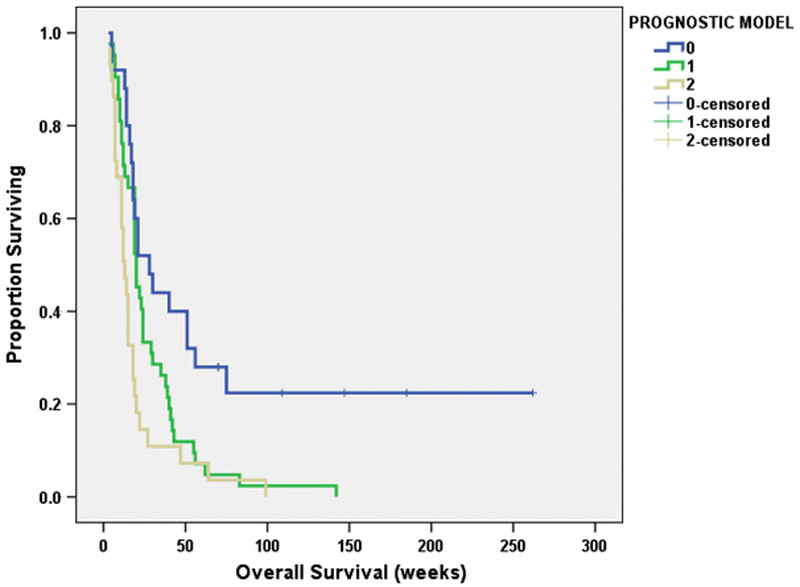
Ninety-six patients who previously received a median of 2 (range 1-4) lines of chemotherapies were treated in 30 Phase I trials. Of 81 evaluable patients, 9 achieved RECIST-objective response (11 %) with a 6-month clinical benefit rate of 14 %. Median progression free and overall survival were 7.7 weeks [95 %CI 7.7 (6.4-9.0)] and 19.1 weeks (95 %CI 17.5-20.8), respectively. Grade 3 or 4 toxicities were observed in 37 patients (39 %) and led to trial discontinuation in 9 (9 %); no toxicity-related death was recorded. In the multivariate analysis, serum albumin (<35 g/dl, HR2.0, p = 0.002) and lactate dehydrogenase (>192 μmol/l, HR1.7, p = 0.016) were prognostic of overall survival.
Phase I clinical trials can be considered a reasonable option in selected patients with relapsed UGIC. The use of objective prognosticators may improve selection and risk/benefit profile of patients.
晚期上消化道癌(UGIC)患者的传统治疗选择有限。一线治疗后,部分患者可接受实验性治疗,包括参与I期试验。本研究旨在描述在专门的I期治疗单元接受治疗的UGIC患者的经历。
记录2005年至2009年间在皇家马斯登医院药物研发单元连续接受治疗的UGIC患者的患者、肿瘤及治疗特征和临床结局。
96例先前接受过中位2(范围1 - 4)线化疗的患者参与了30项I期试验。在81例可评估患者中,9例达到RECIST标准的客观缓解(11%),6个月临床获益率为14%。无进展生存期和总生存期的中位数分别为7.7周[95%CI 7.7(6.4 - 9.0)]和19.1周(95%CI 17.5 - 20.8)。37例患者(39%)出现3级或4级毒性反应,其中9例(9%)导致试验中断;未记录到与毒性相关的死亡病例。多因素分析中,血清白蛋白(<35 g/dl,HR2.0,p = 0.002)和乳酸脱氢酶(>192 μmol/l,HR1.7,p = 0.016)是总生存期的预后因素。
对于部分复发的UGIC患者,I期临床试验可被视为一种合理选择。使用客观的预后指标可能会改善患者的选择及风险/获益情况。