Bachmann Daniel, Weichert Frank, Rinkenauer Gerhard
Department of Computer Science VII, Technical University Dortmund, Dortmund 44221, Germany.
Leibniz Research Centre for Working Environment and Human Factors, Dortmund 44139, Germany.
Sensors (Basel). 2014 Dec 24;15(1):214-33. doi: 10.3390/s150100214.
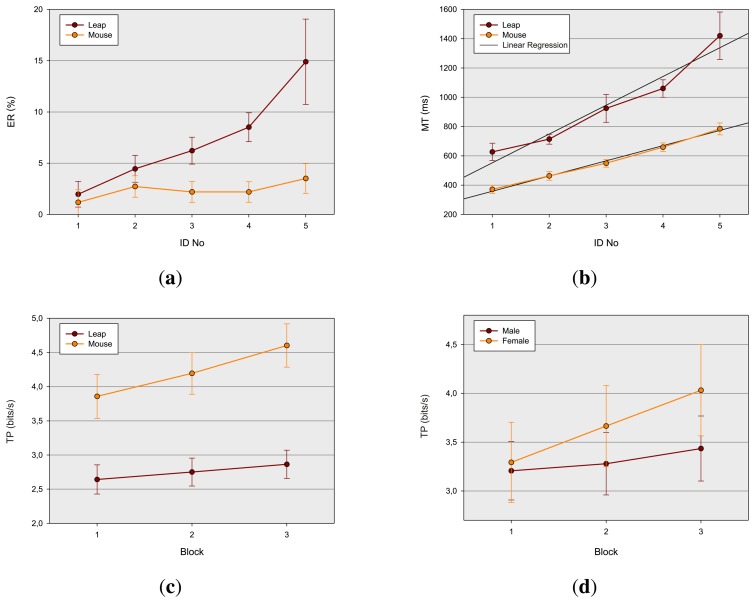
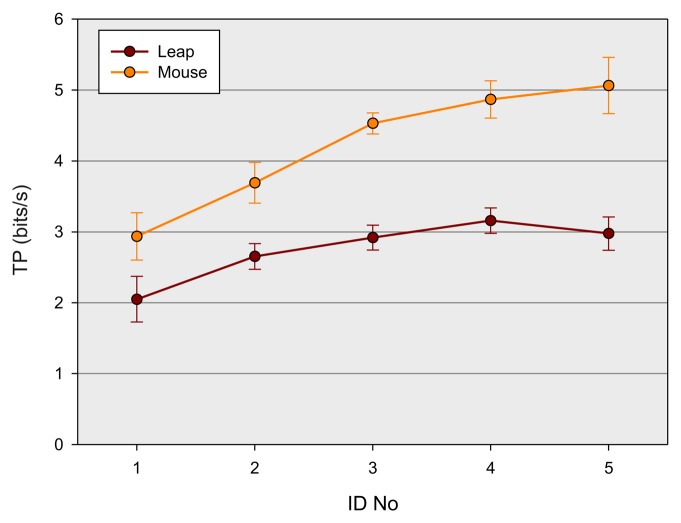
This paper presents a Fitts' law-based analysis of the user's performance in selection tasks with the Leap Motion Controller compared with a standard mouse device. The Leap Motion Controller (LMC) is a new contact-free input system for gesture-based human-computer interaction with declared sub-millimeter accuracy. Up to this point, there has hardly been any systematic evaluation of this new system available. With an error rate of 7.8% for the LMC and 2.8% for the mouse device, movement times twice as large as for a mouse device and high overall effort ratings, the Leap Motion Controller's performance as an input device for everyday generic computer pointing tasks is rather limited, at least with regard to the selection recognition provided by the LMC.
本文呈现了一项基于菲茨定律的分析,该分析将用户使用Leap Motion控制器在选择任务中的表现与标准鼠标设备进行了比较。Leap Motion控制器(LMC)是一种用于基于手势的人机交互的新型非接触式输入系统,宣称具有亚毫米级精度。截至目前,几乎没有对这个新系统进行过任何系统评估。LMC的错误率为7.8%,鼠标设备的错误率为2.8%,其移动时间是鼠标设备的两倍,且总体努力评级较高,至少就LMC提供的选择识别而言,Leap Motion控制器作为日常通用计算机指向任务的输入设备,其性能相当有限。