Núñez Iván Rodríguez, Araos Daniel Zenteno, Delgado Carlos Manterola
San Sebastian University, Faculty of Health Science, Center of Molecular Medicine, Concepción, Chile. Center of Molecular Medicine, Faculty of Health Science, San Sebastian University. Concepción. Chile.
Guillermo Grant Benavente Hospital, Department of Pediatrics, Concepción, Chile. Department of Pediatrics, Guillermo Grant Benavente Hospital, Concepción, Chile.
J Bras Pneumol. 2014 Nov-Dec;40(6):626-33. doi: 10.1590/S1806-37132014000600006.
Respiratory muscle weakness is a functional repercussion of chronic lung disease (CLD). The objective of this study was to assess the effects of home-based respiratory muscle training (RMT) in children and adolescents with CLD or neuromuscular disease (NMD).
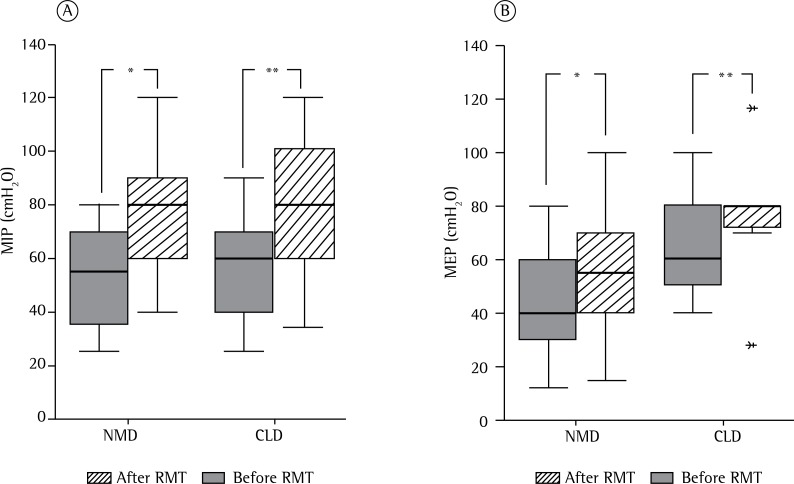
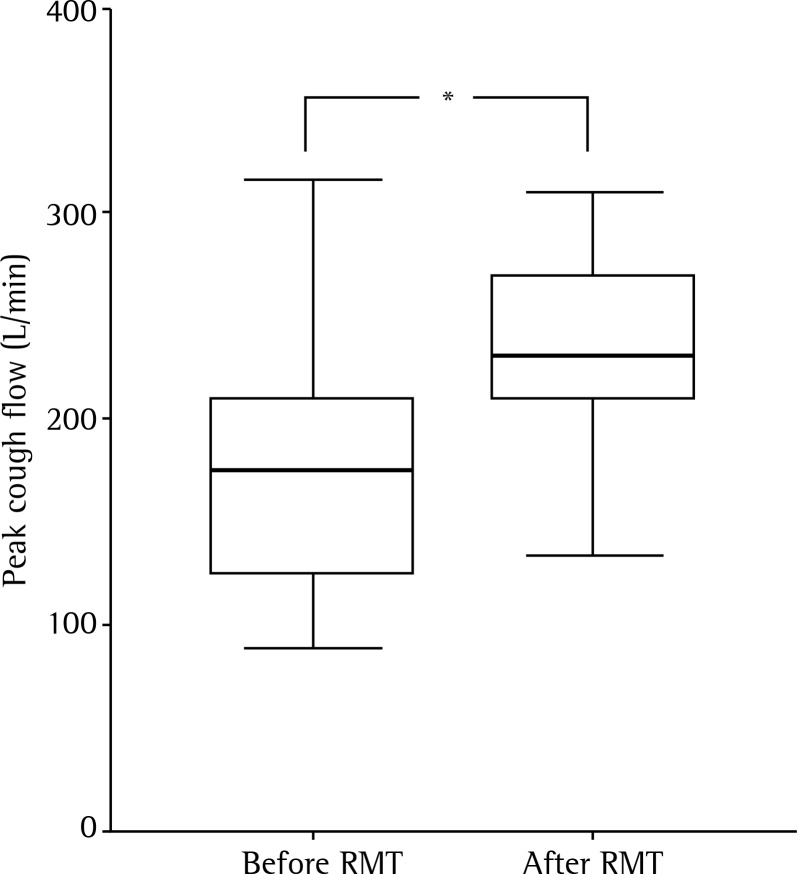
This was a quasi-experimental study involving children and adolescents with CLD or NMD. Before and after 6 months of home-based RMT, we measured respiratory muscle strength (MIP and MEP), PEF, and peak cough flow (PCF). We made statistical comparisons between the pre-RMT and post-RMT values, as well as evaluating the correlation between the duration and effect of RMT.
The study included 29 patients, with a mean age of 12 years (range, 5-17 years), of whom 18 (62.1%) were male. The CLD group comprised 11 patients (37.9%), and the NMD group comprised 18 (62.1%). The mean duration of the RMT was 60 weeks (range, 46-90 weeks) in the CLD group and 39 weeks (range, 24-89 weeks) in the NMD group. In comparison with the pre-RMT values, the post-RMT values for MIP and MEP were significantly higher in both groups, whereas those for PEF and PCF were significantly higher only in the NMD group. We found no correlation between the duration and the effect of RMT.
Home-based RMT appears to be an effective strategy for increasing respiratory muscle strength in children and adolescents with CLD or NMD, although it increased the ability to cough effectively only in those with NMD.
呼吸肌无力是慢性肺病(CLD)的一种功能影响。本研究的目的是评估居家呼吸肌训练(RMT)对患有CLD或神经肌肉疾病(NMD)的儿童和青少年的影响。
这是一项涉及患有CLD或NMD的儿童和青少年的准实验研究。在居家RMT 6个月前后,我们测量了呼吸肌力量(最大吸气压和最大呼气压)、呼气峰流速(PEF)和咳嗽峰流速(PCF)。我们对RMT前和RMT后的数值进行了统计学比较,并评估了RMT的持续时间与效果之间的相关性。
该研究纳入了29例患者,平均年龄12岁(范围5 - 17岁),其中18例(62.1%)为男性。CLD组有11例患者(37.9%),NMD组有18例(62.1%)。CLD组RMT的平均持续时间为60周(范围46 - 90周),NMD组为39周(范围24 - 89周)。与RMT前的数值相比,两组的最大吸气压和最大呼气压在RMT后的数值均显著更高,而呼气峰流速和咳嗽峰流速仅在NMD组显著更高。我们发现RMT的持续时间与效果之间没有相关性。
居家RMT似乎是提高患有CLD或NMD的儿童和青少年呼吸肌力量的有效策略,尽管它仅提高了患有NMD的儿童和青少年有效咳嗽的能力。