Johns Hopkins Center for Communication Programs, Baltimore, MD, USA.
Johns Hopkins Center for Communication Programs, Baltimore, MD, USA
Glob Health Sci Pract. 2014 Dec 10;2(4):427-43. doi: 10.9745/GHSP-D-14-00009.
The Nigerian Urban Reproductive Health Initiative (NURHI), a 6-year comprehensive family planning program (2009-2015) in 4 cities, intentionally applies communication theories to all program elements, not just the demand generation ones, relying mainly on a theory called ideation-the concept that contraceptive use is influenced by people's beliefs, ideas, and feelings and that changing these ideational factors can change people's behavior.
The project used multiple communication channels to foster dialogue about family planning, increase social approval for it, and improve accurate knowledge about contraceptives. Mobile service delivery was started in the third year to improve access to clinical methods in slums.
Data from representative baseline (2010-11) and midterm (2012) surveys of women of reproductive age in the project cities were analyzed. We also used propensity score matching to create a statistically equivalent control group of women not exposed to project activities, and we examined service delivery data from NURHI-supported clinics (January 2011-May 2013) to determine the contribution of mobile services to total family planning services.
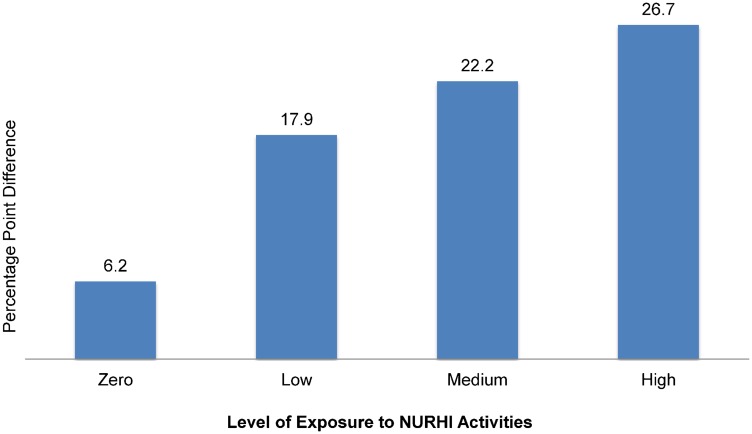
Three years into the initiative, analysis of longitudinal data shows that use of modern contraceptives has increased in each city, varying from 2.3 to 15.5 percentage points, and that the observed increases were predicted by exposure to NURHI activities. Of note is that modern method use increased substantially among the poorest wealth quintiles in project cities, on average, by 8.4 percentage points. The more project activities women were exposed to, the greater their contraceptive use. For example, among women not using a modern method at baseline, contraceptive prevalence among those with no exposure by midterm was 19.1% vs. 43.4% among those with high exposure. Project exposure had a positive dose-response relationship with ideation, as did ideation and contraceptive use. By the end of the observation period, mobile services were contributing nearly 50% of total family planning services provided through NURHI-supported clinics. Propensity score matching found that the increase in contraceptive use in the 4 cities attributable to project exposure was 9.9 percentage points. Intention to use family planning in the next 12 months also increased by 7.5 to 10.2 percentage points across the 4 cities.
Demand-led family planning programs, in which demand generation is the driving force behind the design rather than the conventional, service delivery-oriented approach, may be more suitable in places where expressed demand for contraceptives is low.
尼日利亚城市生殖健康倡议(NURHI)是一个为期 6 年的综合计划生育项目(2009-2015 年),在 4 个城市开展,该项目有意将沟通理论应用于所有项目要素,而不仅仅是需求产生要素,主要依赖于一种名为“理念形成”的理论,即避孕方法的使用受到人们的信仰、观念和感觉的影响,改变这些观念因素可以改变人们的行为。
该项目使用多种沟通渠道来促进有关计划生育的对话,提高对此的社会认可度,并增进对避孕药具的准确了解。在项目开展的第三年,开始提供移动服务,以改善贫民窟获得临床方法的机会。
分析了项目城市中育龄期妇女在项目代表性基线(2010-11 年)和中期(2012 年)调查的数据。我们还使用倾向评分匹配创建了一个统计学等效的对照组,对照组妇女没有接触到项目活动,我们还检查了 NURHI 支持的诊所的服务提供数据(2011 年 1 月至 2013 年 5 月),以确定移动服务对计划生育服务总量的贡献。
在该倡议开展三年后,对纵向数据的分析表明,每个城市的现代避孕方法使用率都有所增加,幅度从 2.3%到 15.5%不等,并且观察到的增加是由接触 NURHI 活动所预测的。值得注意的是,在项目城市中最贫穷的五个财富阶层,现代方法的使用率平均增加了 8.4 个百分点。妇女接触的项目活动越多,其避孕药具的使用率就越高。例如,在基线时没有使用现代方法的妇女中,到中期没有接触项目的妇女的避孕普及率为 19.1%,而接触度高的妇女为 43.4%。项目接触与理念形成呈正剂量反应关系,理念形成与避孕药具使用也是如此。到观察期末,移动服务几乎占 NURHI 支持诊所提供的计划生育服务总量的 50%。倾向评分匹配发现,4 个城市中归因于项目接触的避孕使用率增加了 9.9 个百分点。在未来 12 个月内有计划生育意向的比例也在 4 个城市中增加了 7.5 至 10.2 个百分点。
以需求为导向的计划生育项目,其中需求产生是设计的驱动力,而不是传统的以服务提供为导向的方法,在表达对避孕药具需求较低的地方可能更适用。