Baldassarre Valentina, Cabassi Giovanni, Spadafora Natasha D, Aprile Alessio, Müller Carsten T, Rogers Hilary J, Ferrante Antonio
Department of Agricultural and Environmental Sciences, Università degli Studi di Milano, Via Celoria 2, 20133 Milano, Italy School of Biosciences, Cardiff University, Main Building, Park Place, Cardiff CF10 3AT, UK.
CRA-FLC Fodder and Dairy Productions Research Centre, Via A. Lombardo 11, 26900 Lodi, Italy.
J Exp Bot. 2015 Mar;66(5):1511-26. doi: 10.1093/jxb/eru516. Epub 2015 Jan 22.
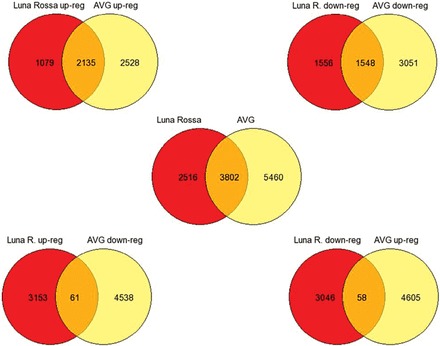
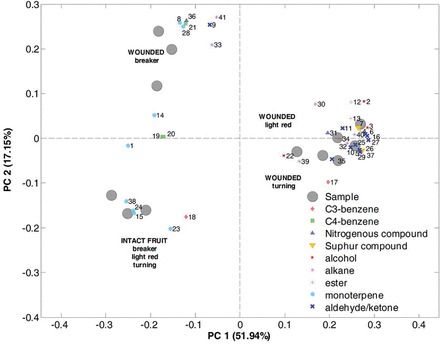
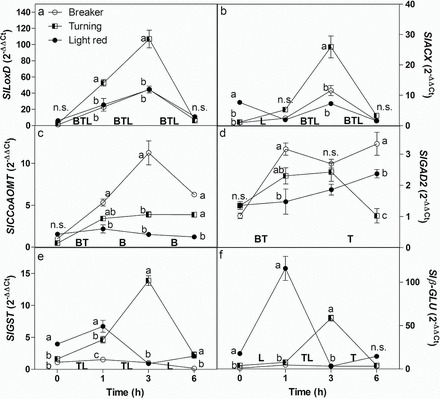
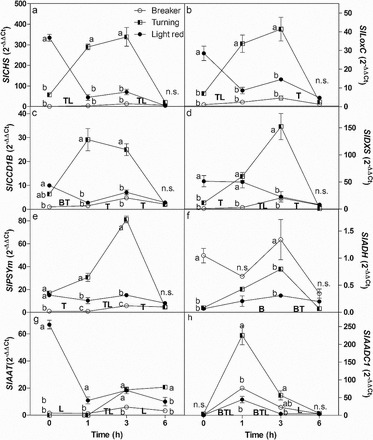
Fleshy fruits develop from an unripe organ that needs to be protected from damage to a ripe organ that attracts frugivores for seed dispersal through production of volatile organic compounds (VOCs). Thus, different responses to wounding damage are predicted. The aim of this study was to discover whether wound-induced changes in the transcriptome and VOC production alter as tomato transitions from unripe to ripe. Transcript changes were analysed 3h post-wounding using microarray analysis in two commercial salad-tomato (Solanum lycopersicum L.) cultivars: Luna Rossa and AVG, chosen for their high aroma production. This was followed by quantitative PCR on Luna Rossa genes involved in VOC biosynthesis and defence responses. VOCs elicited by wounding at different ripening stages were analysed by solid phase micro extraction and gas chromatography-mass spectrometry. Approximately 4000 differentially expressed genes were identified in the cultivar AVG and 2500 in Luna Rossa. In both cultivars the majority of genes were up-regulated and the most affected pathways were metabolism of terpenes, carotenoids, and lipids. Defence-related genes were mostly up-regulated in immature stages of development, whereas expression of genes related to VOCs changed at riper stages. More than 40 VOCs were detected and profiles changed with ripening stage. Thus, both transcriptome and VOC profiles elicited by wounding depend on stage of ripening, indicating a shift from defence to attraction.
肉质果实从不成熟的器官发育而来,这个未成熟器官需要得到保护以免受损伤,之后发育为成熟器官,成熟器官通过产生挥发性有机化合物(VOCs)来吸引食果动物以实现种子传播。因此,可以预测对创伤损伤会有不同的反应。本研究的目的是探究在番茄从不成熟到成熟的转变过程中,创伤诱导的转录组变化和VOCs产生是否会发生改变。在两个商业沙拉番茄(Solanum lycopersicum L.)品种Luna Rossa和AVG中,利用微阵列分析在创伤后3小时分析转录变化,这两个品种因其高香气产量而被选中。随后对Luna Rossa中参与VOC生物合成和防御反应的基因进行定量PCR。通过固相微萃取和气相色谱-质谱联用分析不同成熟阶段创伤引发的VOCs。在AVG品种中鉴定出约4000个差异表达基因,在Luna Rossa品种中鉴定出2500个。在两个品种中,大多数基因上调,受影响最大的途径是萜类、类胡萝卜素和脂质的代谢。与防御相关的基因在发育的未成熟阶段大多上调,而与VOCs相关的基因表达在成熟阶段发生变化。检测到40多种VOCs,其谱图随成熟阶段而变化。因此,创伤引发的转录组和VOC谱图都取决于成熟阶段,表明从防御向吸引的转变。