Marioni Riccardo E, Shah Sonia, McRae Allan F, Ritchie Stuart J, Muniz-Terrera Graciela, Harris Sarah E, Gibson Jude, Redmond Paul, Cox Simon R, Pattie Alison, Corley Janie, Taylor Adele, Murphy Lee, Starr John M, Horvath Steve, Visscher Peter M, Wray Naomi R, Deary Ian J
Centre for Cognitive Ageing and Cognitive Epidemiology, and Centre for Genomic and Experimental Medicine, University of Edinburgh, Edinburgh, UK, Queensland Brain Institute, and.
Queensland Brain Institute, and Translational Research Institute, University of Queensland, Brisbane, QLD, Australia.
Int J Epidemiol. 2015 Aug;44(4):1388-96. doi: 10.1093/ije/dyu277. Epub 2015 Jan 22.
The DNA methylation-based 'epigenetic clock' correlates strongly with chronological age, but it is currently unclear what drives individual differences. We examine cross-sectional and longitudinal associations between the epigenetic clock and four mortality-linked markers of physical and mental fitness: lung function, walking speed, grip strength and cognitive ability.
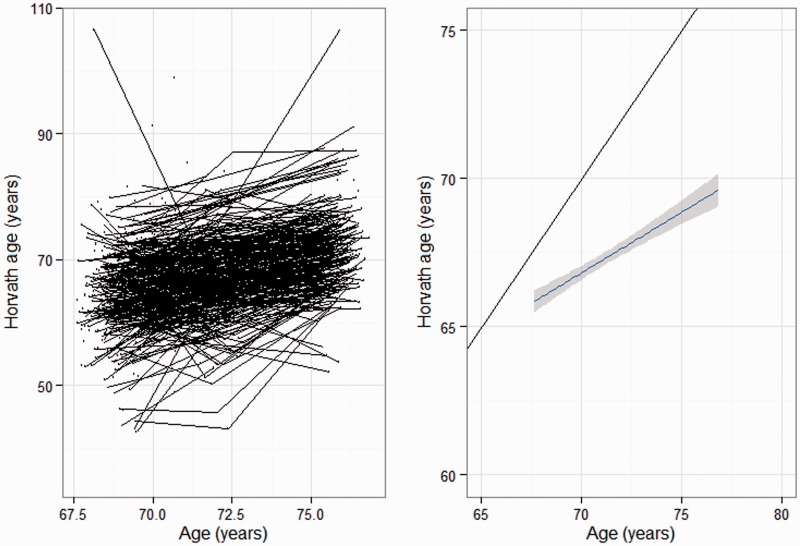
DNA methylation-based age acceleration (residuals of the epigenetic clock estimate regressed on chronological age) were estimated in the Lothian Birth Cohort 1936 at ages 70 (n = 920), 73 (n = 299) and 76 (n = 273) years. General cognitive ability, walking speed, lung function and grip strength were measured concurrently. Cross-sectional correlations between age acceleration and the fitness variables were calculated. Longitudinal change in the epigenetic clock estimates and the fitness variables were assessed via linear mixed models and latent growth curves. Epigenetic age acceleration at age 70 was used as a predictor of longitudinal change in fitness. Epigenome-wide association studies (EWASs) were conducted on the four fitness measures.
Cross-sectional correlations were significant between greater age acceleration and poorer performance on the lung function, cognition and grip strength measures (r range: -0.07 to -0.05, P range: 9.7 x 10(-3) to 0.024). All of the fitness variables declined over time but age acceleration did not correlate with subsequent change over 6 years. There were no EWAS hits for the fitness traits.
Markers of physical and mental fitness are associated with the epigenetic clock (lower abilities associated with age acceleration). However, age acceleration does not associate with decline in these measures, at least over a relatively short follow-up.
基于DNA甲基化的“表观遗传时钟”与实际年龄密切相关,但目前尚不清楚是什么导致了个体差异。我们研究了表观遗传时钟与身体和心理健康的四个与死亡率相关的指标之间的横断面和纵向关联:肺功能、步行速度、握力和认知能力。
在1936年洛锡安出生队列中,分别在70岁(n = 920)、73岁(n = 299)和76岁(n = 273)时估计基于DNA甲基化的年龄加速(表观遗传时钟估计值在实际年龄上的回归残差)。同时测量一般认知能力、步行速度、肺功能和握力。计算年龄加速与健康变量之间的横断面相关性。通过线性混合模型和潜在增长曲线评估表观遗传时钟估计值和健康变量的纵向变化。将70岁时的表观遗传年龄加速用作健康状况纵向变化的预测指标。对这四项健康指标进行全表观基因组关联研究(EWAS)。
年龄加速越大与肺功能、认知和握力测量表现越差之间的横断面相关性显著(r范围:-0.07至-0.05,P范围:9.7×10⁻³至0.024)。所有健康变量均随时间下降,但年龄加速与随后6年的变化无关。对于健康特征,没有EWAS发现。
身体和心理健康指标与表观遗传时钟相关(能力较低与年龄加速相关)。然而,至少在相对较短的随访期内,年龄加速与这些指标的下降无关。