Rouet François, Deleplancque Luc, Mboumba Berthold Bivigou, Sica Jeanne, Mouinga-Ondémé Augustin, Liégeois Florian, Goudeau Alain, Dubois Frédéric, Gaudy-Graffin Catherine
Laboratoire de Rétrovirologie, Centre International de Recherches Médicales de Franceville (CIRMF), Franceville, Gabon.
Centre de Traitement Ambulatoire (CTA), Franceville, Gabon.
PLoS One. 2015 Jan 24;10(1):e0116975. doi: 10.1371/journal.pone.0116975. eCollection 2015.
BACKGROUND/OBJECTIVES: Guidelines for optimized HCV screening are urgently required in Africa, especially for patients infected with HIV, who sometimes show false positive or false negative reactivity in anti-HCV antibody assays. Here, we assessed the usefulness of a fourth-generation HCV Ag-Ab ELISA for the identification of active HCV infection in HIV-positive patients.
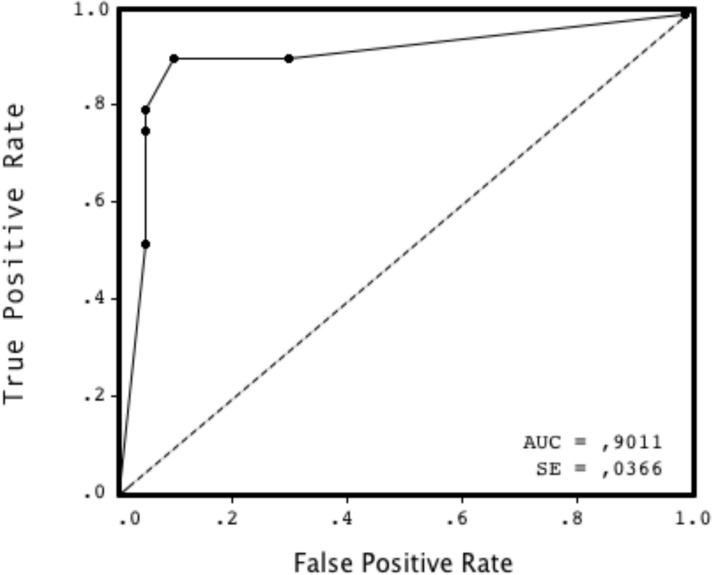
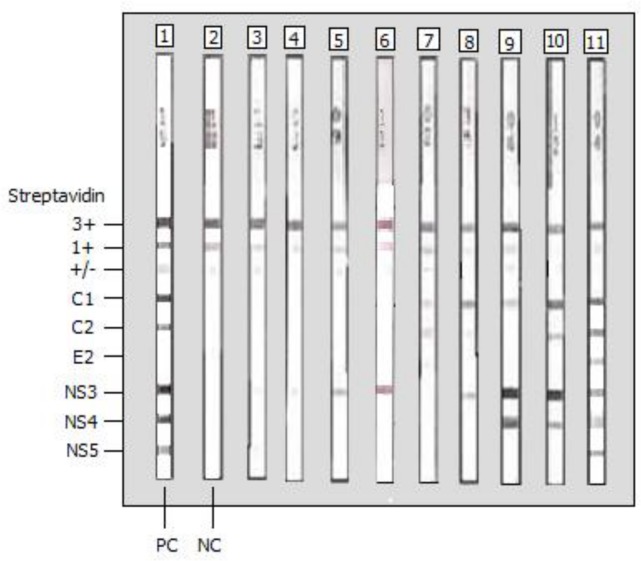
This cross-sectional study was conducted between 03/2010 and 01/2013 and included 762 Gabonese HIV-positive adult patients. The results of ELISA (Monolisa HCV Ag-Ab ULTRA, Bio-Rad) were compared with those obtained by RT-PCR (gold standard). The optimal ELISA signal-to-cutoff (S/CO) ratio to identify patients with active hepatitis C (positive HCV RNA) was determined. Specimens were further tested by the INNO-LIA HCV Score assay (Innogenetics) and the Architect HCV Ag kit (Abbott) to define the best diagnostic strategy.
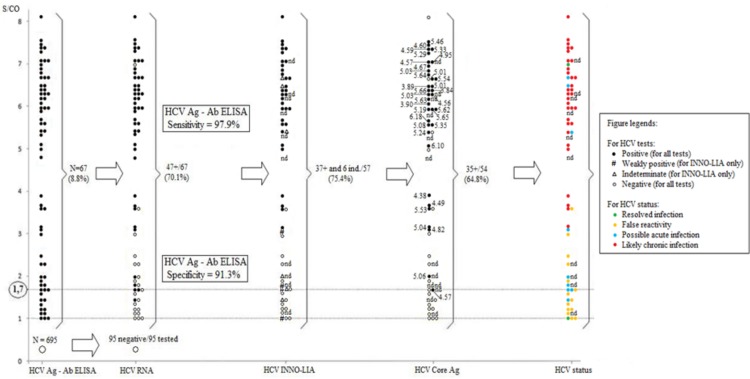
Sixty-seven patients tested positive for HCV (S/CO ratio ≥ 1) by ELISA. Of these, 47 (70.1%) tested positive for HCV RNA. The optimal S/CO associated with active HCV infection was 1.7. At this threshold, the sensitivity of ELISA was 97.9% (95% confidence interval (CI) 90.0-99.9%), its specificity was 91.3% (95% CI 85.0-95.5%), and HCV seroprevalence rate was 7.3% (56/762) (95% CI 5.6-9.4%). Among 57 HCV-seropositive patients with available INNO-LIA results, false reactivity was identified in 14 (24.6%), resolved HCV infection in two (3.5%), possible acute HCV infections in nine (15.8%) and likely chronic HCV infections in 32 (56.1%) patients. HCV core Ag was undetectable in 14/15 (93.3%) specimens that tested negative for HCV RNA whereas it was quantified in 34 (out of 39, 87.2%) samples that tested positive for HCV RNA.
Our study provides comprehensive guidance for HCV testing in Gabon, and will help greatly clinicians to improve case definitions for both the notification and surveillance of HCV in patients co-infected with HIV.
背景/目的:非洲迫切需要优化丙型肝炎病毒(HCV)筛查指南,尤其是针对感染人类免疫缺陷病毒(HIV)的患者,这些患者在抗HCV抗体检测中有时会出现假阳性或假阴性反应。在此,我们评估了第四代HCV抗原-抗体酶联免疫吸附测定(ELISA)在识别HIV阳性患者活动性HCV感染方面的效用。
这项横断面研究于2010年3月至2013年1月进行,纳入了762名加蓬HIV阳性成年患者。将ELISA(伯乐公司的Monolisa HCV Ag-Ab ULTRA)结果与逆转录聚合酶链反应(RT-PCR,金标准)结果进行比较。确定用于识别丙型肝炎活动性患者(HCV RNA阳性)的最佳ELISA信号与临界值(S/CO)比值。通过INNO-LIA HCV Score检测(Innogenetics公司)和Architect HCV Ag检测试剂盒(雅培公司)对样本进行进一步检测,以确定最佳诊断策略。
67名患者ELISA检测HCV呈阳性(S/CO比值≥1)。其中,47名(70.1%)HCV RNA检测呈阳性。与活动性HCV感染相关的最佳S/CO值为1.�。在此阈值下,ELISA的敏感性为97.9%(95%置信区间(CI)90.0 - 99.9%),特异性为91.3%(95%CI 85.0 - 95.5%),HCV血清阳性率为7.3%(56/762)(95%CI 5.6 - 9.4%)。在57名有INNO-LIA检测结果的HCV血清阳性患者中,14名(24.6%)发现有假反应性,2名(3.5%)为已清除的HCV感染,9名(15.8%)可能为急性HCV感染,32名(56.1%)可能为慢性HCV感染。14/15(93.3%)份HCV RNA检测阴性的样本中未检测到HCV核心抗原,而39份HCV RNA检测阳性的样本中有34份(87.2%)检测到了HCV核心抗原的定量结果。
我们的研究为加蓬的HCV检测提供了全面指导,将极大地帮助临床医生改进对HIV合并感染患者中HCV报告和监测的病例定义。