Ocama P, Ssekitoleko R, Nankya-Mutyoba J, Apica B, Otekat G, Seremba E
School of Medicine, Makerere University College of Health Sciences, Kampala, Uganda.
School of Public Health, Makerere University College of Health Sciences, Kampala, Uganda.
Afr Health Sci. 2024 Sep;24(3):41-46. doi: 10.4314/ahs.v24i3.6.
Successful elimination of hepatitis as a public health threat by 2030 will partly rely on the availability and accessibility of affordable accurate disease testing platforms. In the past, testing of hepatitis C virus (HCV) in low resource settings of sub-Saharan Africa (SSA) has relied on anti-HCV testing using rapid diagnostic tests, chemiluminescent microparticle immunoassay (CMIA) and Enzyme-linked Immunosorbent Assays (ELISA) whose diagnostic accuracy has been sub-optimal. We determined the false positivity rate of a CMIA platform that is routinely used to screen donor blood for anti-HCV in Uganda.
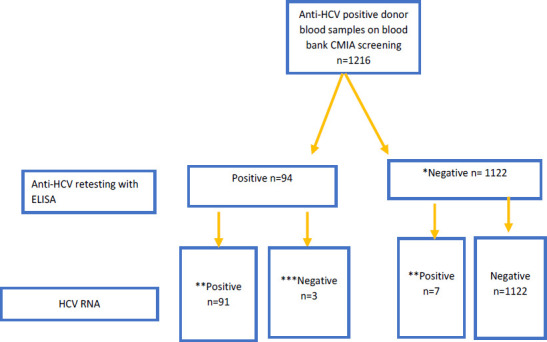
1,216 CMIA-screened anti-HCV-positive blood donor samples at four regional Ugandan blood banks, were subjected to a third generation ELISA and subsequently to nucleic acid testing (NAT).
Of the above 1,216 samples, 1,122 (92.2%) were negative on ELISA and thus deemed false positives. Active infection (NAT positive) was detected in 98 (8.0%). Presumed resolved infection was recorded among 3 (3.2%) of participants that remained positive on the ELISA platform but negative on NAT.
The Architect CMIA assay exhibited very low specificity for anti-HCV testing. In this context, this finding may suggest need to employ testing protocols that include NAT or a combination of tests with higher validity.
到2030年成功消除肝炎这一公共卫生威胁将部分取决于能否获得并使用价格可承受的准确疾病检测平台。过去,在撒哈拉以南非洲(SSA)资源匮乏地区进行丙型肝炎病毒(HCV)检测一直依赖于使用快速诊断检测、化学发光微粒子免疫分析(CMIA)和酶联免疫吸附测定(ELISA)进行抗HCV检测,但其诊断准确性并不理想。我们测定了乌干达一个常用于筛查献血者血液中抗HCV的CMIA平台的假阳性率。
乌干达四个地区血库的1216份经CMIA筛查抗HCV呈阳性的献血者样本,先进行第三代ELISA检测,随后进行核酸检测(NAT)。
在上述1216份样本中,1122份(92.2%)ELISA检测呈阴性,因此被视为假阳性。98份(8.0%)检测到活动性感染(NAT呈阳性)。在ELISA平台上仍呈阳性但NAT呈阴性的3名(3.2%)参与者中记录到疑似已治愈感染。
Architect CMIA检测在抗HCV检测中表现出非常低的特异性。在这种情况下,这一发现可能表明需要采用包括NAT或有效性更高的检测组合的检测方案。