Stein Andrew P, Swick Adam D, Smith Molly A, Blitzer Grace C, Yang Robert Z, Saha Sandeep, Harari Paul M, Lambert Paul F, Liu Cheng Z, Kimple Randall J
Department of Human Oncology, University of Wisconsin School of Medicine and Public Health, Madison, Wisconsin, 53706.
Department of Biostatistics, University of Wisconsin School of Medicine and Public Health, Madison, Wisconsin, 53706.
Cancer Med. 2015 May;4(5):699-712. doi: 10.1002/cam4.387. Epub 2015 Jan 26.
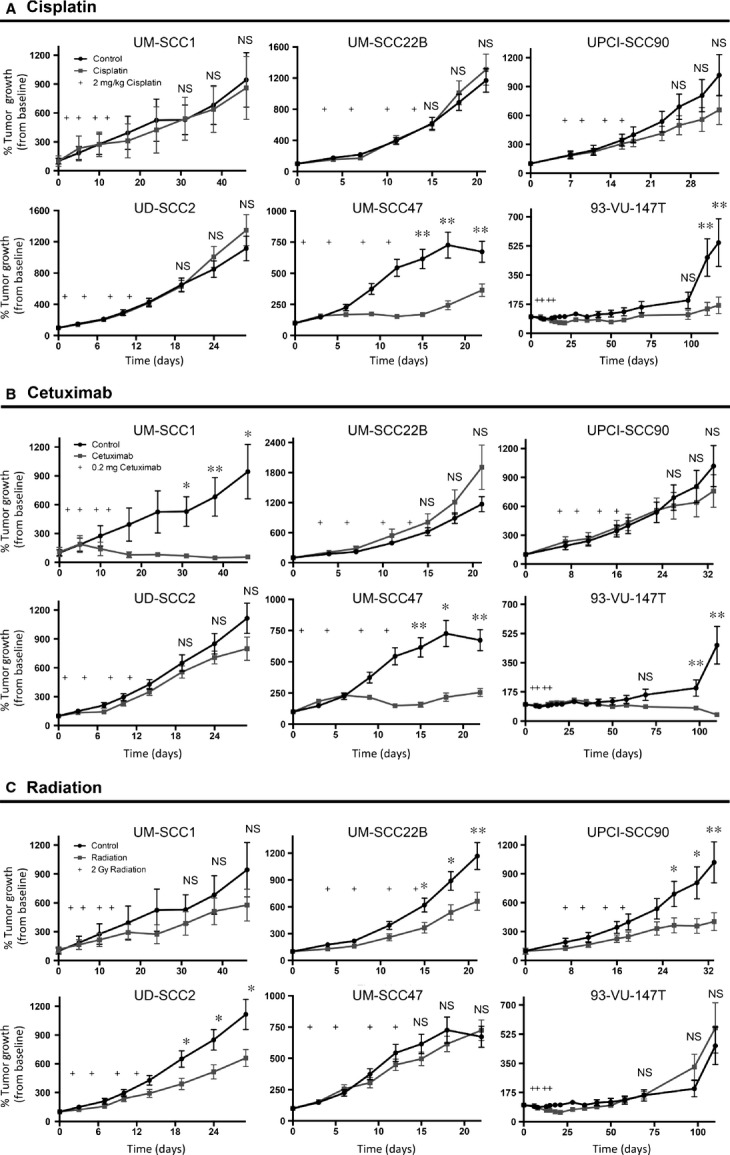
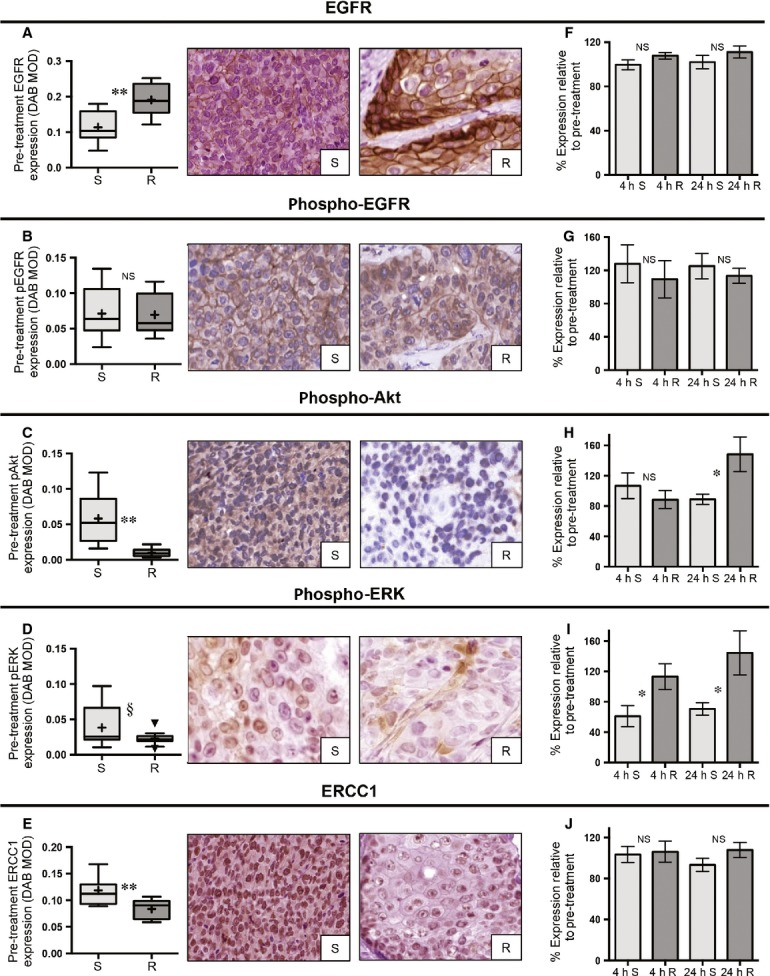
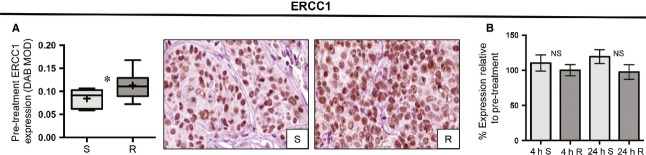
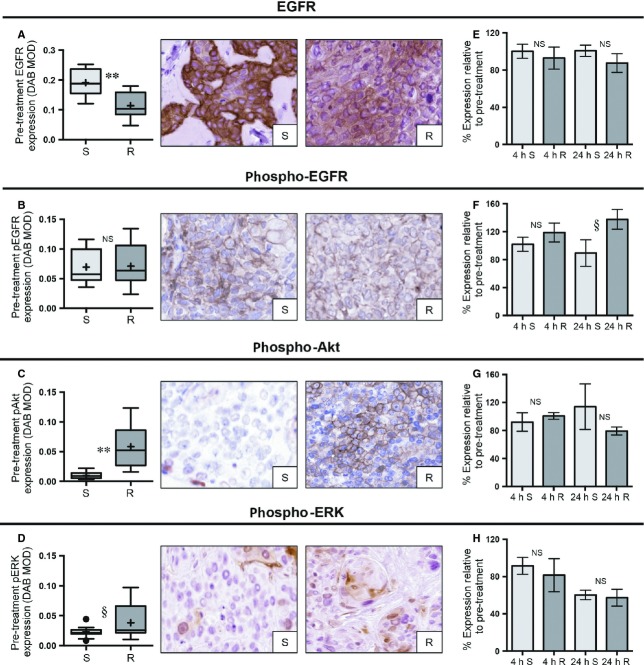
Head and neck squamous cell carcinoma (HNSCC) remains a challenging cancer to treat with overall 5-year survival on the order of 50-60%. Therefore, predictive biomarkers for this disease would be valuable to provide more effective and individualized therapeutic approaches for these patients. While prognostic biomarkers such as p16 expression correlate with outcome; to date, no predictive biomarkers have been clinically validated for HNSCC. We generated xenografts in immunocompromised mice from six established HNSCC cell lines and evaluated response to cisplatin, cetuximab, and radiation. Tissue microarrays were constructed from pre- and posttreatment tumor samples derived from each xenograft experiment. Quantitative immunohistochemistry was performed using a semiautomated imaging and analysis platform to determine the relative expression of five potential predictive biomarkers: epidermal growth factor receptor (EGFR), phospho-EGFR, phospho-Akt, phospho-ERK, and excision repair cross-complementation group 1 (ERCC1). Biomarker levels were compared between xenografts that were sensitive versus resistant to a specific therapy utilizing a two-sample t-test with equal standard deviations. Indeed the xenografts displayed heterogeneous responses to each treatment, and we linked a number of baseline biomarker levels to response. This included low ERCC1 being associated with cisplatin sensitivity, low phospho-Akt correlated with cetuximab sensitivity, and high total EGFR was related to radiation resistance. Overall, we developed a systematic approach to identifying predictive biomarkers and demonstrated several connections between biomarker levels and treatment response. Despite these promising initial results, this work requires additional preclinical validation, likely involving the use of patient-derived xenografts, prior to moving into the clinical realm for confirmation among patients with HNSCC.
头颈部鳞状细胞癌(HNSCC)仍然是一种难以治疗的癌症,其总体5年生存率约为50%-60%。因此,针对这种疾病的预测性生物标志物对于为这些患者提供更有效和个性化的治疗方法将具有重要价值。虽然诸如p16表达等预后生物标志物与预后相关;但迄今为止,尚无针对HNSCC的预测性生物标志物在临床上得到验证。我们从六个已建立的HNSCC细胞系在免疫缺陷小鼠中生成异种移植瘤,并评估其对顺铂、西妥昔单抗和放疗的反应。组织微阵列由每个异种移植实验的治疗前和治疗后肿瘤样本构建而成。使用半自动成像和分析平台进行定量免疫组织化学,以确定五种潜在预测性生物标志物的相对表达:表皮生长因子受体(EGFR)、磷酸化EGFR、磷酸化Akt、磷酸化ERK和切除修复交叉互补组1(ERCC1)。利用具有相等标准差的双样本t检验,比较对特定疗法敏感与耐药的异种移植瘤之间的生物标志物水平。事实上,异种移植瘤对每种治疗均表现出异质性反应,并且我们将一些基线生物标志物水平与反应联系起来。这包括低ERCC1与顺铂敏感性相关,低磷酸化Akt与西妥昔单抗敏感性相关,以及高总EGFR与放疗耐药相关。总体而言,我们开发了一种系统方法来识别预测性生物标志物,并证明了生物标志物水平与治疗反应之间的几种关联。尽管这些初步结果很有前景,但在进入临床领域以在HNSCC患者中进行确认之前,这项工作需要额外的临床前验证,可能涉及使用患者来源的异种移植瘤。