Ashley-Martin Jillian, Dodds Linda, Arbuckle Tye E, Levy Adrian R, Platt Robert W, Marshall Jean S
Interdisciplinary PhD Program, Dalhousie University, Halifax, NS, Canada.
Pediatr Allergy Immunol. 2015 Mar;26(2):161-7. doi: 10.1111/pai.12340. Epub 2015 Feb 18.
The fetal immune system is a critical window of development. The epithelial cell-derived cytokines, thymic stromal lymphopoietin (TSLP), and interleukin-33 (IL-33) have received attention for their role in allergic responses but not been studied during this critical window. The objectives were to assess correlations among IL-33, TSLP, and IgE in umbilical cord blood samples and identify prenatal predictors of these biomarkers.
This study utilized data and banked cord blood collected in the Maternal-Infant Research on Environmental Chemicals (MIREC) Study, a trans-Canada cohort study of 2001 pregnant women. Our analytic sample comprised the 1254 women with a singleton, term birth with a cord blood sample. Spearman correlation coefficients (SCC) and logistic regression models were used to examine associations between biomarkers and identify potential predictors of elevated biomarker levels.
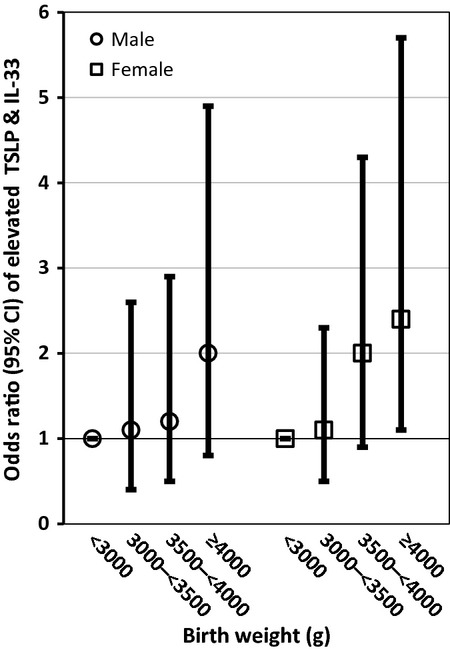
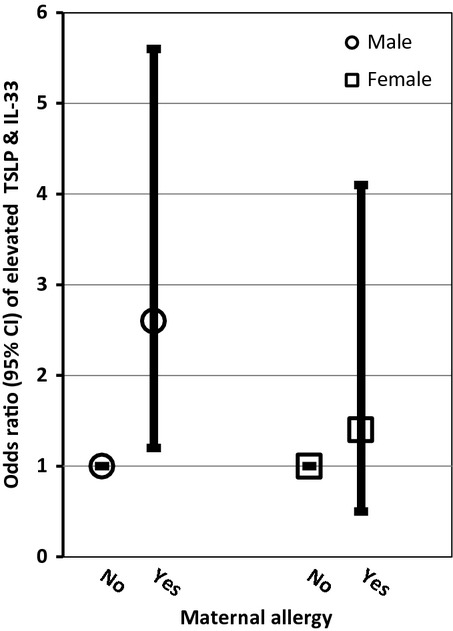
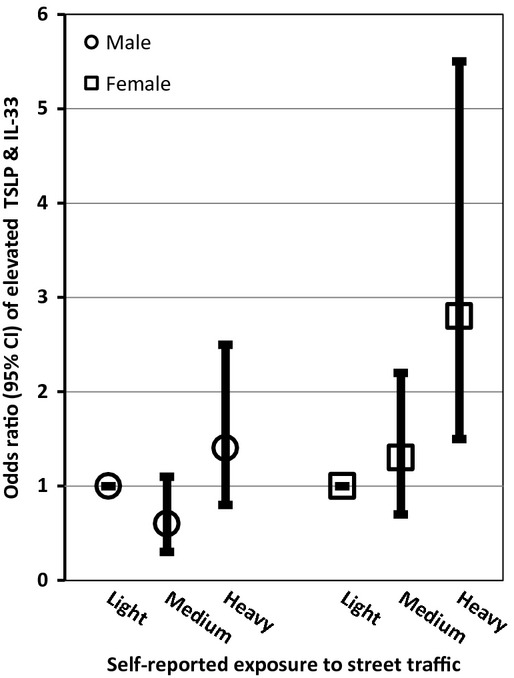
Thymic stromal lymphopoietin and IL-33 were more strongly correlated with each other (SCC = 0.75, p < 0.0001) than with IgE (IL-33 SCC = 0.14, TSLP SCC = 0.21). Maternal allergy, heavy street traffic, and elevated birth weight were significantly associated with jointly elevated TSLP and IL-33 levels, whereas maternal age and female infant sex were inversely associated with elevated IgE.
In this population of Canadian women and infants, TSLP and IL-33 were detectable in cord blood, more strongly correlated with each other than with IgE, and associated with maternal characteristics indicative of inflammatory responses. This study motivates investigation into the value of cord blood IL-33 and TSLP levels as childhood allergy predictors and raises interesting questions regarding in utero coordinated regulation of these cytokines.
胎儿免疫系统是发育的关键时期。上皮细胞衍生的细胞因子,胸腺基质淋巴细胞生成素(TSLP)和白细胞介素-33(IL-33)因其在过敏反应中的作用而受到关注,但在这个关键时期尚未得到研究。目的是评估脐带血样本中IL-33、TSLP和IgE之间的相关性,并确定这些生物标志物的产前预测指标。
本研究利用了母婴环境化学物质研究(MIREC)中收集的数据和储存的脐带血,这是一项对2001名孕妇进行的跨加拿大队列研究。我们的分析样本包括1254名单胎足月分娩且有脐带血样本的妇女。使用Spearman相关系数(SCC)和逻辑回归模型来检验生物标志物之间的关联,并确定生物标志物水平升高的潜在预测指标。
胸腺基质淋巴细胞生成素和IL-33之间的相关性(SCC = 0.75,p < 0.0001)比它们与IgE的相关性更强(IL-33 SCC = 0.14,TSLP SCC = 0.21)。母亲过敏、繁忙的街道交通和出生体重增加与TSLP和IL-33水平共同升高显著相关,而母亲年龄和女婴性别与IgE升高呈负相关。
在这个加拿大妇女和婴儿群体中,脐带血中可检测到TSLP和IL-33,它们之间的相关性比与IgE的相关性更强,并且与表明炎症反应的母亲特征相关。这项研究促使人们对脐带血IL-33和TSLP水平作为儿童过敏预测指标的价值进行研究,并提出了关于这些细胞因子在子宫内协同调节的有趣问题。