Cary Miranda Ashley, Gyurcsik Nancy C, Brawley Lawrence R
Pain Res Manag. 2015 Mar-Apr;20(2):67-74. doi: 10.1155/2015/853961. Epub 2015 Jan 26.
Exercising for ≥ 150 min/week is a recommended strategy for self-managing arthritis. However, exercise nonadherence is a problem. Arthritis pain anxiety may interfere with regular exercise. According to the fear-avoidance model, individuals may confront their pain anxiety by using adaptive self-regulatory responses (eg, changing exercise type or duration). Furthermore, the anxiety-self-regulatory responses relationship may vary as a function of individuals' pain acceptance levels.
To investigate pain acceptance as a moderator of the pain anxiety-adaptive self-regulatory responses relationship. The secondary objective was to examine whether groups of patients who differed in meeting exercise recommendations also differed in pain-related and self-regulatory responses.
Adults (mean [± SD] age 49.75 ± 13.88 years) with medically diagnosed arthritis completed online measures of arthritis pain-related variables and self-regulatory responses at baseline, and exercise participation two weeks later. Individuals meeting (n=87) and not meeting (n=49) exercise recommendations were identified.
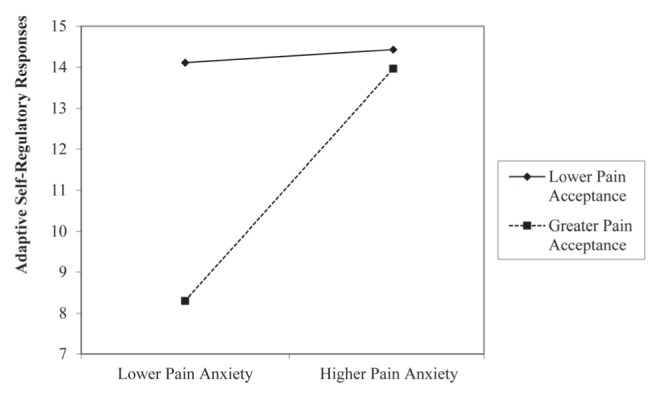
Hierarchical multiple regression analysis revealed that pain acceptance moderated the anxiety-adaptive self-regulatory responses relationship. When pain anxiety was lower, greater pain acceptance was associated with less frequent use of adaptive responses. When anxiety was higher, adaptive responses were used regardless of pain acceptance level. MANOVA findings revealed that participants meeting the recommended exercise dose reported significantly lower pain and pain anxiety, and greater pain acceptance (P<0.05) than those not meeting the dose.
Greater pain acceptance may help individuals to focus their efforts to adapt to their pain anxiety only when it is higher, leaving self-regulatory capacity to cope with additional challenges to exercise adherence (eg, busy schedule).
每周锻炼≥150分钟是推荐的关节炎自我管理策略。然而,运动不依从是个问题。关节炎疼痛焦虑可能会干扰规律运动。根据恐惧回避模型,个体可以通过使用适应性自我调节反应(如改变运动类型或时长)来应对疼痛焦虑。此外,焦虑与自我调节反应之间的关系可能会因个体的疼痛接受程度而有所不同。
研究疼痛接受程度作为疼痛焦虑与适应性自我调节反应关系的调节因素。次要目的是检验在达到运动建议方面存在差异的患者组在疼痛相关反应和自我调节反应方面是否也存在差异。
医学诊断为关节炎的成年人(平均[±标准差]年龄49.75±13.88岁)在基线时完成了关节炎疼痛相关变量和自我调节反应的在线测量,并在两周后报告了运动参与情况。确定了达到(n = 87)和未达到(n = 49)运动建议的个体。
分层多元回归分析显示,疼痛接受程度调节了焦虑与适应性自我调节反应之间的关系。当疼痛焦虑较低时,更高的疼痛接受程度与适应性反应使用频率较低相关。当焦虑较高时,无论疼痛接受程度如何都会使用适应性反应。多变量方差分析结果显示,达到推荐运动剂量的参与者报告的疼痛和疼痛焦虑显著低于未达到剂量的参与者,且疼痛接受程度更高(P<0.05)。
只有当疼痛焦虑较高时,更高的疼痛接受程度才可能帮助个体集中精力适应疼痛焦虑,从而保留自我调节能力以应对运动依从性的其他挑战(如日程繁忙)。