Huang Feng-Yun J, Lee Te-Wei, Chang Chih-Hsien, Chen Liang-Cheng, Hsu Wei-Hsin, Chang Chien-Wen, Lo Jem-Mau
Department of Biomedical Engineering and Environmental Sciences, National Tsing Hua University, Hsinchu, Taiwan.
Institute of Nuclear Energy Research, Longtan, Taiwan.
Int J Nanomedicine. 2015 Jan 9;10:463-73. doi: 10.2147/IJN.S75955. eCollection 2015.
In this study, the (188)Re-labeled PEGylated nanoliposome ((188)Re-liposome) was prepared and evaluated as a therapeutic agent for glioma.
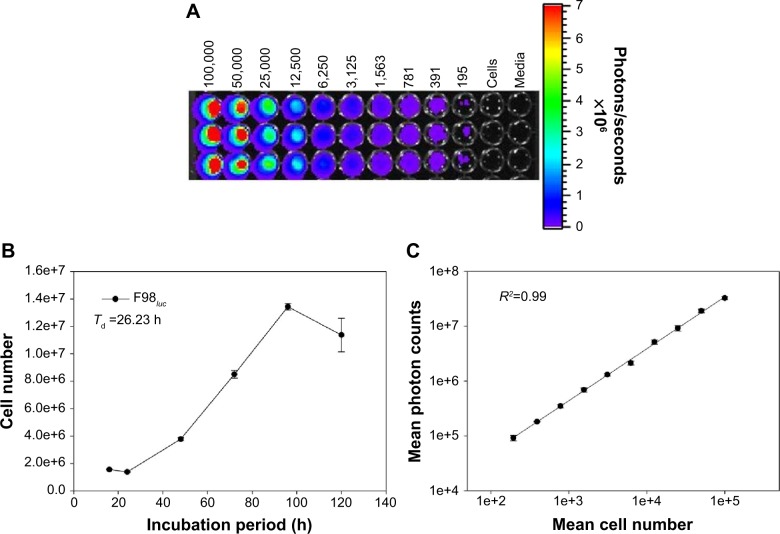
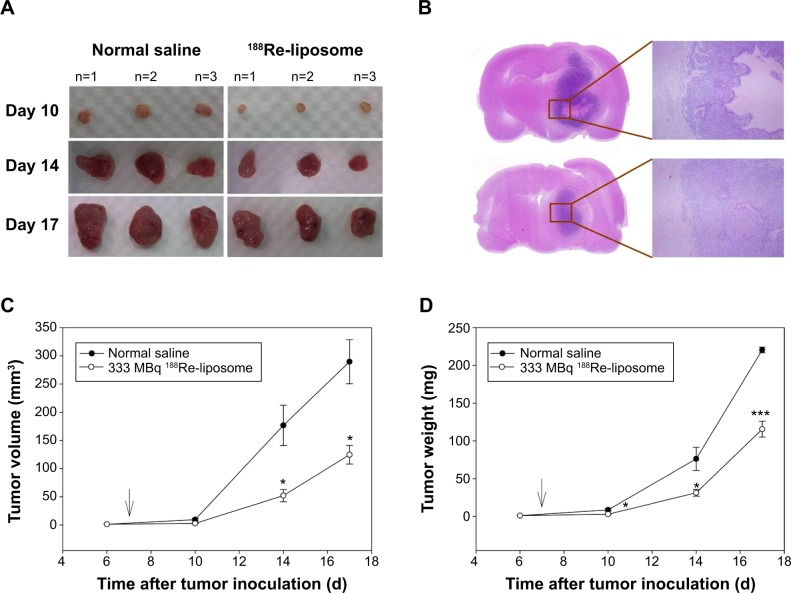
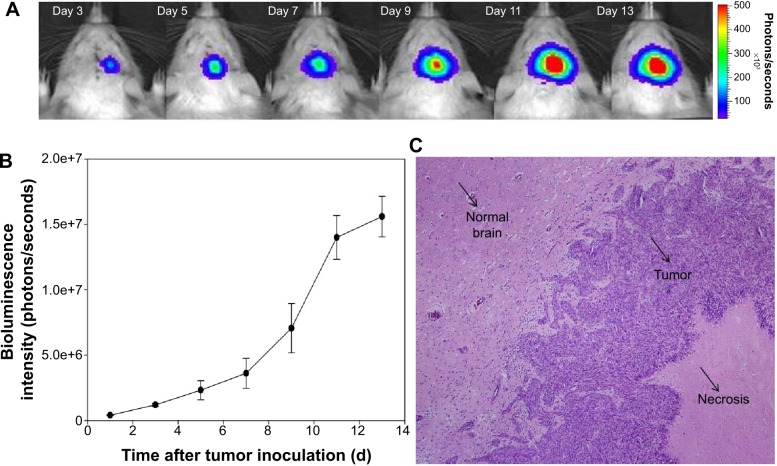
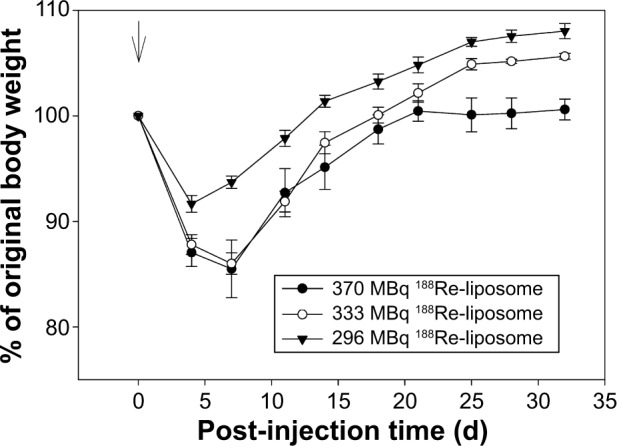
The reporter cell line, F98(luc) was prepared via Lentivector expression kit system and used to set up the orthotopic glioma-bearing rat model for non-invasive bioluminescent imaging. The maximum tolerated dose applicable in Fischer344 rats was explored via body weight monitoring of the rats after single intravenous injection of (188)Re-liposome with varying dosages before the treatment study. The OLINDA/EXM 1.1 software was utilized for estimating the radiation dosimetry. To assess the therapeutic efficacy, tumor-bearing rats were intravenously administered (188)Re-liposome or normal saline followed by monitoring of the tumor growth and animal survival time. In addition, the histopathological examinations of tumors were conducted on the (188)Re-liposome-treated rats.
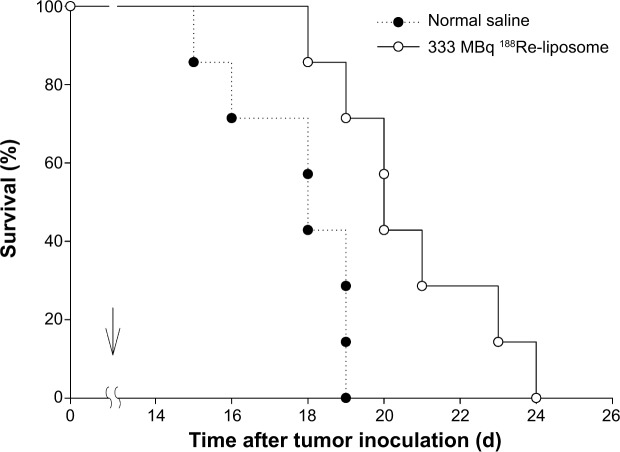
By using bioluminescent imaging, the well-established reporter cell line (F98(luc)) showed a high relationship between cell number and its bioluminescent intensity (R(2)=0.99) in vitro; furthermore, it could also provide clear tumor imaging for monitoring tumor growth in vivo. The maximum tolerated dose of (188)Re-liposome in Fischer344 rats was estimated to be 333 MBq. According to the dosimetry results, higher equivalent doses were observed in spleen and kidneys while very less were in normal brain, red marrow, and thyroid. For therapeutic efficacy study, the progression of tumor growth in terms of tumor volume and/or tumor weight was significantly slower for the (188)Re-liposome-treated group than the control group (P<0.05). As a result, the lifespan of glioma-bearing rats treated with (188)Re-liposome was prolonged 10.67% compared to the control group.
The radiotherapeutic evaluation by dosimetry and survival studies have demonstrated that passive targeting (188)Re-liposome via systemic administration can significantly prolong the lifespan of orthotopic glioma-bearing rats while maintaining reasonable systemic radiation safety. Therefore, (188)Re-liposome could be a potential therapeutic agent for glioblastoma multiforme treatment.
在本研究中,制备了(188)Re标记的聚乙二醇化纳米脂质体((188)Re-脂质体)并将其评估为神经胶质瘤的治疗剂。
通过慢病毒载体表达试剂盒系统制备报告细胞系F98(luc),并用于建立用于非侵入性生物发光成像的原位荷神经胶质瘤大鼠模型。在治疗研究之前,通过单次静脉注射不同剂量的(188)Re-脂质体后监测大鼠体重,探索Fischer344大鼠适用的最大耐受剂量。利用OLINDA/EXM 1.1软件估算辐射剂量学。为了评估治疗效果,对荷瘤大鼠静脉注射(188)Re-脂质体或生理盐水,然后监测肿瘤生长和动物存活时间。此外,对接受(188)Re-脂质体治疗的大鼠进行肿瘤的组织病理学检查。
通过生物发光成像,成熟的报告细胞系(F98(luc))在体外显示细胞数量与其生物发光强度之间具有高度相关性(R(2)=0.99);此外,它还可以为监测体内肿瘤生长提供清晰的肿瘤成像。Fischer344大鼠中(188)Re-脂质体的最大耐受剂量估计为333 MBq。根据剂量学结果,脾脏和肾脏中观察到较高的等效剂量,而正常脑、红骨髓和甲状腺中的等效剂量非常低。对于治疗效果研究,(188)Re-脂质体治疗组的肿瘤体积和/或肿瘤重量方面的肿瘤生长进展明显慢于对照组(P<0.05)。结果,与对照组相比,用(188)Re-脂质体治疗的荷神经胶质瘤大鼠的寿命延长了10.67%。
通过剂量学和生存研究进行的放射治疗评估表明,通过全身给药的被动靶向(188)Re-脂质体可以显著延长原位荷神经胶质瘤大鼠的寿命,同时保持合理的全身辐射安全性。因此,(188)Re-脂质体可能是多形性胶质母细胞瘤治疗的潜在治疗剂。