Thaler John D, Achari Yamini, Lu Ting, Shrive Nigel G, Hart David A
McCaig Institute for Bone and Joint Health, University of Calgary, 3330 Hospital Drive NW, Calgary T2N 4 N1, AB, Canada.
McCaig Institute for Bone and Joint Health, University of Calgary, 3330 Hospital Drive NW, Calgary T2N 4 N1, AB, Canada ; Schulich School of Engineering, University of Calgary, 2500 University Drive NW, Calgary T2N 1 N4, AB, Canada.
Biol Sex Differ. 2014 Sep 27;5:14. doi: 10.1186/s13293-014-0014-6. eCollection 2014.
Joint diseases such as osteoarthritis (OA) predominantly afflict post-menopausal women, suggesting a pertinent role for female hormones. Estrogen receptor beta (ER-β) has been detected in connective tissues of the knee joint suggesting that these tissues are responsive to the hormone estrogen. Matrix metalloproteinase-1 (MMP-1) activity contributes to cartilage degradation, a key factor leading to OA development in synovial joints. Two polymorphic forms of MMP-1 exist due to a deletion/insertion of the guanine residue in the promoter, and the 2G allelic variant of MMP-1 exhibits more activity than the 1G allele. Previous studies have demonstrated that the polymorphic forms of the human MMP-1 are influenced by the modulating effects of estrogen receptor isoforms. In addition to hormonal influences, physiological factors such as altered mechanical loading are also contributory features of OA. In the present study, the combined influence of biomechanical and hormonal variables on the activity of MMP-1 isoforms was evaluated. We hypothesized that the combined effects of ER-β and sheer stress will differentially activate the two allelic forms of MMP-1 in a hormone-independent manner.
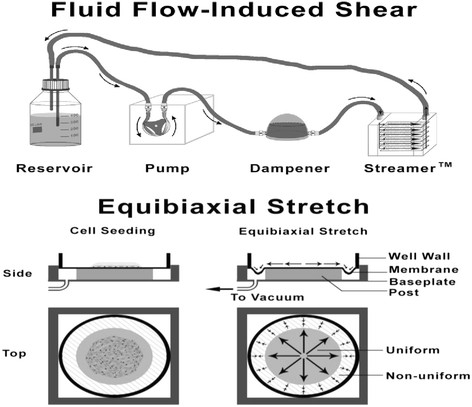
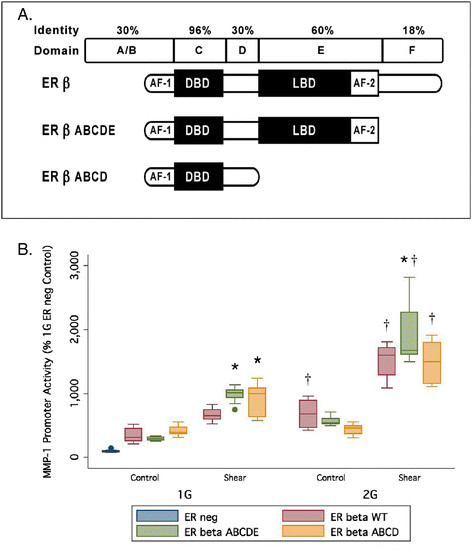
HIG-82 synoviocytes were transiently transfected with 1G or 2G alleles (±) ER-β and subjected to either shear or equibiaxial stress. Next, 1G/2G promoter activity was measured to determine the combined influence of physiological stimuli. Truncated ER-β constructs were used to determine the importance of different domains of ER-β on 1G/2G activation.
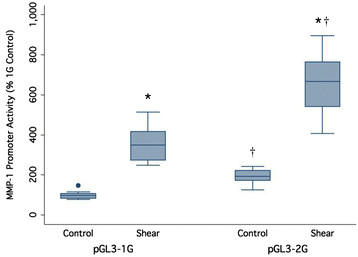
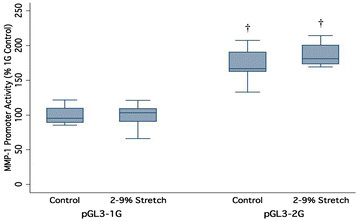
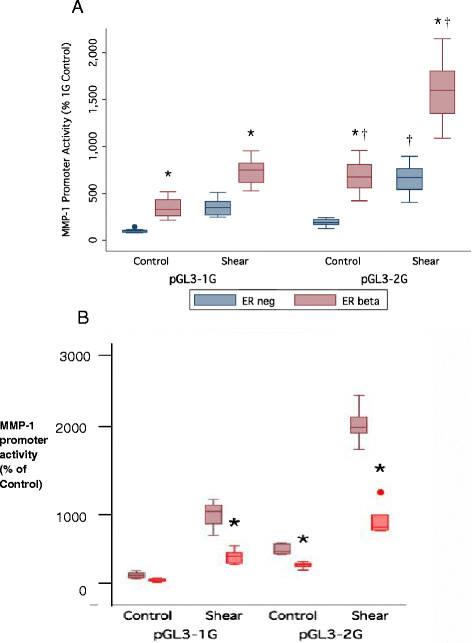
The 2G allele exhibited a constitutively higher activity than the 1G allele, which was further increased when the transfected cells were subject to shear stress, but not equibiaxial stress. Moreover, the combination of ER-β and shear stress further increased the activity levels of the 1G/2G allelic variants. Additionally, select AF-2 truncated ER-β variants led to increased activity levels for the 2G allele, indicating the AF-1 domain was likely involved in the response to mechanical stimulation.
These results suggest that the 1G/2G alleles of MMP-1 are influenced by specific mechanical stimuli like shear stress, as well as the ER-β receptor. These findings contribute to the potential allelic involvement in connective tissue diseases such as OA in females compared to males.
骨关节炎(OA)等关节疾病主要影响绝经后女性,这表明女性激素发挥了相关作用。在膝关节的结缔组织中已检测到雌激素受体β(ER-β),这表明这些组织对雌激素有反应。基质金属蛋白酶-1(MMP-1)的活性会导致软骨降解,而软骨降解是滑膜关节发生OA的关键因素。由于启动子中鸟嘌呤残基的缺失/插入,MMP-1存在两种多态形式,且MMP-1的2G等位基因变体比1G等位基因表现出更高的活性。先前的研究表明,人类MMP-1的多态形式受雌激素受体亚型调节作用的影响。除了激素影响外,诸如机械负荷改变等生理因素也是OA的促成因素。在本研究中,评估了生物力学和激素变量对MMP-1亚型活性的综合影响。我们假设ER-β和剪切应力的联合作用将以激素非依赖的方式差异性激活MMP-1的两种等位基因形式。
用1G或2G等位基因(±)ER-β瞬时转染HIG-82滑膜细胞,并使其承受剪切应力或双轴应力。接下来,测量1G/2G启动子活性以确定生理刺激的综合影响。使用截短的ER-β构建体来确定ER-β不同结构域对1G/2G激活的重要性。
2G等位基因表现出比1G等位基因更高的组成活性,当转染细胞承受剪切应力而非双轴应力时,其活性进一步增加。此外,ER-β和剪切应力的联合作用进一步提高了1G/2G等位基因变体的活性水平。此外,选择的AF-2截短的ER-β变体导致2G等位基因的活性水平增加,表明AF-1结构域可能参与了对机械刺激的反应。
这些结果表明,MMP-1的1G/2G等位基因受剪切应力等特定机械刺激以及ER-β受体的影响。这些发现有助于解释与男性相比,等位基因在女性结缔组织疾病如OA中的潜在作用。