Nix Eli B, Williams Kylie, Cox Andrew D, St Michael Frank, Romero-Steiner Sandra, Schmidt Daniel S, McCready William G, Ulanova Marina
Emerg Infect Dis. 2015 Feb;21(2):273-9. doi: 10.3201/eid2102.140722.
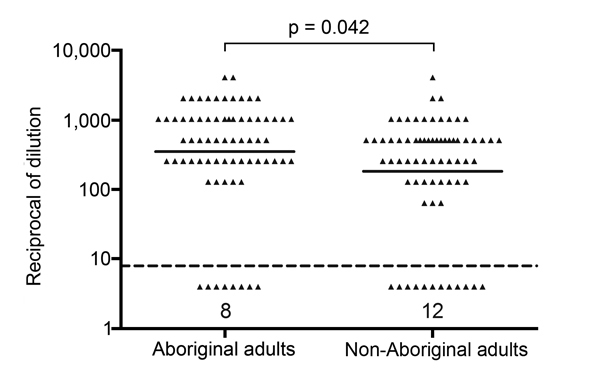
In the post-Haemophilus influenzae type b (Hib) vaccine era that began in the 1980's, H. influenzae type a (Hia) emerged as a prominent cause of invasive disease in North American Aboriginal populations. To test whether a lack of naturally acquired antibodies may underlie increased rates of invasive Hia disease, we compared serum bactericidal activity against Hia and Hib and IgG and IgM against capsular polysaccharide between Canadian Aboriginal and non-Aboriginal healthy and immunocompromised adults. Both healthy and immunocompromised Aboriginal adults exhibited significantly higher bactericidal antibody titers against Hia than did non-Aboriginal adults (p = 0.042 and 0.045 respectively), with no difference in functional antibody activity against Hib. IgM concentrations against Hia were higher than IgG in most study groups; the inverse was true for antibody concentrations against Hib. Our results indicate that Aboriginal adults possess substantial serum bactericidal activity against Hia that is mostly due to IgM antibodies. The presence of sustained IgM against Hia suggests recent Hia exposure.
在始于20世纪80年代的b型流感嗜血杆菌(Hib)疫苗接种时代之后,a型流感嗜血杆菌(Hia)成为北美原住民人群侵袭性疾病的一个主要病因。为了检验缺乏自然获得性抗体是否可能是侵袭性Hia疾病发病率增加的原因,我们比较了加拿大原住民和非原住民健康及免疫功能低下成年人针对Hia和Hib的血清杀菌活性以及针对荚膜多糖的IgG和IgM。健康及免疫功能低下的原住民成年人针对Hia的杀菌抗体滴度均显著高于非原住民成年人(分别为p = 0.042和0.045),而针对Hib的功能性抗体活性无差异。在大多数研究组中,针对Hia的IgM浓度高于IgG;针对Hib的抗体浓度情况则相反。我们的结果表明,原住民成年人拥有针对Hia的大量血清杀菌活性,这主要归因于IgM抗体。持续存在针对Hia的IgM表明近期接触过Hia。