Peck Lloyd S, Clark Melody S, Power Deborah, Reis João, Batista Frederico M, Harper Elizabeth M
British Antarctic Survey, High Cross, Madingley Rd, Cambridge, CB3 0ET, UK.
Glob Chang Biol. 2015 May;21(5):1907-13. doi: 10.1111/gcb.12841. Epub 2015 Jan 28.
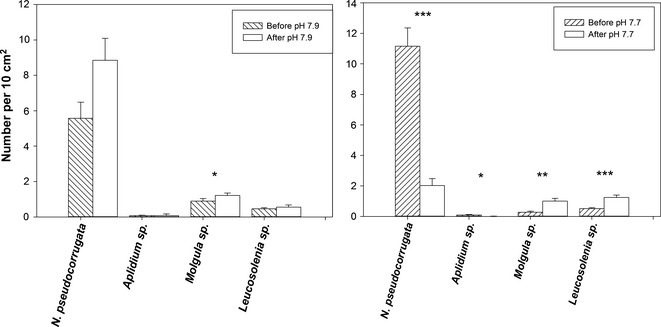
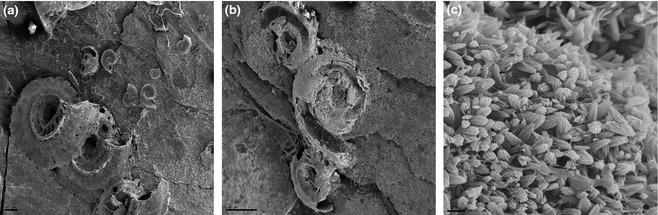
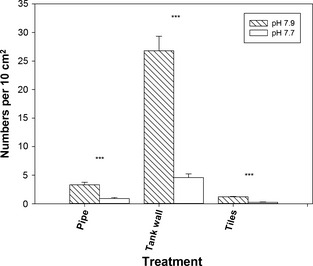
How ocean acidification affects marine life is a major concern for science and society. However, its impacts on encrusting biofouling communities, that are both the initial colonizers of hard substrata and of great economic importance, are almost unknown. We showed that community composition changed significantly, from 92% spirorbids, 3% ascidians and 4% sponges initially to 47% spirorbids, 23% ascidians and 29% sponges after 100 days in acidified conditions (pH 7.7). In low pH, numbers of the spirorbid Neodexiospira pseudocorrugata were reduced ×5 compared to controls. The two ascidians present behaved differently with Aplidium sp. decreasing ×10 in pH 7.7, whereas Molgula sp. numbers were ×4 higher in low pH than controls. Calcareous sponge (Leucosolenia sp.) numbers increased ×2.5 in pH 7.7 over controls. The diatom and filamentous algal community was also more poorly developed in the low pH treatments compared to controls. Colonization of new surfaces likewise showed large decreases in spirorbid numbers, but numbers of sponges and Molgula sp. increased. Spirorbid losses appeared due to both recruitment failure and loss of existing tubes. Spirorbid tubes are comprised of a loose prismatic fabric of calcite crystals. Loss of tube materials appeared due to changes in the binding matrix and not crystal dissolution, as SEM analyses showed crystal surfaces were not pitted or dissolved in low pH conditions. Biofouling communities face dramatic future changes with reductions in groups with hard exposed exoskeletons and domination by soft-bodied ascidians and sponges.
海洋酸化如何影响海洋生物是科学界和社会主要关注的问题。然而,其对结壳生物污损群落的影响几乎未知,而结壳生物污损群落既是硬质基质的最初定殖者,又具有重大经济意义。我们发现,群落组成发生了显著变化,在酸化条件(pH 7.7)下,最初92%为盘管虫、3%为海鞘、4%为海绵,100天后变为47%盘管虫、23%海鞘和29%海绵。在低pH值条件下,盘管虫新伪盘管虫的数量与对照相比减少了5倍。存在的两种海鞘表现不同,在pH 7.7时,Aplidium sp.数量减少了10倍,而Molgula sp.在低pH值条件下数量比对照高4倍。钙质海绵(白枝海绵属)数量在pH 7.7时比对照增加了2.5倍。与对照相比,低pH处理下硅藻和丝状藻类群落的发育也较差。新表面的定殖同样显示盘管虫数量大幅减少,但海绵和Molgula sp.的数量增加。盘管虫数量的减少似乎是由于招募失败和现有管的损失。盘管虫管由方解石晶体的疏松棱柱织物组成。管材料的损失似乎是由于结合基质的变化而非晶体溶解,因为扫描电镜分析表明在低pH条件下晶体表面没有凹坑或溶解。随着硬壳外骨骼群体的减少以及软体海鞘和海绵的主导,生物污损群落面临着巨大的未来变化。