Department of Public Health and Primary Care, University of Cambridge, Cambridge, UK.
Information Services Division, NHS National Services Scotland, Edinburgh, UK.
BJOG. 2015 Oct;122(11):1525-34. doi: 10.1111/1471-0528.13276. Epub 2015 Jan 28.
To determine whether the relationship between previous miscarriage and risk of preterm birth changed over the period 1980-2008, and to determine whether the pattern varied according to the cause of the preterm birth.
Linked birth databases.
All Scottish NHS hospitals.
A total of 732 719 nulliparous women with a first live birth between 1980 and 2008.
Risk was estimated using logistic regression.
Preterm birth, subdivided by cause (spontaneous, induced with a diagnosis of pre-eclampsia, or induced without a diagnosis of pre-eclampsia) and severity [extreme (24-28 weeks of gestation), moderate (29-32 weeks of gestation), and mild (33-36 weeks of gestation)].
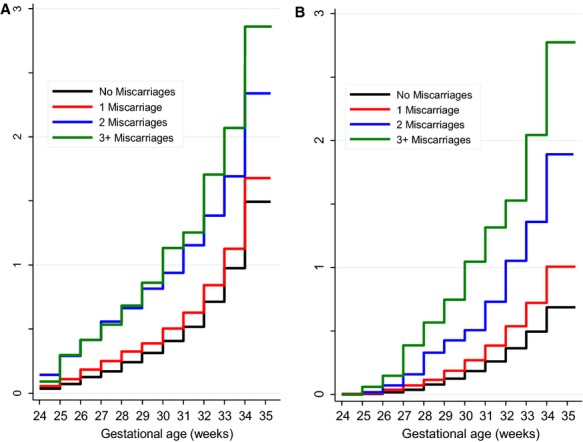
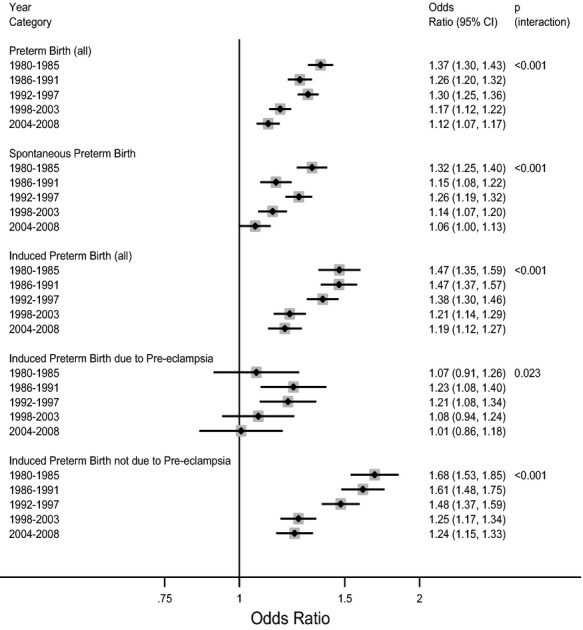
Consistent with previous studies, previous miscarriage was associated with an increased risk of all-cause preterm birth (adjusted odds ratio, aOR 1.26; 95% confidence interval, 95% CI 1.22-1.29). This arose from associations with all subtypes. The strongest association was found with extreme preterm birth (aOR 1.73; 95% CI 1.57-1.90). Risk increased with the number of miscarriages. Women with three or more miscarriages had the greatest risk of all-cause preterm birth (aOR 2.14; 95% CI 1.93-2.38), and the strongest association was with extreme preterm birth (aOR 3.87; 95% CI 2.85-5.26). The strength of the association between miscarriage and preterm birth decreased from 1980 to 2008. This was because of weakening associations with spontaneous preterm birth and induced preterm birth without a diagnosis of pre-eclampsia.
The association between a prior history of miscarriage and the risk of preterm birth declined in Scotland over the period 1980-2008. We speculate that changes in the methods of managing incomplete termination of pregnancy might explain the trend, through reduced cervical damage.
确定在 1980 年至 2008 年间,既往流产与早产风险之间的关系是否发生变化,并确定这种模式是否因早产的原因而异。
链接的出生数据库。
苏格兰所有国民保健服务医院。
1980 年至 2008 年间首次活产的总计 732719 名未产妇。
使用逻辑回归估计风险。
早产,按病因(自发性、因子痫前期诊断而引产或无子痫前期诊断而引产)和严重程度(极早产[24-28 孕周]、中度早产[29-32 孕周]和轻度早产[33-36 孕周])进行细分。
与既往研究一致,既往流产与所有原因早产风险增加相关(调整后的优势比,aOR 1.26;95%置信区间,95%CI 1.22-1.29)。这源于与所有亚型的关联。与极早产的关联最强(aOR 1.73;95%CI 1.57-1.90)。风险随流产次数增加而增加。有 3 次或以上流产史的妇女发生所有原因早产的风险最大(aOR 2.14;95%CI 1.93-2.38),与极早产的关联最强(aOR 3.87;95%CI 2.85-5.26)。1980 年至 2008 年间,流产与早产之间的关联强度下降。这是因为自发性早产和无子痫前期诊断的引产的关联减弱。
在苏格兰,1980 年至 2008 年间,既往流产史与早产风险之间的关联呈下降趋势。我们推测,通过减少宫颈损伤,管理不完全性终止妊娠方法的改变可能解释了这一趋势。