Füllgrabe Christian, Moore Brian C J, Stone Michael A
MRC Institute of Hearing Research Nottingham, UK.
Department of Psychology, University of Cambridge Cambridge, UK.
Front Aging Neurosci. 2015 Jan 13;6:347. doi: 10.3389/fnagi.2014.00347. eCollection 2014.
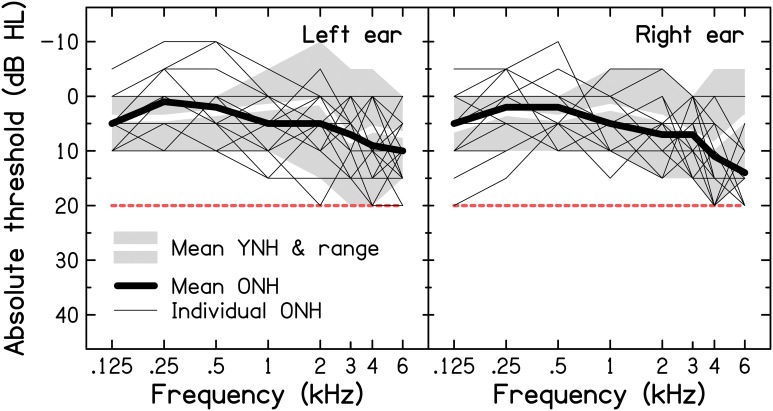
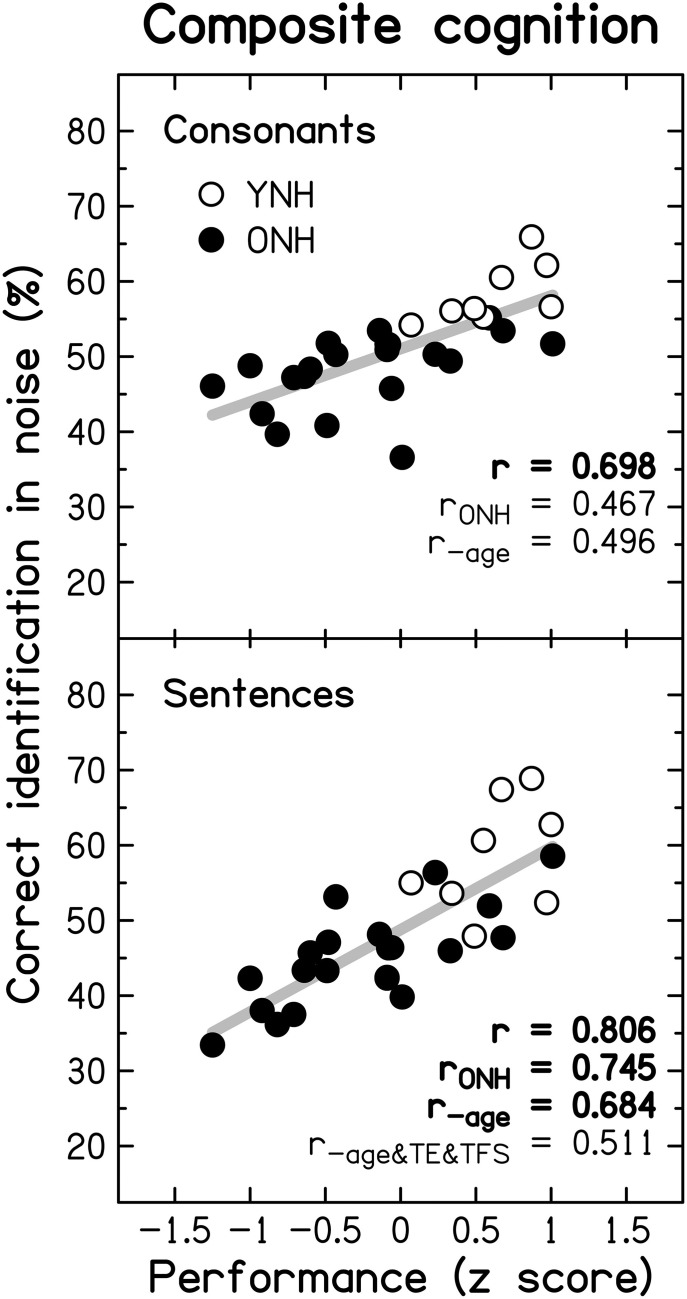
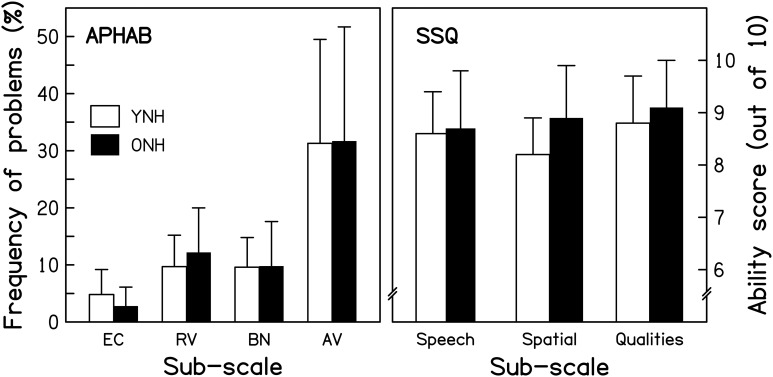
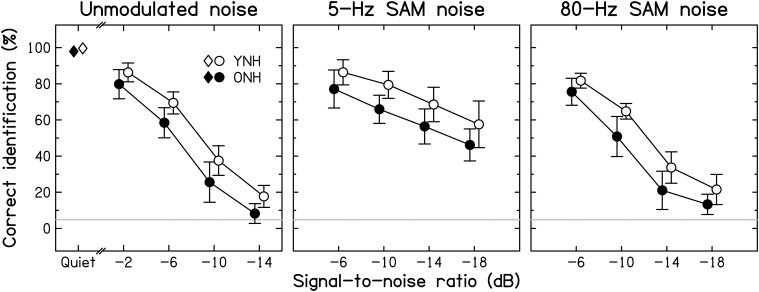
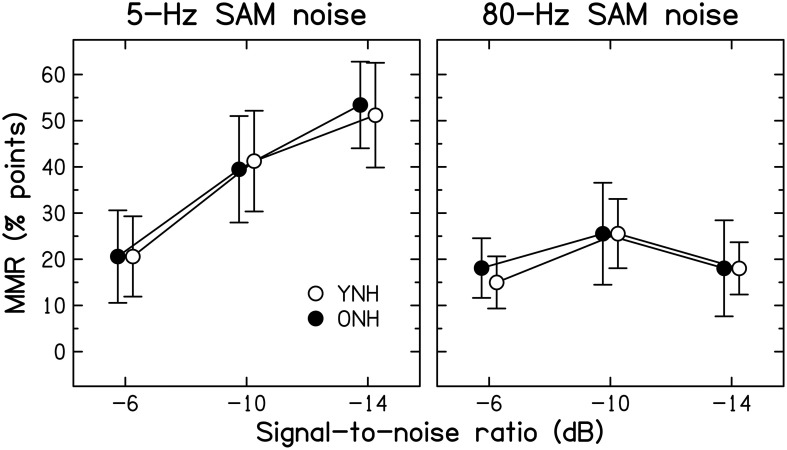
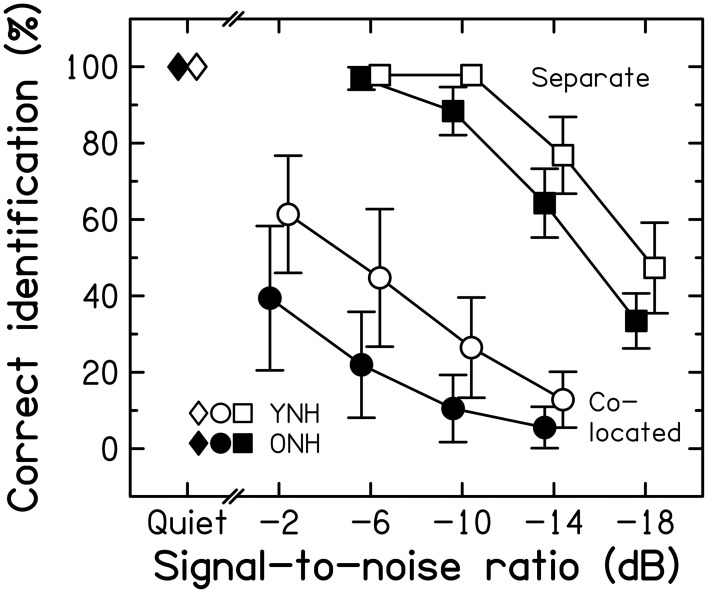
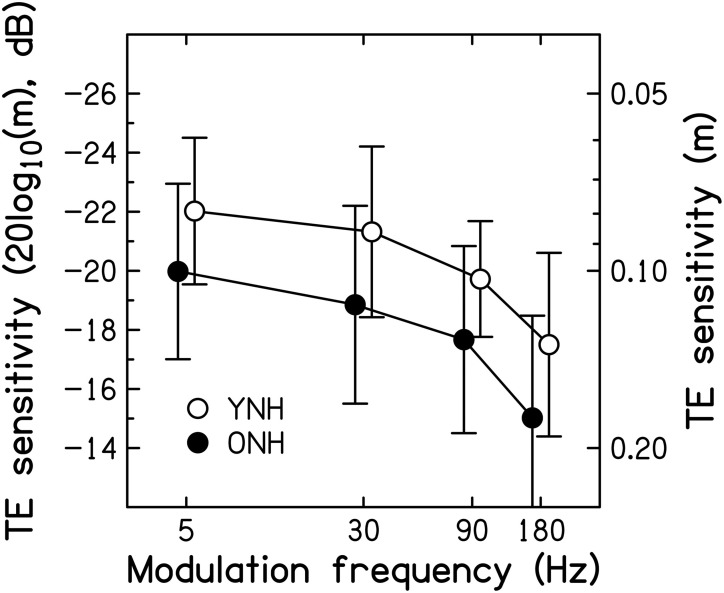
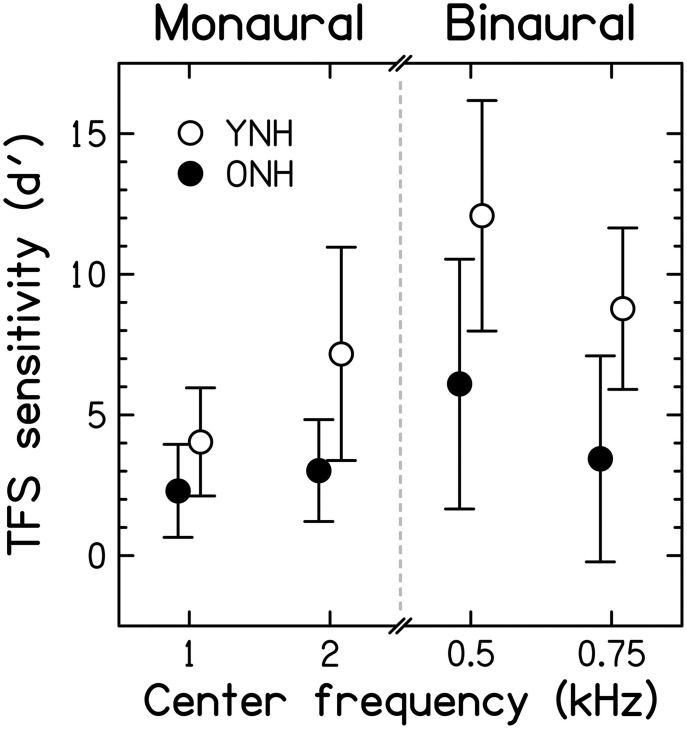
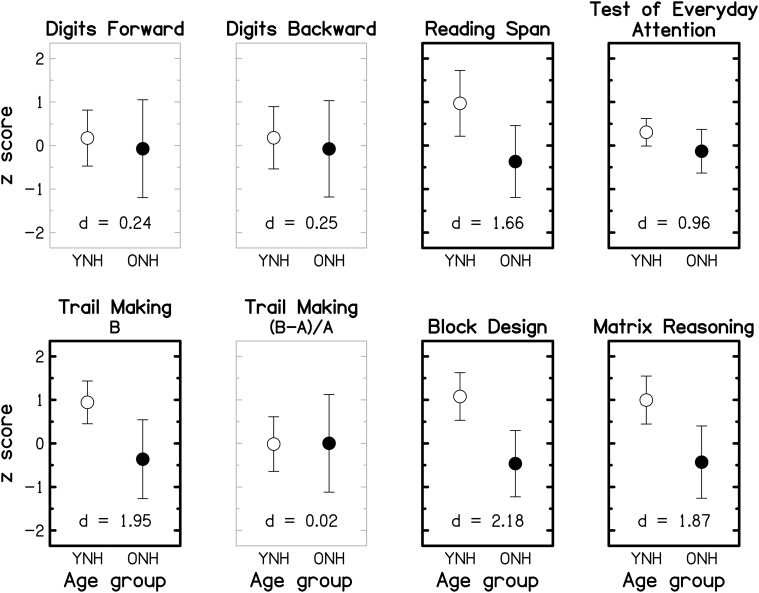
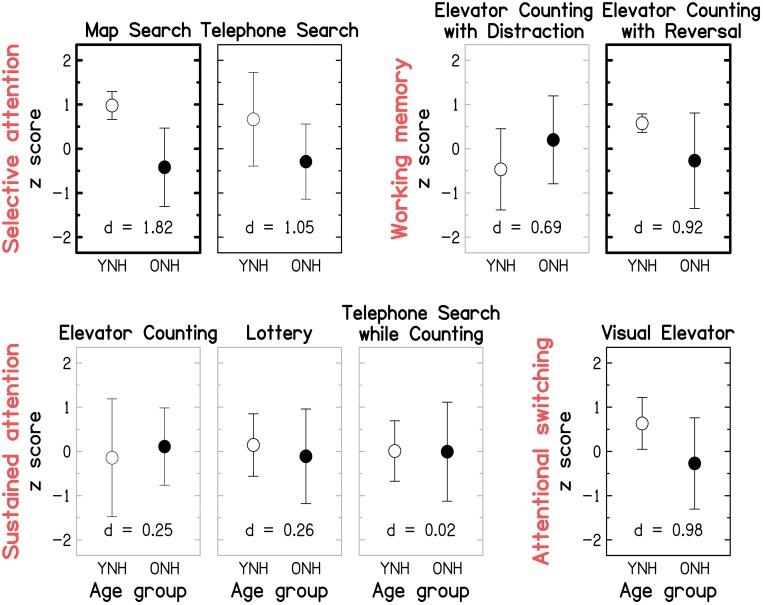
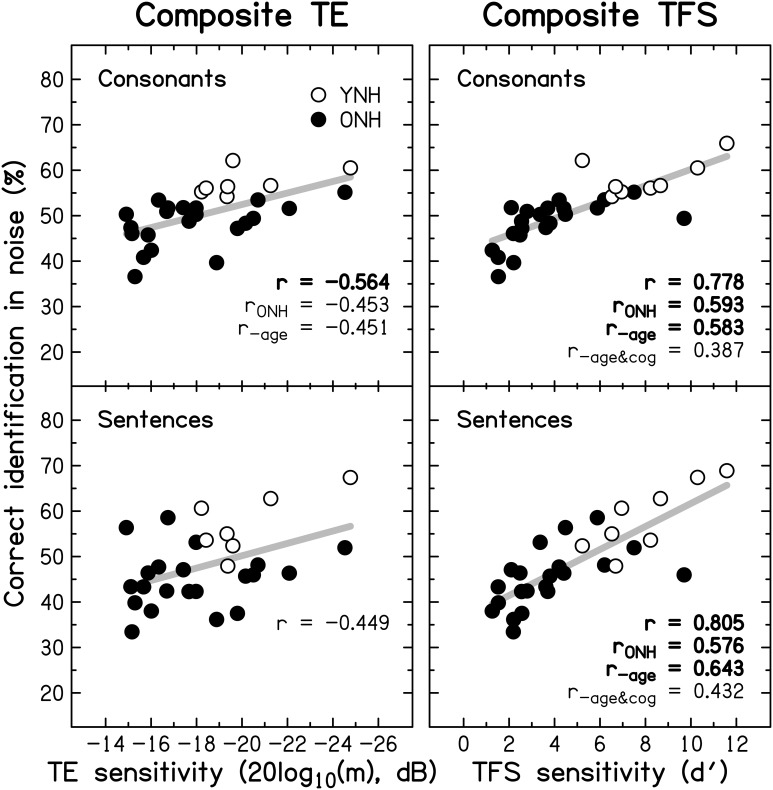
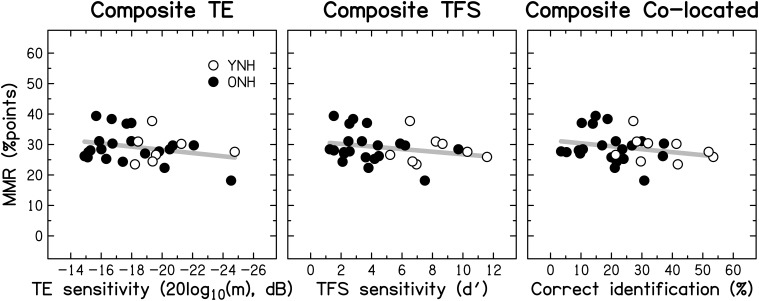
Hearing loss with increasing age adversely affects the ability to understand speech, an effect that results partly from reduced audibility. The aims of this study were to establish whether aging reduces speech intelligibility for listeners with normal audiograms, and, if so, to assess the relative contributions of auditory temporal and cognitive processing. Twenty-one older normal-hearing (ONH; 60-79 years) participants with bilateral audiometric thresholds ≤ 20 dB HL at 0.125-6 kHz were matched to nine young (YNH; 18-27 years) participants in terms of mean audiograms, years of education, and performance IQ. Measures included: (1) identification of consonants in quiet and in noise that was unmodulated or modulated at 5 or 80 Hz; (2) identification of sentences in quiet and in co-located or spatially separated two-talker babble; (3) detection of modulation of the temporal envelope (TE) at frequencies 5-180 Hz; (4) monaural and binaural sensitivity to temporal fine structure (TFS); (5) various cognitive tests. Speech identification was worse for ONH than YNH participants in all types of background. This deficit was not reflected in self-ratings of hearing ability. Modulation masking release (the improvement in speech identification obtained by amplitude modulating a noise background) and spatial masking release (the benefit obtained from spatially separating masker and target speech) were not affected by age. Sensitivity to TE and TFS was lower for ONH than YNH participants, and was correlated positively with speech-in-noise (SiN) identification. Many cognitive abilities were lower for ONH than YNH participants, and generally were correlated positively with SiN identification scores. The best predictors of the intelligibility of SiN were composite measures of cognition and TFS sensitivity. These results suggest that declines in speech perception in older persons are partly caused by cognitive and perceptual changes separate from age-related changes in audiometric sensitivity.
随着年龄增长,听力损失会对言语理解能力产生不利影响,这种影响部分源于可听度降低。本研究的目的是确定衰老是否会降低听力图正常的听众的言语可懂度,如果是,则评估听觉时间处理和认知处理的相对贡献。21名年龄较大的听力正常者(ONH;60 - 79岁),其在0.125 - 6 kHz频率下双侧听力阈值≤20 dB HL,在平均听力图、受教育年限和操作智商方面与9名年轻听力正常者(YNH;18 - 27岁)进行匹配。测量指标包括:(1)在安静环境中以及在5 Hz或80 Hz调制或未调制的噪声环境中对辅音的识别;(2)在安静环境中以及在同处或空间分离的双说话者嘈杂声中对句子的识别;(3)检测5 - 180 Hz频率下的时间包络(TE)调制;(4)对时间精细结构(TFS)的单耳和双耳敏感度;(5)各种认知测试。在所有类型的背景环境中,ONH参与者的言语识别能力均比YNH参与者差。这种缺陷在听力能力的自我评估中并未体现出来。调制掩蔽释放(通过对噪声背景进行幅度调制而获得的言语识别改善)和空间掩蔽释放(从空间分离掩蔽声和目标言语中获得的益处)不受年龄影响。ONH参与者对TE和TFS的敏感度低于YNH参与者,且与噪声中的言语(SiN)识别呈正相关。ONH参与者的许多认知能力低于YNH参与者,并且通常与SiN识别分数呈正相关。SiN可懂度的最佳预测指标是认知和TFS敏感度的综合测量。这些结果表明,老年人言语感知能力的下降部分是由与听力测量敏感度的年龄相关变化无关的认知和感知变化引起的。