Wingler Astrid
Research Department of Genetics, Evolution and Environment, University College London London, UK.
Front Plant Sci. 2015 Jan 12;5:794. doi: 10.3389/fpls.2014.00794. eCollection 2014.
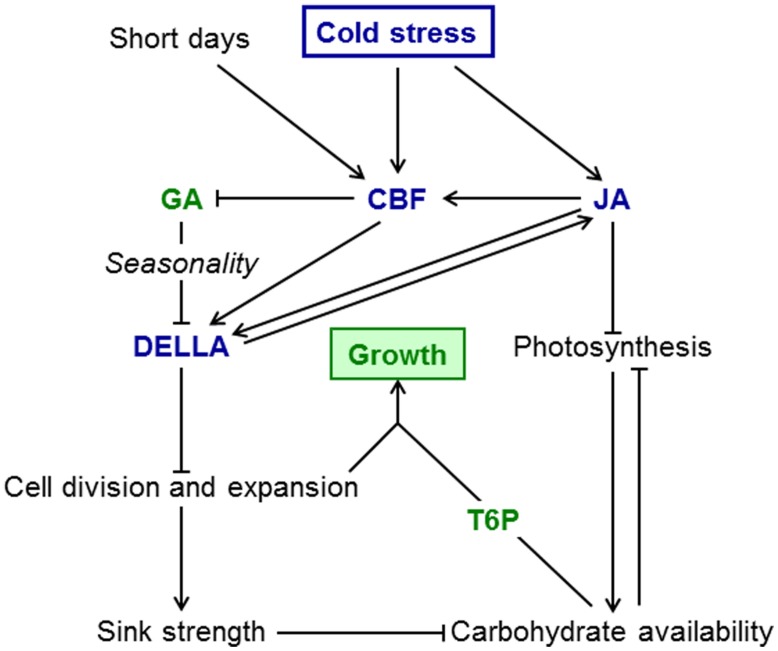
Low temperature inhibits plant growth despite the fact that considerable rates of photosynthetic activity can be maintained. Instead of lower rates of photosynthesis, active inhibition of cell division and expansion is primarily responsible for reduced growth. This results in sink limitation and enables plants to accumulate carbohydrates that act as compatible solutes or are stored throughout the winter to enable re-growth in spring. Regulation of growth in response to temperature therefore requires coordination with carbon metabolism, e.g., via the signaling metabolite trehalose-6-phosphate. The phytohormones gibberellin (GA) and jasmonate (JA) play an important role in regulating growth in response to temperature. Growth restriction at low temperature is mainly mediated by DELLA proteins, whose degradation is promoted by GA. For annual plants, it has been shown that the GA/DELLA pathway interacts with JA signaling and C-repeat binding factor dependent cold acclimation, but these interactions have not been explored in detail for perennials. Growth regulation in response to seasonal factors is, however, particularly important in perennials, especially at high latitudes. In autumn, growth cessation in trees is caused by shortening of the daylength in interaction with phytohormone signaling. In perennial grasses seasonal differences in the sensitivity to GA may enable enhanced growth in spring. This review provides an overview of the signaling interactions that determine plant growth at low temperature and highlights gaps in our knowledge, especially concerning the seasonality of signaling responses in perennial plants.
尽管低温条件下植物仍能维持相当高的光合活性,但低温会抑制植物生长。生长减缓主要是由于细胞分裂和扩展受到主动抑制,而非光合作用速率降低。这导致了库限制,使植物能够积累碳水化合物,这些碳水化合物可作为相容性溶质,或在整个冬季储存起来,以便春季重新生长。因此,响应温度的生长调节需要与碳代谢协调,例如通过信号代谢物海藻糖 -6- 磷酸。植物激素赤霉素(GA)和茉莉酸(JA)在响应温度调节生长方面发挥着重要作用。低温下的生长限制主要由DELLA蛋白介导,GA可促进DELLA蛋白的降解。对于一年生植物,已表明GA/DELLA途径与JA信号传导以及C-重复结合因子依赖性冷驯化相互作用,但多年生植物中这些相互作用尚未得到详细研究。然而,响应季节性因素的生长调节在多年生植物中尤为重要,特别是在高纬度地区。秋季,树木生长停止是由日照长度缩短与植物激素信号传导相互作用引起的。在多年生禾本科植物中,对GA敏感性的季节性差异可能使春季生长增强。本综述概述了决定低温下植物生长的信号相互作用,并突出了我们知识中的空白,特别是关于多年生植物信号响应的季节性方面。