Department of Biotechnology and Systems Biology, National Institute of Biology, Večna pot 111, SI-1000 Ljubljana, Slovenia.
Plant Methods. 2014 Dec 31;10(1):42. doi: 10.1186/s13007-014-0042-6. eCollection 2014.
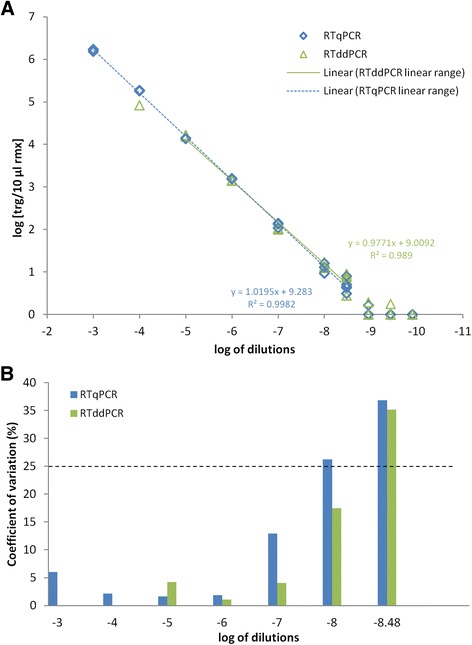
Detection and quantification of plant pathogens in the presence of inhibitory substances can be a challenge especially with plant and environmental samples. Real-time quantitative PCR has enabled high-throughput detection and quantification of pathogens; however, its quantitative use is linked to standardized reference materials, and its sensitivity to inhibitors can lead to lower quantification accuracy. Droplet digital PCR has been proposed as a method to overcome these drawbacks. Its absolute quantification does not rely on standards and its tolerance to inhibitors has been demonstrated mostly in clinical samples. Such features would be of great use in agricultural and environmental fields, therefore our study compared the performance of droplet digital PCR method when challenged with inhibitors common to plant and environmental samples and compared it with quantitative PCR.
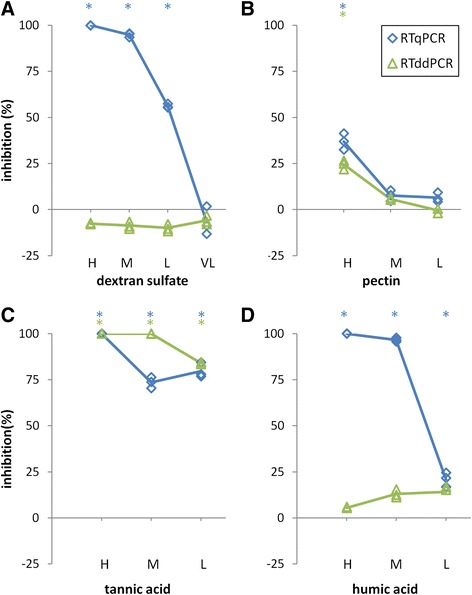
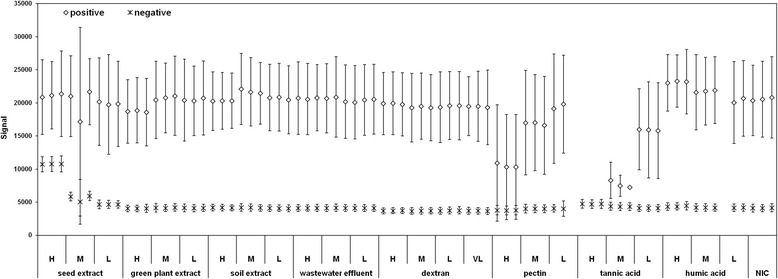
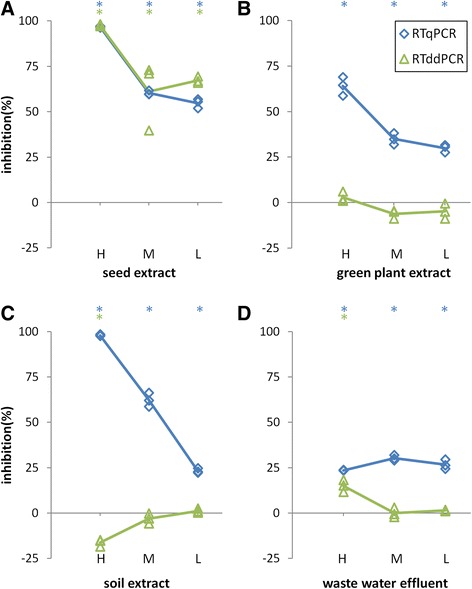
Transfer of an existing Pepper mild mottle virus assay from reverse transcription real-time quantitative PCR to reverse transcription droplet digital PCR was straight forward. When challenged with complex matrices (seeds, plants, soil, wastewater) and selected purified inhibitors droplet digital PCR showed higher resilience to inhibition for the quantification of an RNA virus (Pepper mild mottle virus), compared to reverse transcription real-time quantitative PCR.
This study confirms the improved detection and quantification of the PMMoV RT-ddPCR in the presence of inhibitors that are commonly found in samples of seeds, plant material, soil, and wastewater. Together with absolute quantification, independent of standard reference materials, this makes droplet digital PCR a valuable tool for detection and quantification of pathogens in inhibition prone samples.
在存在抑制物质的情况下,检测和定量植物病原体可能是一个挑战,尤其是对于植物和环境样本。实时定量 PCR 使病原体的高通量检测和定量成为可能;然而,其定量使用与标准化参考材料相关联,并且其对抑制剂的敏感性可能导致定量准确性降低。液滴数字 PCR 已被提议作为克服这些缺点的方法。其绝对定量不依赖于标准,并且其对抑制剂的耐受性已在临床样本中得到证明。这些特性在农业和环境领域将非常有用,因此我们的研究比较了液滴数字 PCR 方法在受到植物和环境样本中常见抑制剂的挑战时的性能,并将其与定量 PCR 进行了比较。
将现有的辣椒轻斑驳病毒测定从反转录实时定量 PCR 直接转移到反转录液滴数字 PCR 是可行的。当受到复杂基质(种子、植物、土壤、废水)和选定的纯化抑制剂的挑战时,与反转录实时定量 PCR 相比,液滴数字 PCR 对 RNA 病毒(辣椒轻斑驳病毒)的定量表现出更高的抑制抗性。
本研究证实了在存在常见于种子、植物材料、土壤和废水中的抑制剂的情况下,PMMoV RT-ddPCR 的检测和定量得到了改善。与绝对定量、不依赖标准参考材料一起,这使得液滴数字 PCR 成为检测和定量抑制倾向样本中病原体的有价值工具。