Chou Jian-Liang, Huang Rui-Lan, Shay Jacqueline, Chen Lin-Yu, Lin Sheng-Jie, Yan Pearlly S, Chao Wei-Ting, Lai Yi-Hui, Lai Yen-Ling, Chao Tai-Kuang, Lee Cheng-I, Tai Chien-Kuo, Wu Shu-Fen, Nephew Kenneth P, Huang Tim H-M, Lai Hung-Cheng, Chan Michael W Y
Department of Life Science, National Chung Cheng University, 168 University Road, Min-Hsiung, Chia-Yi 621, Taiwan ; Institute of Molecular Biology, National Chung Cheng University, Min-Hsiung, Chia-Yi, Taiwan ; Division of Gastroenterology, Chang Gung Memorial Hospital, Chia-Yi, Taiwan.
Department of Obstetrics and Gynecology, Shuang Ho Hospital, Taipei Medical University, No 291, Zhongzheng Rd., Zhonghe District, New Taipei City, 23561 Taiwan.
Clin Epigenetics. 2015 Jan 14;7(1):1. doi: 10.1186/s13148-014-0036-2. eCollection 2015.
The dysregulation of transforming growth factor-β (TGF-β) signaling plays a crucial role in ovarian carcinogenesis and in maintaining cancer stem cell properties. Classified as a member of the ATP-binding cassette (ABC) family, ABCA1 was previously identified by methylated DNA immunoprecipitation microarray (mDIP-Chip) to be methylated in ovarian cancer cell lines, A2780 and CP70. By microarray, it was also found to be upregulated in immortalized ovarian surface epithelial (IOSE) cells following TGF-β treatment. Thus, we hypothesized that ABCA1 may be involved in ovarian cancer and its initiation.
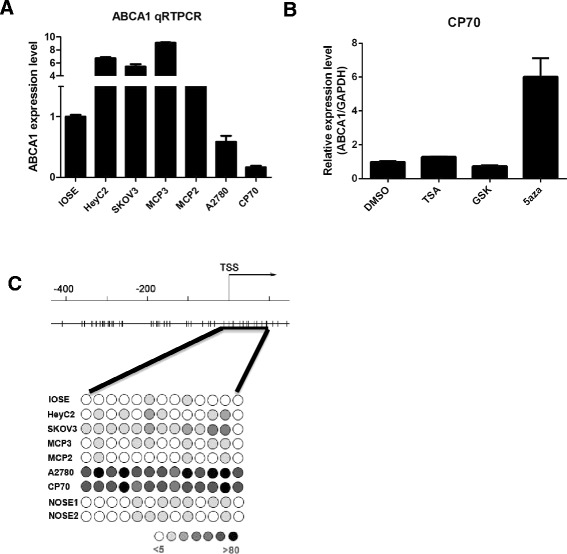
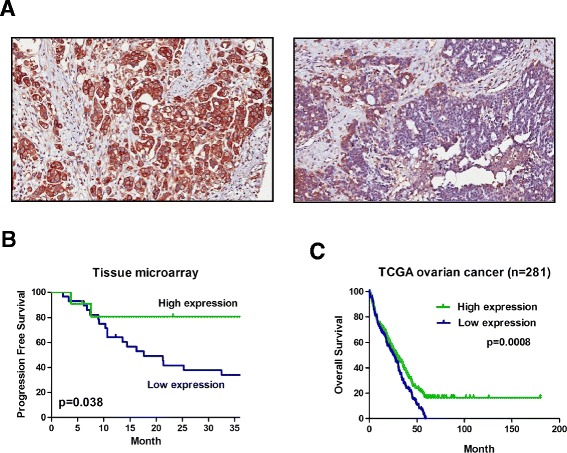
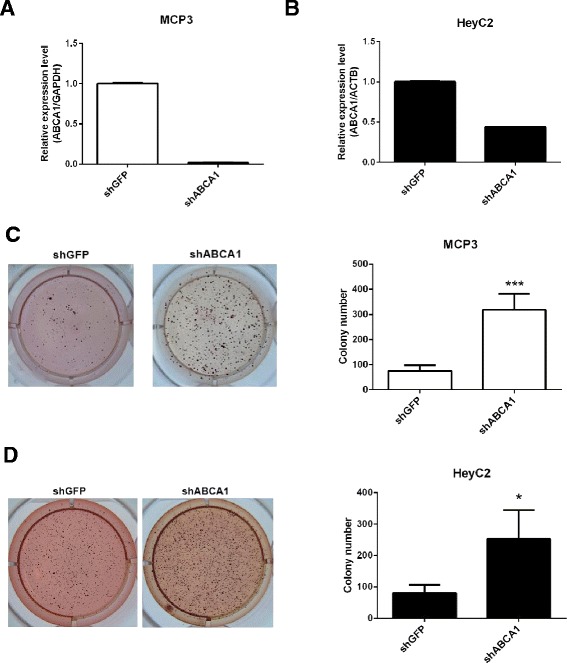
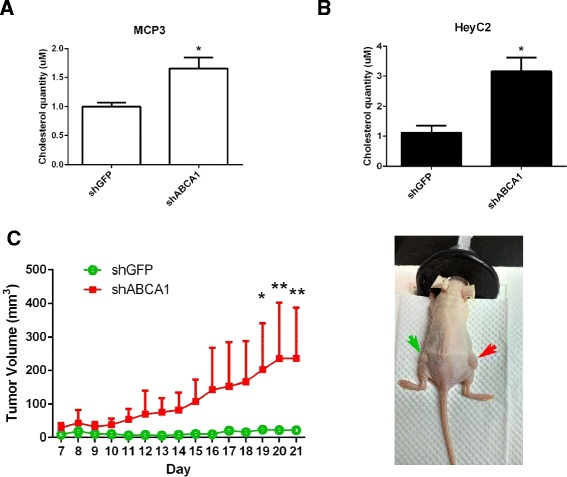
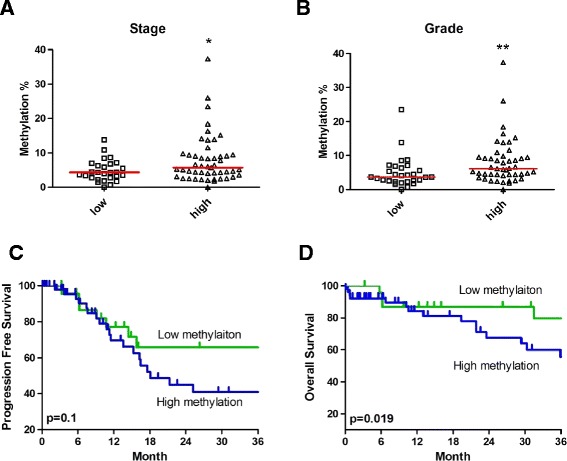
We first compared the expression level of ABCA1 in IOSE cells and a panel of ovarian cancer cell lines and found that ABCA1 was expressed in HeyC2, SKOV3, MCP3, and MCP2 ovarian cancer cell lines but downregulated in A2780 and CP70 ovarian cancer cell lines. The reduced expression of ABCA1 in A2780 and CP70 cells was associated with promoter hypermethylation, as demonstrated by bisulfite pyro-sequencing. We also found that knockdown of ABCA1 increased the cholesterol level and promoted cell growth in vitro and in vivo. Further analysis of ABCA1 methylation in 76 ovarian cancer patient samples demonstrated that patients with higher ABCA1 methylation are associated with high stage (P = 0.0131) and grade (P = 0.0137). Kaplan-Meier analysis also found that patients with higher levels of methylation of ABCA1 have shorter overall survival (P = 0.019). Furthermore, tissue microarray using 55 ovarian cancer patient samples revealed that patients with a lower level of ABCA1 expression are associated with shorter progress-free survival (P = 0.038).
ABCA1 may be a tumor suppressor and is hypermethylated in a subset of ovarian cancer patients. Hypermethylation of ABCA1 is associated with poor prognosis in these patients.
转化生长因子-β(TGF-β)信号失调在卵巢癌发生及维持癌症干细胞特性中起关键作用。ABCA1被归类为ATP结合盒(ABC)家族成员,先前通过甲基化DNA免疫沉淀微阵列(mDIP-Chip)鉴定其在卵巢癌细胞系A2780和CP70中发生甲基化。通过微阵列还发现,在TGF-β处理后,永生化卵巢表面上皮(IOSE)细胞中ABCA1表达上调。因此,我们推测ABCA1可能参与卵巢癌及其起始过程。
我们首先比较了ABCA1在IOSE细胞和一组卵巢癌细胞系中的表达水平,发现ABCA1在HeyC2、SKOV3、MCP3和MCP2卵巢癌细胞系中表达,但在A2780和CP70卵巢癌细胞系中下调。亚硫酸氢盐焦磷酸测序表明,A2780和CP70细胞中ABCA1表达降低与启动子高甲基化有关。我们还发现,敲低ABCA1可增加胆固醇水平,并在体外和体内促进细胞生长。对76例卵巢癌患者样本中ABCA1甲基化的进一步分析表明,ABCA1甲基化水平较高的患者与高分期(P = 0.0131)和高分级(P = 0.0137)相关。Kaplan-Meier分析还发现,ABCA1甲基化水平较高的患者总生存期较短(P = 0.019)。此外,使用55例卵巢癌患者样本的组织微阵列显示,ABCA1表达水平较低的患者无进展生存期较短(P = 0.038)。
ABCA1可能是一种肿瘤抑制因子,在一部分卵巢癌患者中发生高甲基化。ABCA1的高甲基化与这些患者的不良预后相关。