Xu Chunsheng, Li Chuanfu, Wu Hongli, Wu Yuanyuan, Hu Sheng, Zhu Yifang, Zhang Wei, Wang Linying, Zhu Senhua, Liu Junping, Zhang Qingping, Yang Jun, Zhang Xiaochu
Medical Imaging Center, The First Affiliated Hospital of Anhui University of Chinese Medicine, Anhui 230031, China ; Laboratory of Digital Medical Imaging, The First Affiliated Hospital of Anhui University of Chinese Medicine, Anhui 230031, China ; Institute of Computer Application of Chinese Medicine, Anhui Academy of Chinese Medicine, Anhui 230038, China.
Laboratory of Digital Medical Imaging, The First Affiliated Hospital of Anhui University of Chinese Medicine, Anhui 230031, China ; Institute of Computer Application of Chinese Medicine, Anhui Academy of Chinese Medicine, Anhui 230038, China.
Biomed Res Int. 2015;2015:183074. doi: 10.1155/2015/183074. Epub 2015 Jan 1.
We sought to use the regional homogeneity (ReHo) approach as an index in the resting-state functional MRI to investigate the gender differences of spontaneous brain activity within cerebral cortex and resting-state networks (RSNs) in young adult healthy volunteers.
One hundred and twelve healthy volunteers (56 males, 56 females) participated in the resting-state fMRI scan. The ReHo mappings in the cerebral cortex and twelve RSNs of the male and female groups were compared.
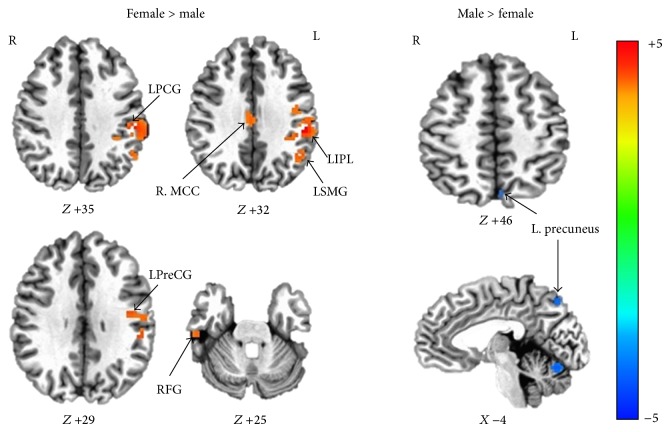
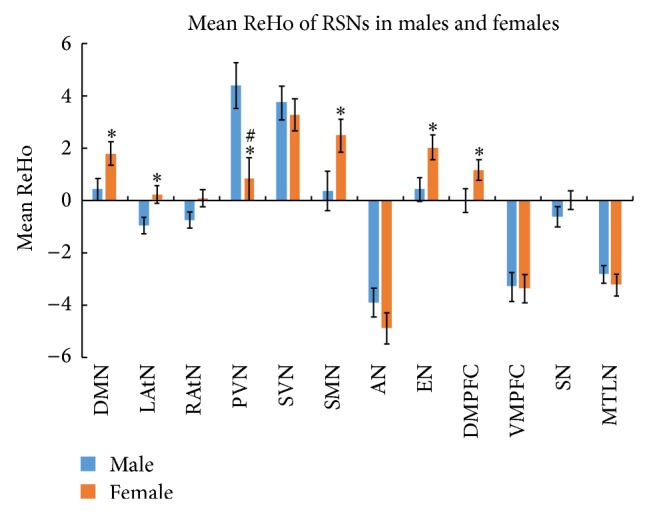
We found statistically significant gender differences in the primary visual network (PVN) (P < 0.004, with Bonferroni correction) and left attention network (LAtN), default mode network (DMN), sensorimotor network (SMN), executive network (EN), and dorsal medial prefrontal network (DMPFC) as well (P < 0.05, uncorrected). The male group showed higher ReHo in the left precuneus, while the female group showed higher ReHo in the right middle cingulate gyrus, fusiform gyrus, left inferior parietal lobule, precentral gyrus, supramarginal gyrus, and postcentral gyrus.
Our results suggested that men and women had regional specific differences during the resting-state. The findings may improve our understanding of the gender differences in behavior and cognition from the perspective of resting-state brain function.
我们试图使用局部一致性(ReHo)方法作为静息态功能磁共振成像中的一个指标,来研究年轻健康志愿者大脑皮质和静息态网络(RSNs)内自发脑活动的性别差异。
112名健康志愿者(56名男性,56名女性)参与了静息态功能磁共振成像扫描。比较了男性和女性组大脑皮质及12个RSNs中的ReHo图谱。
我们发现,在初级视觉网络(PVN)(经Bonferroni校正,P<0.004)以及左侧注意网络(LAtN)、默认模式网络(DMN)、感觉运动网络(SMN)、执行网络(EN)和背内侧前额叶网络(DMPFC)中存在具有统计学意义的性别差异(未校正,P<0.05)。男性组在左侧楔前叶显示出更高的ReHo,而女性组在右侧中央扣带回、梭状回、左侧顶下小叶、中央前回、缘上回和中央后回显示出更高的ReHo。
我们的结果表明,男性和女性在静息状态下存在区域特异性差异。这些发现可能会从静息态脑功能的角度提高我们对行为和认知中性别差异的理解。