Dallmeier Dhayana, Pencina Michael J, Rajman Iris, Koenig Wolfgang, Rothenbacher Dietrich, Brenner Hermann
University of Ulm Medical Center, Department of Internal Medicine II-Cardiology, Ulm, Germany; Department of Epidemiology, Boston University School of Public Health, Boston, MA, United States of America; Ulm University, Institute of Epidemiology and Medical Biometry, Ulm, Germany.
Duke Clinical Research Institute, Department of Biostatistics and Bioinformatics, Duke University, Durham, NC, United States of America.
PLoS One. 2015 Jan 28;10(1):e0117143. doi: 10.1371/journal.pone.0117143. eCollection 2015.
To assess the prognostic value of 12-months N-Terminal Pro-Brain Natriuretic Peptide (NT-proBNP) levels on adverse cardiovascular events in patients with stable coronary heart disease.
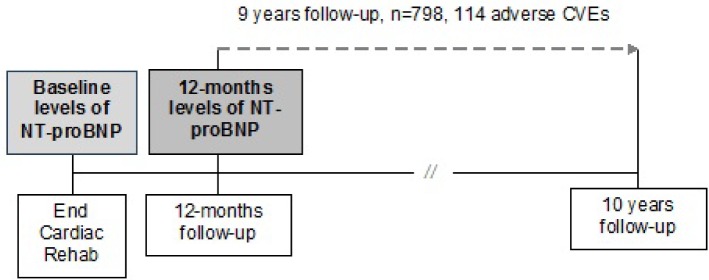
NT-proBNP concentrations were measured at baseline and at 12-months follow-up in participants of cardiac rehabilitation (median follow-up 8.96 years). Cox-proportional hazards models evaluated the prognostic value of log-transformed NT-proBNP levels, and of 12-months NT-proBNP relative changes on adverse cardiovascular events adjusting for established risk factors measured at baseline.
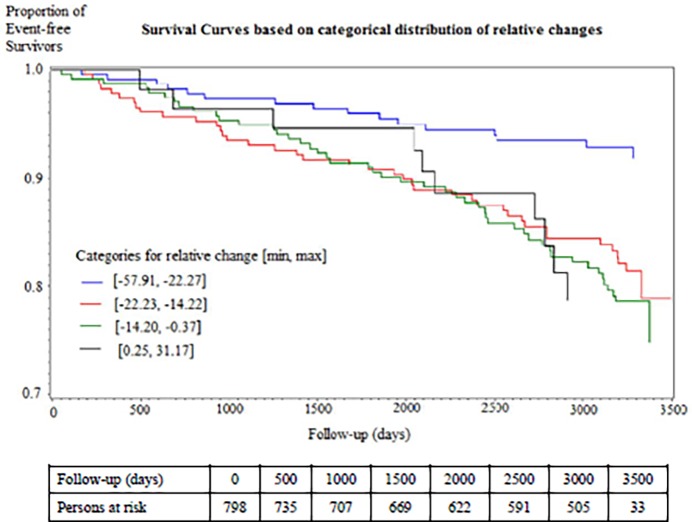
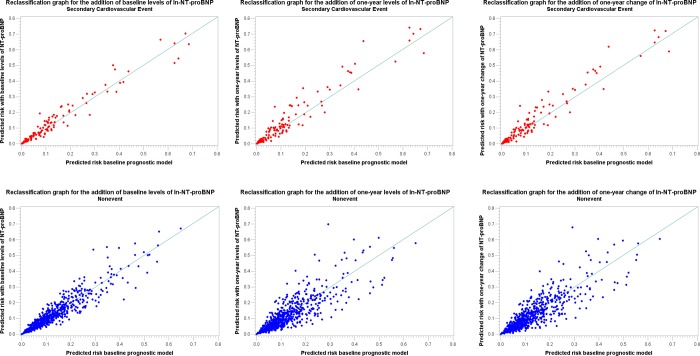
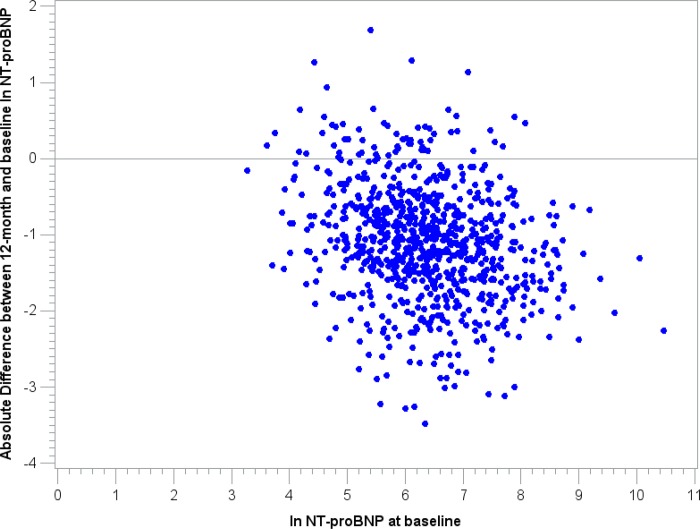
Among 798 participants (84.7% men, mean age 59 years) there were 114 adverse cardiovascular events. 12-months NT-proBNP levels were higher than baseline levels in 60 patients (7.5%) and numerically more strongly associated with the outcome in multivariable analysis (HR 1.65 [95% CI 1.33-2.05] vs. HR 1.41 [95% CI 1.12-1.78], with a net reclassification improvement (NRI) of 0.098 [95% CI 0.002-0.194] compared to NRI of 0.047 [95% CI -0.0004-0.133] for baseline NT-proBNP levels. A 12-month 10% increment of NT-proBNP was associated with a HR of 1.35 [95% CI 1.12-1.63] for the onset of an adverse cardiovascular event. Subjects with a 12-month increment of NT-proBNP had a HR of 2.56 [95% CI 1.10-5.95] compared to those with the highest 12-months reduction.
Twelve-months NT-proBNP levels after an acute cardiovascular event are strongly associated with a subsequent event and may provide numerically better reclassification of patients at risk for an adverse cardiovascular event compared to NT-proBNP baseline levels after adjustment for established risk factors.
评估12个月N端前脑钠肽(NT-proBNP)水平对稳定型冠心病患者不良心血管事件的预后价值。
在心脏康复参与者的基线和12个月随访时测量NT-proBNP浓度(中位随访8.96年)。Cox比例风险模型评估对数转换后的NT-proBNP水平以及12个月NT-proBNP相对变化对不良心血管事件的预后价值,并对基线时测量的既定风险因素进行校正。
在798名参与者(84.7%为男性,平均年龄59岁)中,发生了114起不良心血管事件。60名患者(7.5%)的12个月NT-proBNP水平高于基线水平,在多变量分析中与结局的数值关联更强(HR 1.65 [95% CI 1.33 - 2.05] 对比HR 1.41 [95% CI 1.12 - 1.78],净重新分类改善(NRI)为0.098 [95% CI 0.002 - 0.194],而基线NT-proBNP水平的NRI为0.047 [95% CI -0.0004 - 0.133])。NT-proBNP增加10%与不良心血管事件发生的HR为1.35 [95% CI 1.12 - 1.63]相关。与12个月降低最多的患者相比,NT-proBNP增加的患者HR为2.56 [95% CI 1.10 - 5.95]。
急性心血管事件后12个月的NT-proBNP水平与随后的事件密切相关,并且在对既定风险因素进行校正后,与NT-proBNP基线水平相比,可能在数值上能更好地对有不良心血管事件风险的患者进行重新分类。