Feng Daofu, Leong Meiha, Li Ting, Chen Lin, Li Tao
Department of General Surgery, General Hospital of Chinese PLA, Beijing, 100853, China.
Department of General Surgery, General Hospital of Tianjin Medical University, Tianjin, 300052, China.
World J Surg Oncol. 2015 Jan 30;13:11. doi: 10.1186/s12957-015-0444-6.
We wished to evaluate the impact of S-1 combined with oxaliplatin (SOX regimen) as neoadjuvant chemotherapy on surgical outcomes after gastrectomy with D2 lymphadenectomy.
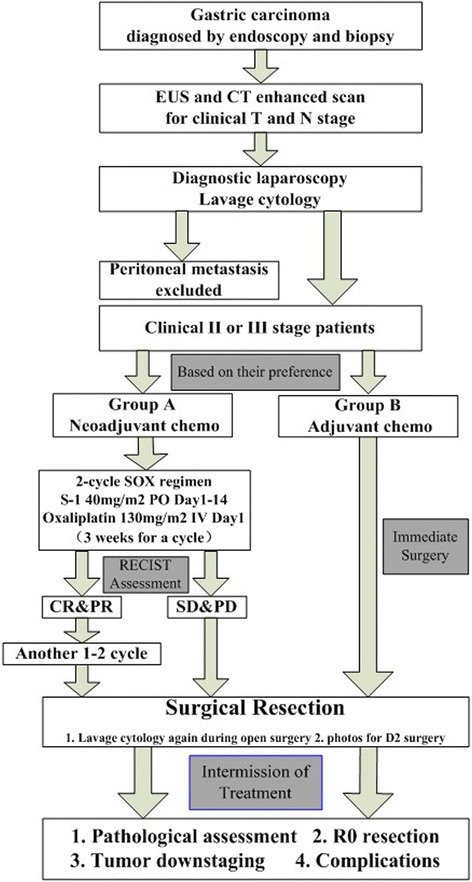
From February 2012 to September 2013, 170 patients with American Joint Committee on Cancer (AJCC) stage II-III gastric cancer were assessed retrospectively. Eighty patients underwent neoadjuvant chemotherapy before radical gastrectomy, and 90 patients received surgical treatment with adjuvant chemotherapy. Patients received S-1 (80 mg/m(2)/day; days 1-14) and oxaliplatin (130 mg/m(2); day 1) as neoadjuvant or adjuvant chemotherapy, and this schedule was repeated every 3 weeks. Gastrectomy with D2 lymphadenectomy was standard therapy for each patient. Surgical outcomes between the two groups were analyzed statistically.
There was no significant difference in the total prevalence of complications between neoadjuvant and adjuvant groups (18.8% vs. 22.2%, P = 0.704). The most common postoperative complications were surgical site infection (6.5%) and gastrointestinal motility disorders (3.5%). The clinical response rate was 68.8%, and ten patients (12.5%) had a pathological complete response after neoadjuvant chemotherapy. The SOX regimen as neoadjuvant chemotherapy for AJCC stage II/III gastric cancer can be effective without increasing the risk of postoperative complications.
The SOX regimen could be a neoadjuvant chemotherapy for advanced gastric cancer worldwide in the future.
我们希望评估S-1联合奥沙利铂(SOX方案)作为新辅助化疗对D2淋巴结清扫术后胃癌手术结局的影响。
回顾性评估2012年2月至2013年9月期间170例美国癌症联合委员会(AJCC)II-III期胃癌患者。80例患者在根治性胃切除术前行新辅助化疗,90例患者接受辅助化疗的手术治疗。患者接受S-1(80mg/m²/天;第1-14天)和奥沙利铂(130mg/m²;第1天)作为新辅助或辅助化疗,该方案每3周重复一次。D2淋巴结清扫的胃切除术是每位患者的标准治疗。对两组间的手术结局进行统计学分析。
新辅助组和辅助组并发症总发生率无显著差异(18.8%对22.2%,P = 0.704)。最常见的术后并发症是手术部位感染(6.5%)和胃肠动力障碍(3.5%)。临床缓解率为68.8%,10例患者(12.5%)在新辅助化疗后达到病理完全缓解。SOX方案作为AJCC II/III期胃癌的新辅助化疗有效,且不增加术后并发症风险。
SOX方案未来可能成为全球晚期胃癌的新辅助化疗方案。