Bae Chang-Bum, Jung Ju-Yang, Kim Hyoun-Ah, Suh Chang-Hee
From the Department of Rheumatology, Ajou University School of Medicine, Suwon, Korea.
Medicine (Baltimore). 2015 Jan;94(4):e451. doi: 10.1097/MD.0000000000000451.
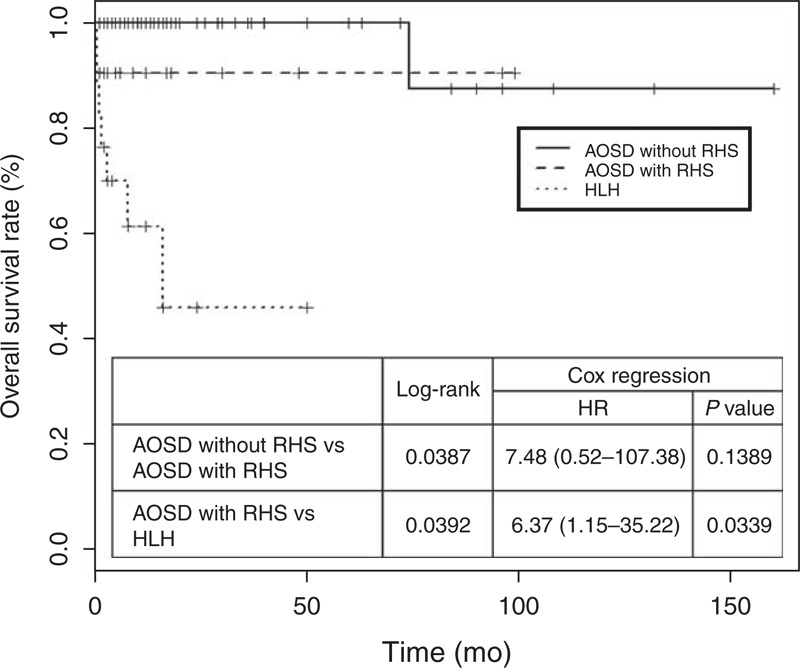
Hemophagocytic syndrome (HPS) is a potentially life-threatening complication of systemic inflammatory disorders. Adult-onset Still disease (AOSD) is one of the systemic autoimmune diseases associated with reactive hemophagocytic syndrome (RHS). This study aimed to evaluate the characteristic findings, predictive factors, and prognosis of RHS in patients with AOSD. We retrospectively evaluated 109 patients diagnosed with AOSD and reviewed their clinical data and laboratory findings, including the biopsy results of 21 AOSD patients with RHS. Moreover, data from 17 hemophagocytic lymphohistiocytosis (HLH) patients evaluated during the same period were compared with those from the RHS patients. Twenty-one patients (19.3%) developed RHS during the course of AOSD, and only 7 patients (6.4%) were confirmed by bone marrow, liver, or lymph node biopsy. AOSD patients with RHS showed significantly higher frequencies of splenomegaly, hepatomegaly, and lymphadenopathy than did those without RHS. Moreover, patients with RHS showed significantly higher relapse rates than those without RHS (61.9% vs 18.2%, P < 0.001). Possible triggering factors inducing hemophagocytosis were detected in 16 of 21 RHS patients (76.2%): disease flare in 12 patients (75%), infection in 3 patients (18.8%), and drug use in 1 patient (6.3%). AOSD patients with RHS showed higher frequencies of leukopenia, anemia, thrombocytopenia, hypoalbuminemia, hypofibrinogenemia, hypertriglyceridemia, hyperferritinemia, and elevated lactate dehydrogenase levels than did those without RHS. Multivariate logistic regression with forward selection procedure showed that low platelet count (<121,000/mm³), anemia, and hepatomegaly were independent predictors of RHS. Patients with definite RHS and those with probable RHS showed comparable results. Although RHS is a life-threatening complication of AOSD, long-term prognosis was observed to be similar in patients with and those without RHS. Compared to RHS patients, HLH patients had poor prognosis, such as higher death rates (52.9% vs 9.5%, P = 0.005). RHS can be considered when an AOSD patient shows at least 2 of the following 3 findings: low platelet count, anemia, and hepatomegaly. Diagnostic confirmation by biopsy may not be essential if typical clinical findings of RHS are present. Moreover, prognosis of RHS was better than that of HLH diagnosed by the presence of trilineage cytopenia at admission.
噬血细胞综合征(HPS)是系统性炎症性疾病一种潜在的危及生命的并发症。成人斯蒂尔病(AOSD)是与反应性噬血细胞综合征(RHS)相关的系统性自身免疫性疾病之一。本研究旨在评估AOSD患者RHS的特征性表现、预测因素及预后。我们回顾性评估了109例诊断为AOSD的患者,并复习了他们的临床资料和实验室检查结果,包括21例合并RHS的AOSD患者的活检结果。此外,将同期评估的17例噬血细胞性淋巴组织细胞增生症(HLH)患者的数据与RHS患者的数据进行了比较。21例患者(19.3%)在AOSD病程中发生了RHS,仅7例患者(6.4%)经骨髓、肝脏或淋巴结活检确诊。合并RHS的AOSD患者脾肿大、肝肿大和淋巴结病的发生率显著高于未合并RHS的患者。此外,RHS患者的复发率显著高于未合并RHS的患者(61.9%对18.2%,P<0.001)。21例RHS患者中有16例(76.2%)检测到可能诱发噬血细胞现象的触发因素:12例患者(75%)病情复发,3例患者(18.8%)感染,1例患者(6.3%)使用药物。合并RHS的AOSD患者白细胞减少、贫血、血小板减少、低白蛋白血症、低纤维蛋白原血症、高甘油三酯血症、高铁蛋白血症及乳酸脱氢酶水平升高的发生率高于未合并RHS的患者。采用向前选择法的多因素logistic回归分析显示,血小板计数低(<121,000/mm³)、贫血和肝肿大是RHS的独立预测因素。确诊RHS的患者和可能患有RHS的患者结果相当。尽管RHS是AOSD的一种危及生命的并发症,但观察到合并RHS和未合并RHS的患者长期预后相似。与RHS患者相比,HLH患者预后较差,如死亡率较高(52.9%对9.5%,P=0.005)。当AOSD患者出现以下3项表现中的至少2项时可考虑RHS:血小板计数低、贫血和肝肿大。如果存在RHS的典型临床表现,活检确诊可能并非必要。此外,RHS的预后优于入院时因三系血细胞减少而诊断的HLH。