Schelkunov Mikhail I, Shtratnikova Viktoria Yu, Nuraliev Maxim S, Selosse Marc-Andre, Penin Aleksey A, Logacheva Maria D
M. V. Lomonosov Moscow State University, Moscow, Russia.
M. V. Lomonosov Moscow State University, Moscow, Russia Joint Russian-Vietnamese Tropical Scientific and Technological Center, Cau Giay, Hanoi, Vietnam.
Genome Biol Evol. 2015 Jan 28;7(4):1179-91. doi: 10.1093/gbe/evv019.
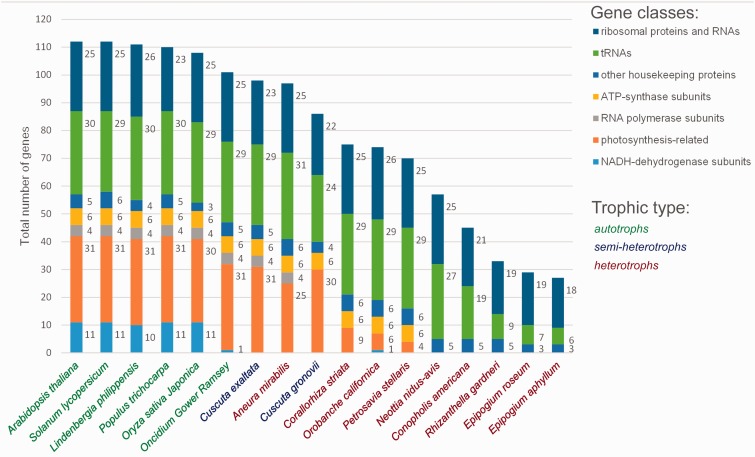
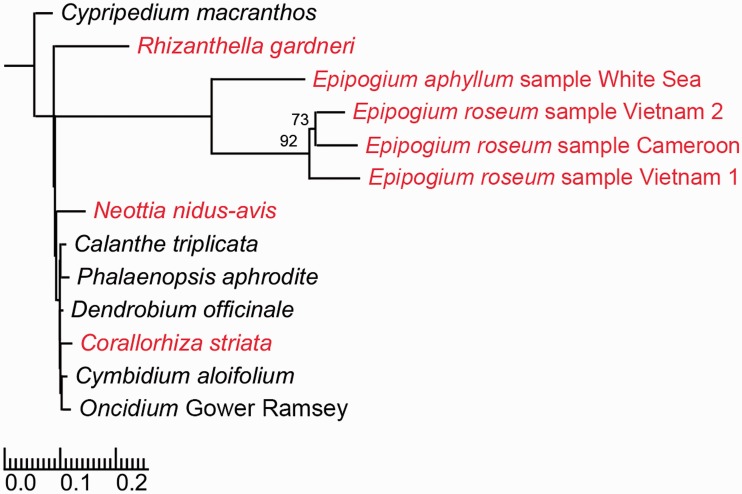
The question on the patterns and limits of reduction of plastid genomes in nonphotosynthetic plants and the reasons of their conservation is one of the intriguing topics in plant genome evolution. Here, we report sequencing and analysis of plastid genome in nonphotosynthetic orchids Epipogium aphyllum and Epipogium roseum, which, with sizes of 31 and 19 kbp, respectively, represent the smallest plastid genomes characterized by now. Besides drastic reduction, which is expected, we found several unusual features of these "minimal" plastomes: Multiple rearrangements, highly biased nucleotide composition, and unprecedentedly high substitution rate. Only 27 and 29 genes remained intact in the plastomes of E. aphyllum and E. roseum-those encoding ribosomal components, transfer RNAs, and three additional housekeeping genes (infA, clpP, and accD). We found no signs of relaxed selection acting on these genes. We hypothesize that the main reason for retention of plastid genomes in Epipogium is the necessity to translate messenger RNAs (mRNAs) of accD and/or clpP proteins which are essential for cell metabolism. However, these genes are absent in plastomes of several plant species; their absence is compensated by the presence of a functional copy arisen by gene transfer from plastid to the nuclear genome. This suggests that there is no single set of plastid-encoded essential genes, but rather different sets for different species and that the retention of a gene in the plastome depends on the interaction between the nucleus and plastids.
非光合植物质体基因组减少的模式和限度以及其保留原因的问题,是植物基因组进化中一个引人入胜的话题。在此,我们报告了非光合兰花无叶美冠兰和玫瑰美冠兰质体基因组的测序与分析,它们的大小分别为31和19千碱基对,是目前已鉴定出的最小质体基因组。除了预期中的大幅减少外,我们还发现这些“最小”质体基因组有几个不寻常的特征:多次重排、高度偏向的核苷酸组成以及前所未有的高替换率。在无叶美冠兰和玫瑰美冠兰的质体基因组中,分别只有27个和29个基因保持完整,这些基因编码核糖体成分、转运RNA以及另外三个管家基因(infA、clpP和accD)。我们没有发现这些基因受到宽松选择的迹象。我们推测,美冠兰质体基因组得以保留的主要原因是需要翻译对细胞代谢至关重要的accD和/或clpP蛋白的信使RNA(mRNA)。然而,这些基因在几种植物物种的质体基因组中并不存在;它们的缺失通过从质体转移到核基因组而产生的功能拷贝得到补偿。这表明不存在一套单一的质体编码必需基因,而是不同物种有不同的基因组合,并且质体基因组中一个基因的保留取决于细胞核与质体之间的相互作用。