• 文献检索
  • 文档翻译
  • 深度研究
  • 学术资讯
  • Suppr Zotero 插件Zotero 插件
  • 邀请有礼
  • 套餐&价格
  • 历史记录
应用&插件
Suppr Zotero 插件Zotero 插件浏览器插件Mac 客户端Windows 客户端微信小程序
定价
高级版会员购买积分包购买API积分包
服务
文献检索文档翻译深度研究API 文档MCP 服务
关于我们
关于 Suppr公司介绍联系我们用户协议隐私条款
关注我们

Suppr 超能文献

核心技术专利:CN118964589B侵权必究
粤ICP备2023148730 号-1Suppr @ 2026

文献检索

告别复杂PubMed语法,用中文像聊天一样搜索,搜遍4000万医学文献。AI智能推荐,让科研检索更轻松。

立即免费搜索

文件翻译

保留排版,准确专业,支持PDF/Word/PPT等文件格式,支持 12+语言互译。

免费翻译文档

深度研究

AI帮你快速写综述,25分钟生成高质量综述,智能提取关键信息,辅助科研写作。

立即免费体验

兰科植物的质体基因组进化与系统发育,附24个新序列

Plastome Evolution and Phylogeny of Orchidaceae, With 24 New Sequences.

作者信息

Kim Young-Kee, Jo Sangjin, Cheon Se-Hwan, Joo Min-Jung, Hong Ja-Ram, Kwak Myounghai, Kim Ki-Joong

机构信息

Division of Life Sciences, Korea University, Seoul, South Korea.

Department of Plant Resources, National Institute of Biological Resources, Incheon, South Korea.

出版信息

Front Plant Sci. 2020 Feb 21;11:22. doi: 10.3389/fpls.2020.00022. eCollection 2020.

DOI:10.3389/fpls.2020.00022
PMID:32153600
原文链接:https://pmc.ncbi.nlm.nih.gov/articles/PMC7047749/
Abstract

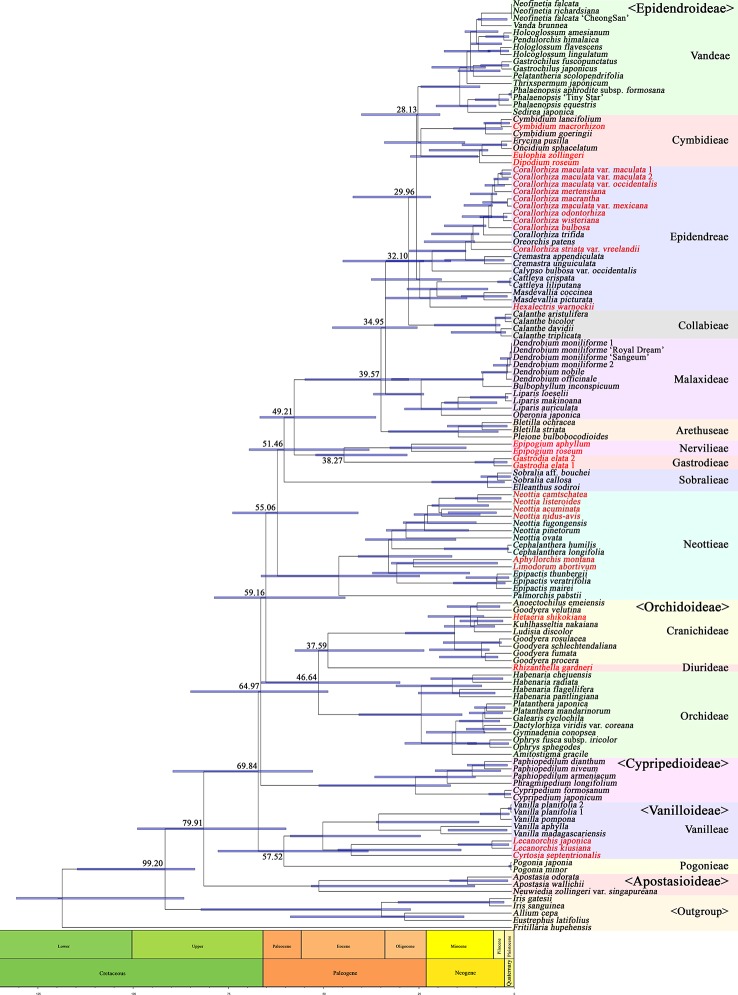
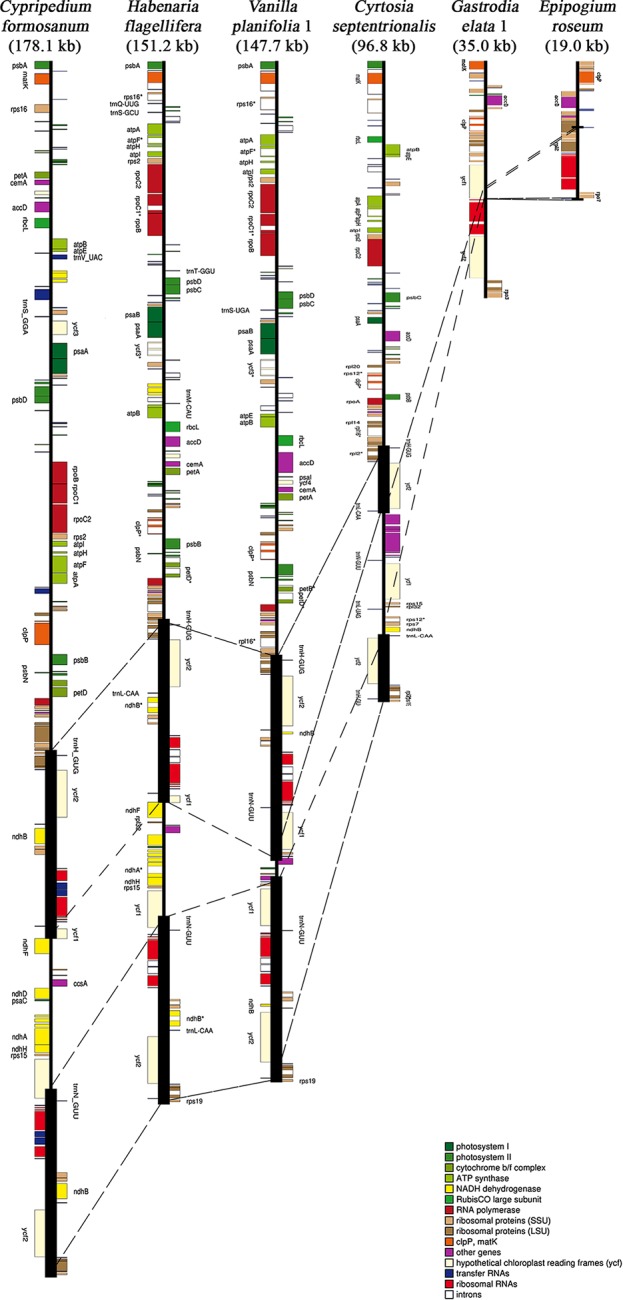
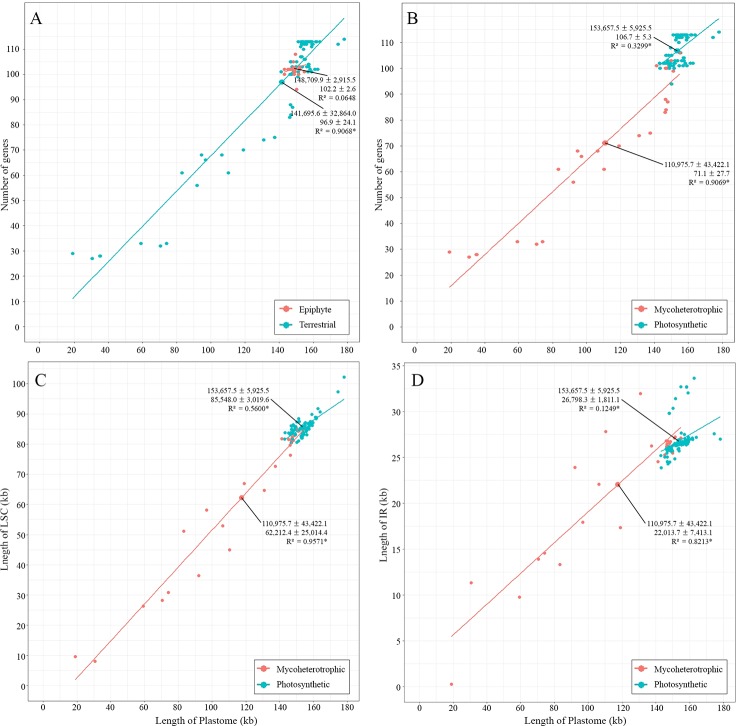
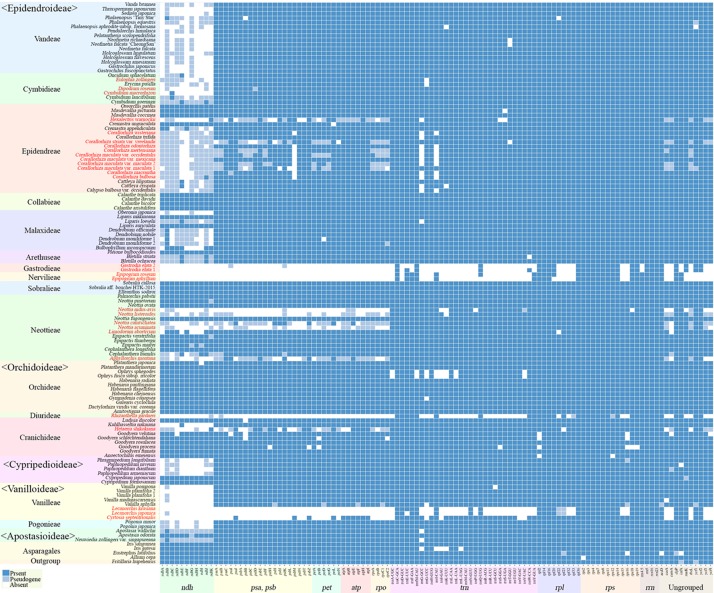
In order to understand the evolution of the orchid plastome, we annotated and compared 124 complete plastomes of Orchidaceae representing all the major lineages in their structures, gene contents, gene rearrangements, and IR contractions/expansions. Forty-two of these plastomes were generated from the corresponding author's laboratory, and 24 plastomes-including nine genera (, , , , , , , and )-are new in this study. All orchid plastomes, except and have a quadripartite structure consisting of a large single copy (LSC), two inverted repeats (IRs), and a small single copy (SSC) region. The IR region was completely lost in the plastomes. The SSC is lost in the plastome. The smallest plastome size was 19,047 bp, in and the largest plastome size was 178,131 bp, in . The small plastome sizes are primarily the result of gene losses associated with mycoheterotrophic habitats, while the large plastome sizes are due to the expansion of noncoding regions. The minimal number of common genes among orchid plastomes to maintain minimal plastome activity was 15, including the three subunits of (14, 16, and 36), seven subunits of (2, 3, 4, 7, 8, 11, and 14), three subunits of (5, 16, and 23), C-GCA, and P genes. Three stages of gene loss were observed among the orchid plastomes. The first was gene loss, which is widespread in Apostasioideae, Vanilloideae, Cypripedioideae, and Epidendroideae, but rare in the Orchidoideae. The second stage was the loss of photosynthetic genes (, and ) and gene subunits, which are restricted to and some species of and . The third stage was gene loss related to prokaryotic gene expression (, , and others), which was observed in , , and In addition, an intermediate stage between the second and third stage was observed in (Vanilloideae). The majority of intron losses are associated with the loss of their corresponding genes. In some orchid taxa, however, introns have been lost in 1616, and P(2) without their corresponding gene being lost. A total of 104 gene rearrangements were counted when comparing 116 orchid plastomes. Among them, many were concentrated near the IRa/b-SSC junction area. The plastome phylogeny of 124 orchid species confirmed the relationship of {Apostasioideae [Vanilloideae (Cypripedioideae (Orchidoideae, Epidendroideae))]} at the subfamily level and the phylogenetic relationships of 17 tribes were also established. Molecular clock analysis based on the whole plastome sequences suggested that Orchidaceae diverged from its sister family 99.2 mya, and the estimated divergence times of five subfamilies are as follows: Apostasioideae (79.91 mya), Vanilloideae (69.84 mya), Cypripedioideae (64.97 mya), Orchidoideae (59.16 mya), and Epidendroideae (59.16 mya). We also released the first nuclear ribosomal (nr) DNA unit (18S-ITS1-5.8S-ITS2-28S-NTS-ETS) sequences for the 42 species of Orchidaceae. Finally, the phylogenetic tree based on the nrDNA unit sequences is compared to the tree based on the 42 identical plastome sequences, and the differences between the two datasets are discussed in this paper.

摘要

为了解兰花质体基因组的进化,我们注释并比较了124个兰科植物的完整质体基因组,这些基因组代表了所有主要谱系,涉及结构、基因内容、基因重排以及反向重复序列(IR)的收缩/扩张。其中42个质体基因组由通讯作者的实验室产生,24个质体基因组(包括9个属:[此处原文缺失属名])是本研究中的新数据。除[此处原文缺失属名]和[此处原文缺失属名]外,所有兰花质体基因组都具有四分体结构,由一个大单拷贝(LSC)、两个反向重复序列(IRs)和一个小单拷贝(SSC)区域组成。在[此处原文缺失属名]质体基因组中,IR区域完全丢失。在[此处原文缺失属名]质体基因组中,SSC区域丢失。最小的质体基因组大小为19,047 bp,存在于[此处原文缺失属名]中,最大的质体基因组大小为178,131 bp,存在于[此处原文缺失属名]中。较小的质体基因组大小主要是与菌异养生境相关的基因丢失的结果,而较大的质体基因组大小则是由于非编码区域的扩张。兰花质体基因组中维持最小质体基因组活性的共同基因的最小数量为15个,包括光合系统I的三个亚基(14、16和36)、光合系统II的七个亚基(2、3、4、7、8、11和14)、细胞色素b6f复合体的三个亚基(5、16和23)、C-GCA以及P基因。在兰花质体基因组中观察到了三个基因丢失阶段。第一阶段是光合系统I基因丢失,这在拟兰亚科、香荚兰亚科、杓兰亚科和树兰亚科中广泛存在,但在红门兰亚科中很少见。第二阶段是光合基因(psbA、psbD和psbM)和细胞色素b6f复合体基因亚基的丢失,这仅限于[此处原文缺失属名]以及[此处原文缺失属名]和[此处原文缺失属名]的一些物种。第三阶段是与原核基因表达相关的基因丢失(rpl22、rps19、rps7等),这在[此处原文缺失属名]、[此处原文缺失属名]、[此处原文缺失属名]和[此处原文缺失属名]中观察到。此外,在香荚兰亚科的[此处原文缺失属名]中观察到了第二阶段和第三阶段之间的一个中间阶段。大多数内含子的丢失与它们相应基因的丢失相关。然而,在一些兰花分类群中,内含子在1616和P(2)中丢失,而它们相应的基因并未丢失。在比较116个兰花质体基因组时,总共统计到104次基因重排。其中,许多重排集中在IRa/b-SSC交界区域附近。124种兰花的质体基因组系统发育在亚科水平上证实了{拟兰亚科[香荚兰亚科(杓兰亚科(红门兰亚科、树兰亚科))]}的关系,并且还建立了17个族的系统发育关系。基于全质体基因组序列的分子钟分析表明,兰科与其姐妹科在9920万年前分化,五个亚科的估计分化时间如下:拟兰亚科(7991万年前)、香荚兰亚科(6984万年前)、杓兰亚科(6497万年前)、红门兰亚科(5916万年前)和树兰亚科(5916万年前)。我们还公布了42种兰科植物的首个核糖体(nr)DNA单元(18S-ITS1-5.8S-ITS2-28S-NTS-ETS)序列。最后,将基于nrDNA单元序列的系统发育树与基于42个相同质体基因组序列的树进行比较,并在本文中讨论了这两个数据集之间的差异。
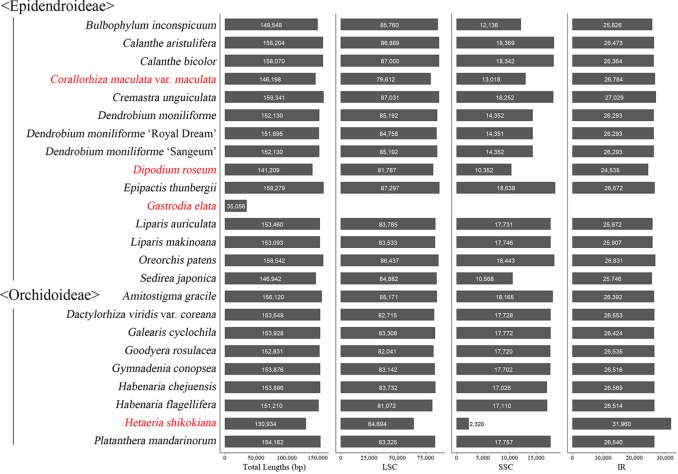
https://cdn.ncbi.nlm.nih.gov/pmc/blobs/e0aa/7047749/ad8bfe465b62/fpls-11-00022-g010.jpg
https://cdn.ncbi.nlm.nih.gov/pmc/blobs/e0aa/7047749/25918cd4b546/fpls-11-00022-g001.jpg
https://cdn.ncbi.nlm.nih.gov/pmc/blobs/e0aa/7047749/9d47fcb509fd/fpls-11-00022-g002.jpg
https://cdn.ncbi.nlm.nih.gov/pmc/blobs/e0aa/7047749/88afe64a6665/fpls-11-00022-g003.jpg
https://cdn.ncbi.nlm.nih.gov/pmc/blobs/e0aa/7047749/a965b0dae80b/fpls-11-00022-g004.jpg
https://cdn.ncbi.nlm.nih.gov/pmc/blobs/e0aa/7047749/70e0d5bad216/fpls-11-00022-g005.jpg
https://cdn.ncbi.nlm.nih.gov/pmc/blobs/e0aa/7047749/5447c76bf420/fpls-11-00022-g006.jpg
https://cdn.ncbi.nlm.nih.gov/pmc/blobs/e0aa/7047749/650bd4fd685c/fpls-11-00022-g007.jpg
https://cdn.ncbi.nlm.nih.gov/pmc/blobs/e0aa/7047749/6eb9d073edbf/fpls-11-00022-g008.jpg
https://cdn.ncbi.nlm.nih.gov/pmc/blobs/e0aa/7047749/7c3a3a36f861/fpls-11-00022-g009.jpg
https://cdn.ncbi.nlm.nih.gov/pmc/blobs/e0aa/7047749/ad8bfe465b62/fpls-11-00022-g010.jpg
https://cdn.ncbi.nlm.nih.gov/pmc/blobs/e0aa/7047749/25918cd4b546/fpls-11-00022-g001.jpg
https://cdn.ncbi.nlm.nih.gov/pmc/blobs/e0aa/7047749/9d47fcb509fd/fpls-11-00022-g002.jpg
https://cdn.ncbi.nlm.nih.gov/pmc/blobs/e0aa/7047749/88afe64a6665/fpls-11-00022-g003.jpg
https://cdn.ncbi.nlm.nih.gov/pmc/blobs/e0aa/7047749/a965b0dae80b/fpls-11-00022-g004.jpg
https://cdn.ncbi.nlm.nih.gov/pmc/blobs/e0aa/7047749/70e0d5bad216/fpls-11-00022-g005.jpg
https://cdn.ncbi.nlm.nih.gov/pmc/blobs/e0aa/7047749/5447c76bf420/fpls-11-00022-g006.jpg
https://cdn.ncbi.nlm.nih.gov/pmc/blobs/e0aa/7047749/650bd4fd685c/fpls-11-00022-g007.jpg
https://cdn.ncbi.nlm.nih.gov/pmc/blobs/e0aa/7047749/6eb9d073edbf/fpls-11-00022-g008.jpg
https://cdn.ncbi.nlm.nih.gov/pmc/blobs/e0aa/7047749/7c3a3a36f861/fpls-11-00022-g009.jpg
https://cdn.ncbi.nlm.nih.gov/pmc/blobs/e0aa/7047749/ad8bfe465b62/fpls-11-00022-g010.jpg

相似文献

1
Plastome Evolution and Phylogeny of Orchidaceae, With 24 New Sequences.兰科植物的质体基因组进化与系统发育,附24个新序列
Front Plant Sci. 2020 Feb 21;11:22. doi: 10.3389/fpls.2020.00022. eCollection 2020.
2
Evolutionary Patterns of the Chloroplast Genome in Vanilloid Orchids (Vanilloideae, Orchidaceae).叶绿体基因组在花椒兰族(Vanilloideae,兰科)中的进化模式。
Int J Mol Sci. 2023 Feb 14;24(4):3808. doi: 10.3390/ijms24043808.
3
The Complete Plastome Sequences of Four Orchid Species: Insights into the Evolution of the Orchidaceae and the Utility of Plastomic Mutational Hotspots.四种兰花物种的完整质体基因组序列:对兰科植物进化及质体基因组突变热点效用的见解
Front Plant Sci. 2017 May 3;8:715. doi: 10.3389/fpls.2017.00715. eCollection 2017.
4
Evolutionary differences in gene loss and pseudogenization among mycoheterotrophic orchids in the tribe Vanilleae (subfamily Vanilloideae).香草亚科(Vanilloideae)香荚兰族(Vanilleae)菌根异养兰花基因丢失和假基因化的进化差异
Front Plant Sci. 2023 Mar 22;14:1160446. doi: 10.3389/fpls.2023.1160446. eCollection 2023.
5
Extensive Losses of Photosynthesis Genes in the Plastome of a Mycoheterotrophic Orchid, Cyrtosia septentrionalis (Vanilloideae: Orchidaceae).共生型兰花 Cyrtosia septentrionalis(Vanilloideae:Orchidaceae)质体基因组中光合作用基因的广泛缺失。
Genome Biol Evol. 2019 Feb 1;11(2):565-571. doi: 10.1093/gbe/evz024.
6
Plastome evolution and phylogeny of subtribe Aeridinae (Vandeae, Orchidaceae).质体基因组进化与万代兰亚族(兰科,树兰族)系统发育。
Mol Phylogenet Evol. 2020 Mar;144:106721. doi: 10.1016/j.ympev.2019.106721. Epub 2019 Dec 21.
7
Phylogenomics of Orchidaceae based on plastid and mitochondrial genomes.基于质体和线粒体基因组的兰科系统发生基因组学。
Mol Phylogenet Evol. 2019 Oct;139:106540. doi: 10.1016/j.ympev.2019.106540. Epub 2019 Jun 25.
8
Seven New Complete Plastome Sequences Reveal Rampant Independent Loss of the ndh Gene Family across Orchids and Associated Instability of the Inverted Repeat/Small Single-Copy Region Boundaries.七个新的完整质体基因组序列揭示了兰花中ndh基因家族的大量独立丢失以及反向重复/小单拷贝区域边界的相关不稳定性。
PLoS One. 2015 Nov 11;10(11):e0142215. doi: 10.1371/journal.pone.0142215. eCollection 2015.
9
Comparative Analysis of the Complete Plastomes of and (Apostasioideae) Reveals Different Evolutionary Dynamics of IR/SSC Boundary among Photosynthetic Orchids.天麻属和拟天麻属(拟兰亚科)完整质体基因组的比较分析揭示了光合兰花中IR/SSC边界的不同进化动态。
Front Plant Sci. 2017 Oct 4;8:1713. doi: 10.3389/fpls.2017.01713. eCollection 2017.
10
Morphological and genomic evidence for a new species of (Orchidaceae: Epidendroideae) from SW China.来自中国西南部的一种新的(兰科:树兰亚科)的形态学和基因组证据。
Plant Divers. 2021 Jan 23;43(5):409-419. doi: 10.1016/j.pld.2021.01.002. eCollection 2021 Oct.

引用本文的文献

1
Plastome phylogenomics of the diverse neotropical orchid genus Lepanthes with emphasis on subgenus Marsipanthes (Pleurothallidinae: Orchidaceae).新热带地区多样化的 Lepanthes 属兰花的质体基因组系统发育学研究,重点关注 Marsipanthes 亚属(侧萼兰亚族:兰科)。
BMC Ecol Evol. 2025 Aug 7;25(1):79. doi: 10.1186/s12862-025-02396-6.
2
Genome Skimming Reveals Plastome Conservation, Phylogenetic Structure, and Novel Molecular Markers in Valuable Orchid .基因组浅层测序揭示了珍贵兰花的质体基因组保守性、系统发育结构和新型分子标记
Genes (Basel). 2025 Jun 20;16(7):723. doi: 10.3390/genes16070723.
3
The complete chloroplast genome of (Rolfe ex Downie) Garay and its phylogenetic analysis.

本文引用的文献

1
Next-generation sequencing yields the complete chloroplast genome of acc. smg222 and phylogenetic analysis.新一代测序技术获得了acc. smg222的完整叶绿体基因组并进行了系统发育分析。
Mitochondrial DNA B Resour. 2018 Feb 12;3(1):215-216. doi: 10.1080/23802359.2018.1437812.
2
The complete plastome sequence of the endangered orchid (Orchidaceae).濒危兰花(兰科)的完整质体基因组序列
Mitochondrial DNA B Resour. 2017 Oct 18;2(2):725-727. doi: 10.1080/23802359.2017.1390411.
3
The complete plastome sequence of the endangered orchid (Orchidaceae).
(罗尔夫·唐尼)加雷的完整叶绿体基因组及其系统发育分析。
Mitochondrial DNA B Resour. 2025 Jul 9;10(8):683-686. doi: 10.1080/23802359.2025.2528572. eCollection 2025.
4
Plastome and transcriptome analysis reveals a degenerated photosynthesis-related pathway in the mycoheterotrophic vanilloid orchid Cyrtosia lindleyana.质体基因组和转录组分析揭示了菌异养香草兰 Cyrtosia lindleyana 中一条退化的光合作用相关途径。
BMC Plant Biol. 2025 Jul 2;25(1):841. doi: 10.1186/s12870-025-06850-x.
5
Comparative Analysis of the Chloroplast Genomes of Cypripedium: Assessing the Roles of SSRs and TRs in the Non-Coding Regions of LSC in Shaping Chloroplast Genome Size.杓兰属叶绿体基因组的比较分析:评估简单序列重复(SSRs)和串联重复(TRs)在大单拷贝区(LSC)非编码区对叶绿体基因组大小塑造中的作用
Int J Mol Sci. 2025 Apr 14;26(8):3691. doi: 10.3390/ijms26083691.
6
Rapid loss of plastid genes in slipper orchids (Cypripedioideae, Orchidaceae).拖鞋兰(兰科,杓兰亚科)质体基因的快速丢失
Front Plant Sci. 2025 Apr 22;16:1507415. doi: 10.3389/fpls.2025.1507415. eCollection 2025.
7
Mitochondrial genome evolution in the orchid subfamily Cypripedioideae (Orchidaceae).兰科杓兰亚科线粒体基因组的进化
Funct Integr Genomics. 2025 Apr 30;25(1):96. doi: 10.1007/s10142-025-01596-z.
8
Plastome phylogenomics unravels the evolutionary relationships and biogeographic history of Chloranthaceae.质体基因组系统发育基因组学揭示了金粟兰科的进化关系和生物地理历史。
BMC Plant Biol. 2025 Apr 25;25(1):543. doi: 10.1186/s12870-025-06586-8.
9
The complete chloroplast genome sequences of three Cypripedium species and their phylogenetic analysis.三种杓兰属植物的完整叶绿体基因组序列及其系统发育分析
Sci Rep. 2025 Apr 18;15(1):13461. doi: 10.1038/s41598-025-98287-3.
10
Unveiling a Meaningful Form of × Sw. (Cypripedioideae, Orchidaceae) from Changbai Mountain, China: Insights from Morphological, Molecular, and Plastome Analyses.揭示中国长白山×Sw.(兰科,杓兰亚科)的一种有意义的形态:来自形态学、分子和质体基因组分析的见解
Plants (Basel). 2025 Mar 3;14(5):772. doi: 10.3390/plants14050772.
濒危兰花(兰科)的完整质体基因组序列。
Mitochondrial DNA B Resour. 2017 Oct 14;2(2):704-706. doi: 10.1080/23802359.2017.1390410.
4
The plastid genome of Vanillon (, Orchidaceae).万代兰属(兰科)的质体基因组。
Mitochondrial DNA B Resour. 2017 Sep 29;2(2):689-691. doi: 10.1080/23802359.2017.1383201.
5
has one of the most reduced and mutated plastid genomes known.拥有已知的最为简化和发生突变的质体基因组之一。
PeerJ. 2019 Sep 12;7:e7500. doi: 10.7717/peerj.7500. eCollection 2019.
6
Thirteen New Plastid Genomes from Mixotrophic and Autotrophic Species Provide Insights into Heterotrophy Evolution in Neottieae Orchids.13 个来自混养和自养物种的新质体基因组为 Neottieae 兰花异养进化提供了新见解。
Genome Biol Evol. 2019 Sep 1;11(9):2457-2467. doi: 10.1093/gbe/evz170.
7
BEAST 2.5: An advanced software platform for Bayesian evolutionary analysis.BEAST 2.5:一个用于贝叶斯进化分析的高级软件平台。
PLoS Comput Biol. 2019 Apr 8;15(4):e1006650. doi: 10.1371/journal.pcbi.1006650. eCollection 2019 Apr.
8
Evolution of plastid genomes of Holcoglossum (Orchidaceae) with recent radiation.具有近期辐射的 Holcoglossum(兰科)质体基因组的进化。
BMC Evol Biol. 2019 Feb 26;19(1):63. doi: 10.1186/s12862-019-1384-5.
9
Extensive Losses of Photosynthesis Genes in the Plastome of a Mycoheterotrophic Orchid, Cyrtosia septentrionalis (Vanilloideae: Orchidaceae).共生型兰花 Cyrtosia septentrionalis(Vanilloideae:Orchidaceae)质体基因组中光合作用基因的广泛缺失。
Genome Biol Evol. 2019 Feb 1;11(2):565-571. doi: 10.1093/gbe/evz024.
10
The complete plastid genomes of Ophrys iricolor and O. sphegodes (Orchidaceae) and comparative analyses with other orchids.Ophrys iricolor 和 O. sphegodes(兰科)的完整质体基因组及与其他兰花的比较分析。
PLoS One. 2018 Sep 18;13(9):e0204174. doi: 10.1371/journal.pone.0204174. eCollection 2018.