O'Donnell Steve, Adler David H, Inboriboon Pholaphat Charles, Alvarado Hermenegildo, Acosta Raul, Godoy-Monzon Daniel
Department of Neurology, University of Utah Health Sciences Center, Salt Lake City 84132, UT, USA.
Department of Emergency Medicine, University of Rochester School of Medicine and Dentistry, Rochester 14642, NY, USA.
Int J Emerg Med. 2014 Aug 2;7:24. doi: 10.1186/s12245-014-0024-5. eCollection 2014.
Emergency Medicine (EM) is increasingly becoming an international field. The number of fellowships in International EM in the USA is growing along with opportunities to complete international health electives (IHEs) during residency training. The impact on host institutions, however, has not been adequately investigated. The objective of this study is to assess the experience of several South American hospitals hosting foreign EM residents completing IHEs.
Anonymous, semi-structured one-on-one interviews were conducted with physicians working in Emergency Departments in three hospitals in Lima, Peru and one hospital in Buenos Aires, Argentina. All participants reported previously working with EM foreign rotators. Interviews were analyzed qualitatively and coded for common themes.
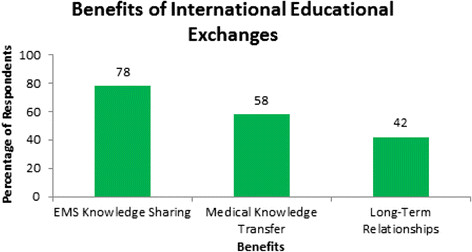
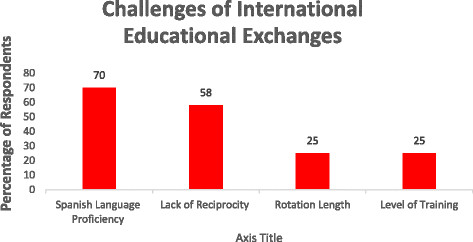
Three department chairs, six residents, and 15 attending physicians were interviewed (total = 24). After qualitative analysis of interviews, two broad theme categories emerged: Benefits and Challenges. Most commonly reported benefits were knowledge sharing about emergency medical systems (78%), medical knowledge transfer (58%), and long-term relationship formation (42%). Top challenges included rotator Spanish language proficiency (70%) lack of reciprocity (58%), and level of training and rotation length (25%). Spanish proficiency related directly to how involved rotators became in patient care (e.g., taking a history, participating in rounds) but was not completely prohibitive, as a majority of physicians interviewed felt comfortable speaking in English. Lack of reciprocity refers to the difficulty of sending host physicians abroad as well as failed attempts at building long-lasting relationships with foreign institutions. Lastly, 25% preferred rotators to stay for at least 1 month and rotate in the last year of EM residency. This latter preference increased knowledge transfer from rotator to host.
Our research identified benefits and challenges of IHEs in Emergency Medicine from the perspective of physician hosts in several hospitals in South America. Our results suggest that IHEs function best when EM residents rotate later in residency training and when relationships are maintained and deepened among those involved including host physicians, rotators, and institutions. This leads to future rotators, project collaboration, research, and publications which not only benefit individuals involved but also the wider field of Emergency Medicine.
急诊医学(EM)日益成为一个国际化领域。美国国际急诊医学奖学金的数量不断增加,同时住院医师培训期间完成国际健康选修课程(IHEs)的机会也在增多。然而,对接收机构的影响尚未得到充分研究。本研究的目的是评估几家接待完成IHEs的外国急诊医学住院医师的南美医院的经验。
对秘鲁利马的三家医院和阿根廷布宜诺斯艾利斯的一家医院急诊科的医生进行了匿名的半结构化一对一访谈。所有参与者都报告曾与外国急诊医学轮转医生共事过。对访谈进行定性分析并编码以找出共同主题。
共访谈了3位科室主任、6名住院医师和15名主治医师(共24人)。对访谈进行定性分析后,出现了两大类主题:益处和挑战。最常报告的益处是关于急救医疗系统的知识共享(78%)、医学知识传授(58%)和建立长期关系(42%)。主要挑战包括轮转医生的西班牙语水平(70%)、缺乏对等交流(58%)以及培训水平和轮转时长(25%)。西班牙语水平直接关系到轮转医生参与患者护理的程度(例如,问诊、参加查房),但并非完全具有阻碍性,因为大多数接受访谈的医生用英语交流也感到自在。缺乏对等交流是指派遣接待医生出国存在困难,以及与外国机构建立持久关系的尝试失败。最后,25%的人希望轮转医生至少停留1个月并在急诊医学住院医师培训的最后一年进行轮转。后一种偏好增加了轮转医生向接待方的知识传授。
我们的研究从南美几家医院的医生接待方的角度确定了急诊医学中IHEs的益处和挑战。我们的结果表明,当急诊医学住院医师在住院医师培训后期进行轮转,并且包括接待医生、轮转医生和机构在内的相关各方之间的关系得到维持和深化时,IHEs的效果最佳。这会带来未来的轮转医生、项目合作、研究和出版物,不仅使相关个人受益,也使更广泛的急诊医学领域受益。