Galukande Moses, Sekavuga Dennis Bbaale, Muganzi Alex, Coutinho Alex
International Hospital Kampala, Namuwongo P.O. Box 8177, Kampala, Uganda.
Infectious Diseases Institute, Makerere University, Kampala, Uganda.
Int J Emerg Med. 2014 Sep 24;7:37. doi: 10.1186/s12245-014-0037-0. eCollection 2014.
In the advent of mass voluntary medical male circumcision (VMMC) for the partial prevention of HIV, previously rare adverse events associated with adult male circumcision are likely to be encountered with higher frequency. Fournier's gangrene, defined as a polymicrobial necrotizing fasciitis of the perineal, perianal or genital areas, is one such rare and life-threatening adverse event. In this report, we present two cases that were identified in the context of a VMMC programme over a 3-year period during which approximately 100,000 adult circumcisions were performed.
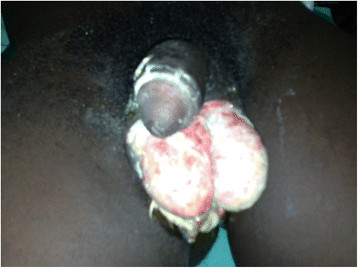
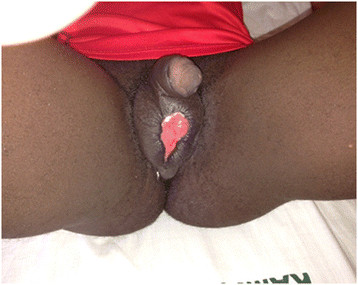
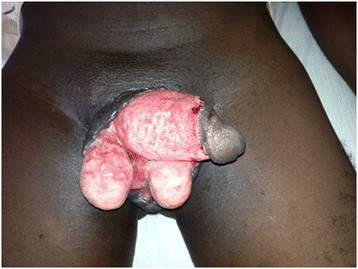
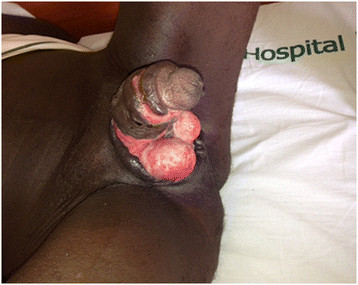
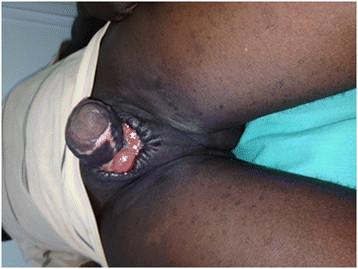
Case 1: A 19-year-old male who had VMMC performed using the dorsal slit technique developed pain and blisters on the scrotal skin on the sixth postoperative day. He had no co-morbidities, and serology for HIV was negative. On examination, locally he had scrotal skin necrosis with an offensive odour and was dehydrated but afebrile. Repeated aggressive debridement was done while he stayed in a hospital for 3 weeks; at which point, he had healthy granulation tissue and was free of infection. The wound had closed spontaneously and completely by the fifth month. Case 2: A 52-year-old male who had VMMC performed with the sleeve resection method developed pain and swelling of the penis and scrotum on the fourth postoperative day. He had a low-grade fever of 37.6°C. He was not diabetic or immunosuppressed and had a negative HIV serology. He was admitted and was given IV antibiotics, and repeated aggressive debridement was performed. On the third week of hospitalization, he had healthy granulation tissue and received a split skin graft on the penile shaft. At 4 months, the scrotal defect had completely closed.
Fournier's gangrene is a rare occurrence after adult male circumcision with associated high morbidity. These are the first descriptions in the VMMC era.
在大规模自愿男性包皮环切术(VMMC)用于部分预防艾滋病病毒(HIV)的时代,以前与成年男性包皮环切术相关的罕见不良事件可能会更频繁地出现。福尼尔坏疽被定义为会阴、肛周或生殖器区域的多微生物坏死性筋膜炎,就是这样一种罕见且危及生命的不良事件。在本报告中,我们呈现了在一项VMMC计划的3年期间内发现的两例病例,在此期间大约进行了10万例成年男性包皮环切术。
病例1:一名19岁男性接受了采用背侧切开技术的VMMC,术后第6天阴囊皮肤出现疼痛和水疱。他没有合并症,HIV血清学检测为阴性。检查发现,局部阴囊皮肤坏死并有恶臭,他脱水但无发热。在他住院3周期间反复进行了积极的清创术;此时,他有健康的肉芽组织且无感染。伤口在第5个月时自行完全愈合。病例2:一名52岁男性接受了袖套切除术的VMMC,术后第4天阴茎和阴囊出现疼痛和肿胀。他有37.6°C的低热。他没有糖尿病或免疫抑制,HIV血清学检测为阴性。他入院后接受了静脉抗生素治疗,并反复进行了积极的清创术。住院第3周时,他有健康的肉芽组织,并在阴茎干上接受了植皮手术。4个月时,阴囊缺损完全闭合。
福尼尔坏疽是成年男性包皮环切术后罕见的并发症,发病率高。这些是VMMC时代的首例描述。