Paladini Alessio, Cochetti Giovanni, Tancredi Angelica, Mearini Matteo, Vitale Andrea, Pastore Francesca, Mangione Paolo, Mearini Ettore
Department of Medicine and Surgery, Urology Clinic, University of Perugia, 06129, Perugia, Italy.
Basic Clin Androl. 2022 Jul 19;32(1):12. doi: 10.1186/s12610-022-00162-y.
Fournier's gangrene (FG) is a necrotizing fasciitis caused by aerobic and anaerobic bacterial infection that involves genitalia and perineum. Males, in their 60 s, are more affected with 1.6 new cases/100.000/year. Main risk factors are diabetes, malignancy, inflammatory bowel disease. FG is a potentially lethal disease with a rapid and progressive involvement of subcutaneous and fascial plane. A multimodal approach with surgical debridement, antibiotic therapy, intensive support care, and hyperbaric oxygen therapy (HBOT) is often needed. We present the inpatient management of an FG case during the Covid-19 pandemic period. A narrative review of the Literature searching "Fournier's gangrene", "necrotizing fasciitis" on PubMed and Scopus was performed.
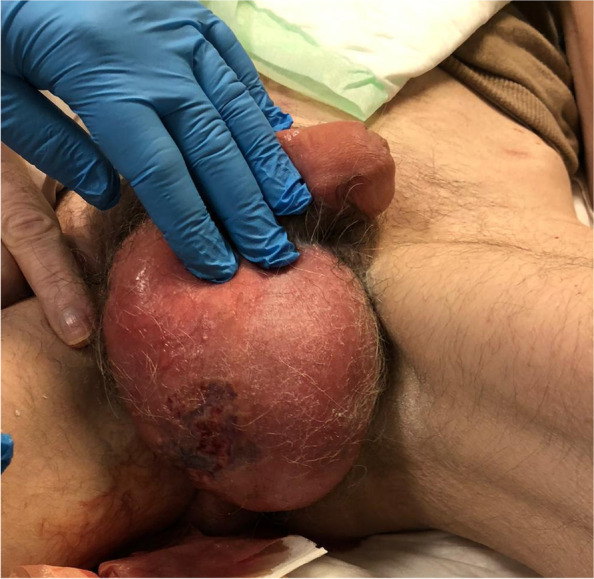
A 60 years old man affected by diabetes mellitus, with ileostomy after colectomy for ulcerative colitis, was admitted to our Emergency Department with fever and acute pain, edema, dyschromia of right hemiscrotum, penis, and perineal region. Computed tomography revealed air-gas content and fluid-edematous thickening of these regions. Fournier's Gangrene Severity Index was 9. A prompt broad-spectrum antibiotic therapy with Piperacillin/Tazobactam, Imipenem and Daptomycin, surgical debridement of genitalia and perineal region with vital tissue exposure, were performed. Bedside daily surgical wound medications with fibrine debridement, normal saline and povidone-iodine solutions irrigation, iodoform and fatty gauze application, were performed until discharge on the 40 postoperative day. Every 3 days office-based medication with silver dressing, after normal saline and povidone-iodine irrigation and fibrinous tissue debridement, was performed until complete re-epithelialization of the scrotum on the 60 postoperative day.
FG is burdened by a high mortality rate, up to 30%. In the literature, HBOT could improve wound restoration and disease-specific survival. Unfortunately, in our center, we do not have HBOT. Moreover, one of the pandemic period problems was the patient's displacement and outpatient hospital management. For all these reasons we decided for a conservative inpatient management. Daily cleaning of the surgical wound allowed to obtain its complete restoration avoiding surgical graft and hyperbaric oxygen chamber therapy, without foregoing optimal outcomes.
福尼尔坏疽(FG)是一种由需氧菌和厌氧菌感染引起的坏死性筋膜炎,累及生殖器和会阴。60多岁的男性受影响更为严重,年发病率为1.6例/10万。主要危险因素包括糖尿病、恶性肿瘤、炎症性肠病。FG是一种潜在的致命疾病,可迅速累及皮下组织和筋膜平面。通常需要采用手术清创、抗生素治疗、重症支持治疗和高压氧治疗(HBOT)的多模式方法。我们介绍了1例在新冠疫情期间住院治疗的FG病例。通过在PubMed和Scopus上检索“福尼尔坏疽”“坏死性筋膜炎”对相关文献进行了叙述性综述。
一名60岁男性,患有糖尿病,因溃疡性结肠炎行结肠切除术后行回肠造口术,因发热、急性疼痛、水肿、右侧阴囊、阴茎和会阴区色素沉着异常入住我院急诊科。计算机断层扫描显示这些区域有气体和液体水肿增厚。福尼尔坏疽严重程度指数为9。立即给予哌拉西林/他唑巴坦、亚胺培南和达托霉素进行广谱抗生素治疗,并对生殖器和会阴区进行手术清创,暴露重要组织。术后每天在床边进行手术伤口处理,包括纤维蛋白清创、生理盐水和聚维酮碘溶液冲洗、应用碘仿和脂肪纱布,直至术后第40天出院。术后每3天在门诊进行一次换药,用银敷料,在生理盐水和聚维酮碘冲洗及纤维组织清创后,直至术后第60天阴囊完全重新上皮化。
FG的死亡率很高,可达30%。文献表明,HBOT可改善伤口愈合和疾病特异性生存率。不幸的是,我们中心没有HBOT。此外,疫情期间的问题之一是患者的转移和门诊管理。由于所有这些原因,我们决定采用保守的住院治疗方法。每天对手术伤口进行清洁,使其完全愈合,避免了手术植皮和高压氧舱治疗,且未影响最佳治疗效果。