Biogen Idec (J.E., L.A., K.R.), Cambridge, MA; AbbVie Biotherapeutics Inc. (J.S.), Redwood City, CA; Medical University of Lodz (K.S.), Poland; Neuroimmunology Branch (B.B.), National Institute of Neurological Disorders and Stroke, National Institutes of Health, Bethesda, MD; Excel Scientific Solutions (E.P.), Southport, CT; and Blizard Institute (G.G.), Barts and The London School of Medicine and Dentistry, Queen Mary University of London, UK.
Neurol Neuroimmunol Neuroinflamm. 2015 Jan 22;2(2):e65. doi: 10.1212/NXI.0000000000000065. eCollection 2015 Apr.
To assess the relationship between CD56(bright) natural killer (NK) cells and multiple sclerosis (MS) disease activity in patients with relapsing-remitting MS treated with daclizumab high-yield process (DAC HYP).
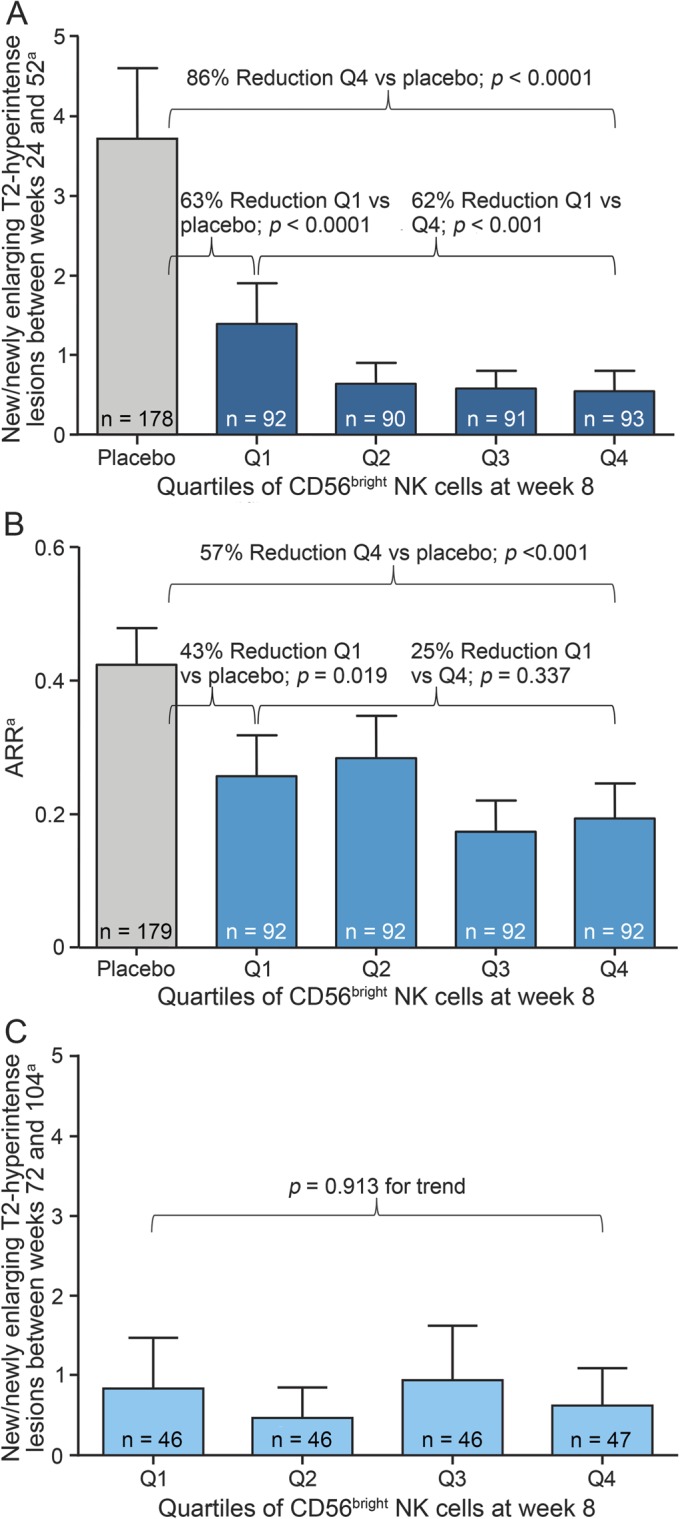
Data were from patients enrolled in a 52-week randomized, double-blind, placebo-controlled study of DAC HYP and its extension study. Assessments included relationships of CD56(bright) NK cell numbers (identified using fluorescence-activated cell sorting) at weeks 4 and 8 with the numbers of new or newly enlarging T2-hyperintense lesions between weeks 24 and 52 and the annualized relapse rate.
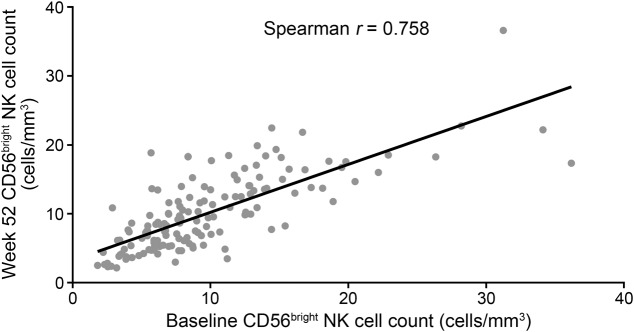
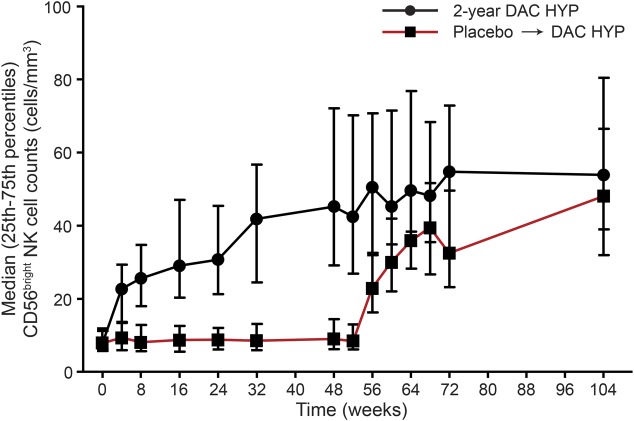
In DAC HYP-treated patients but not placebo-treated patients, the numbers of CD56(bright) NK cells increased over 52 weeks of treatment, and their numbers at weeks 4 and 8 predicted the number of new or newly enlarging T2-hyperintense lesions between weeks 24 and 52 of treatment (p ≤ 0.005 for each comparison). Similar but nonsignificant trends were observed between CD56(bright) NK cell counts and the annualized relapse rate in DAC HYP-treated patients. DAC HYP-treated patients who showed lower levels of expansion of CD56(bright) NK cells still developed fewer new or newly enlarging T2-hyperintense lesions than placebo-treated patients during the first year of treatment.
CD56(bright) NK cells appear to mediate some of the treatment-related effects of DAC HYP, but their numbers do not account for the full effect of DAC HYP on MS-related outcomes.
评估在接受达珠单抗高产量过程(DAC HYP)治疗的复发性缓解型多发性硬化症(RRMS)患者中,CD56(亮)自然杀伤(NK)细胞与疾病活动之间的关系。
数据来自参加 DAC HYP 为期 52 周的随机、双盲、安慰剂对照研究及其扩展研究的患者。评估包括在第 24 周到第 52 周之间,使用荧光激活细胞分选术识别的 CD56(亮)NK 细胞数量与新出现或新增大的 T2 高信号病变数量之间的关系,以及每年复发率。
在 DAC HYP 治疗的患者中,但不是在安慰剂治疗的患者中,CD56(亮)NK 细胞数量在 52 周的治疗过程中增加,并且它们在第 4 周和第 8 周的数量预测了在第 24 周到第 52 周的治疗期间新出现或新增大的 T2 高信号病变的数量(每次比较的 p 值均≤0.005)。在 DAC HYP 治疗的患者中,也观察到 CD56(亮)NK 细胞计数与每年复发率之间存在类似但无统计学意义的趋势。在第一年的治疗期间,与安慰剂治疗的患者相比,显示 CD56(亮)NK 细胞扩展水平较低的 DAC HYP 治疗的患者仍较少发生新出现或新增大的 T2 高信号病变。
CD56(亮)NK 细胞似乎介导了 DAC HYP 治疗的一些相关作用,但它们的数量并不能说明 DAC HYP 对 MS 相关结局的全部影响。